










The talking catfishes (Doradidae) are an interesting group of fishes in many ways. A lot of the species have a very contrasting pattern of dark and light elements, they can make sounds (that can be compared with a grumbling or gnarling) and their armour of bony plates often looks that bizarr that one might think these creatures have been developed on the drawing board of a fantasy filmer rather than in nature.
Orinocodoras eigenmanni is only very rarely imported. The species moreover can be easily confused with a species of Platydoras. O. eigenmanni attains a maximum length of about 20 cm. Our specimens were imported from Colombia. It is most interesting that some of our fish have a marbled pattern which has not been described in literature so far, at least to the best of our knowledge. However, other specimens of the import look perfectly like they should do.
Orinocodoras eigenmanni is a peaceful species that is trying to get in contact with conspecifics in the aquarium. Very small fishes can become eaten of course, but O. eigenmanni fits perfectly in a community tank with medium sized fish. The species feeds readily on any usual fishfood. During feeding times the basically night-active species is also very active on daytimes.
For our customers: the fish have code 273181 on our stocklist. Please note that we exclusively supply the wholesale trade.
Lexicon: Orinocodoras: means “Doras from the Orinoco”; Doras is another genus of talking catfish. eigenmanni: dedication name for the ichthyologist Carl H. Eigenmann (1863 – 1927). Platydoras: from the ancient Greek, means “broad Doras”; Doras is another genus of talking catfish.
Suggestion of a common name: Donauwelle talking cat (the Donauwelle,which means “wave of the river Danube” is a chocolate covered cake with vanilla pudding, referring to the contrasting pattern of the fish).
Text & photos: Frank Schäfer
| Angaben zum Tier | |
|---|---|
| Herkunft | Kolumbien / Colombia |
| Verfügbare Größe in cm | 5-7 |


 Finally we were successful and imported a larger number of this wonderfully coloured predatory tetra from Peru. Both sexes have the splendid orange belly. Females can be recognized by the shape of the ventral fins: they are comparatively small and rounded (large and pointed in males).


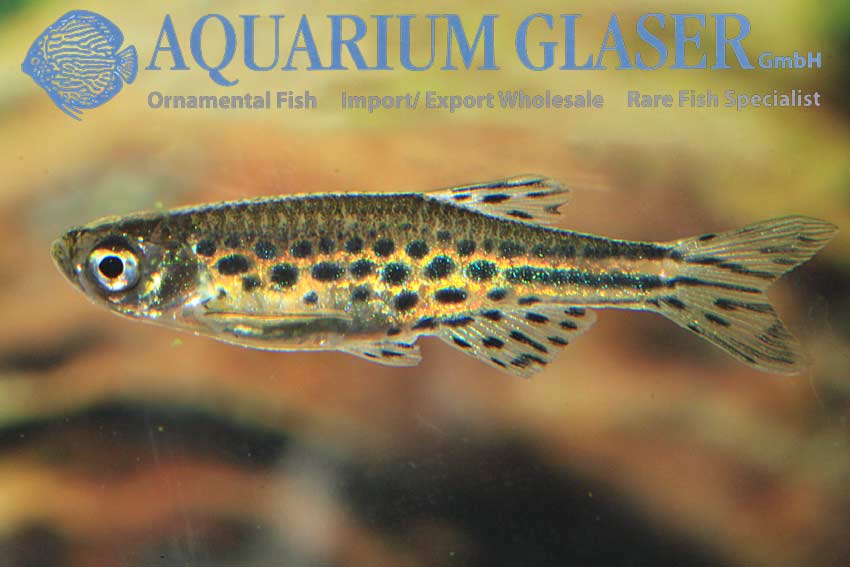


 Only limited number available. Code: 262322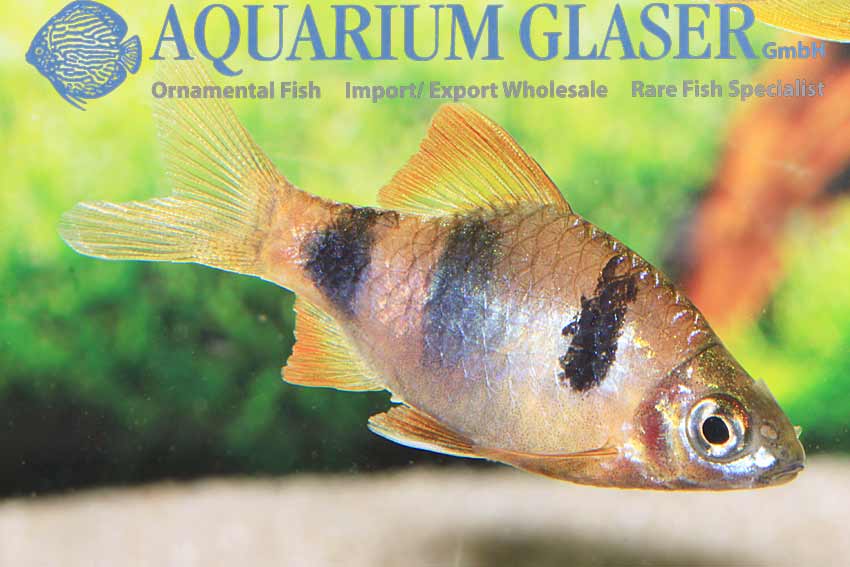


 Code: 456043


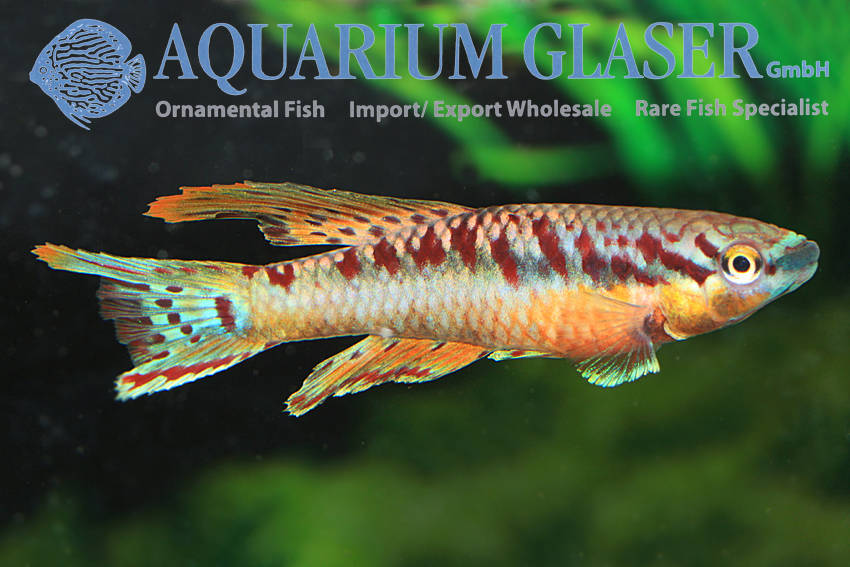


 Code number: 221092


 The snooks (Centropomus) are distributed in the New World; currently 12 species are recognized. Persons that are reminiscent of giant perches (Lates) by looking at snooks are not wrong: until quite recently the snooks and the giant perches were united in a single family, Centropomidae.


 The coastal rainforests of southeastern Brazil are the home of a good number of unusual aquarium fish. One of the most popular and most attractive species from that region is for sure Scleromystax barbatus, the Bearded cory (formerly known as Corydoras b.). Sadly the natural habitats in that region are much affected by the growing human population. Especially the pollution of the water bodies is a growing threat for the aquatic animals and many of the endemic fish are in danger of extinction. Collecting these animals for aquarium purposes has no effect in this context. On the other hand it is not unlikely that some of the more attractive species will survive this century only in captivity.


