








09. Characoids: tetra relationship (520)
-
-
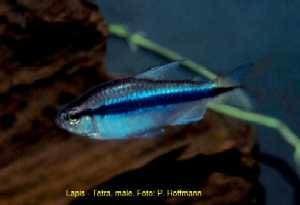
Hyphessobrycon cyanotaenia, Lapis-Tetra
This tetra was introduced to us under the name of “Inpaichthys sp. Lapislazuli” in February 2002 by Mrs. Glaser-Dreyer (Aquarium Glaser GmbH). On the (Japanese) internet it is called Lapis tetra. It was imported in a bigger number of pieces without exact declaration of place of discovery. The males are growing up to at least […]
-
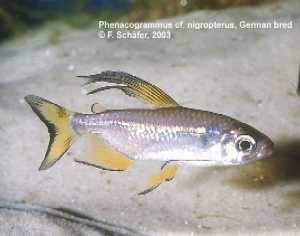
Phenacogrammus cf. nigropterus
This new African tetra, presented by Dieter Bork in “Das Aquarium” 12/01 as “pastel-congo-tetra”, comes from Lake Maindombe (also known as “Lac Leopold II”) in the Democratic Republic Congo (Zaire). Ornamental fish breeder Winter was able to multiply them in a bigger number of pieces. The fins of the males are pulled out beautifully and […]
-
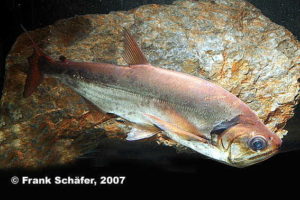
Hydrolycus tatauaia
From Peru some sabre toothed Tiger Fishes of the species Hydrolycus tatauaia came to us. For the maintenance of these impressive hunters naturally roomy aquariums (> 1000l) are needed. Young specimen can be kept in swarms, in the wild even swarms of mixed species were observed. With ageing their aggression potential rises and they become […]
-
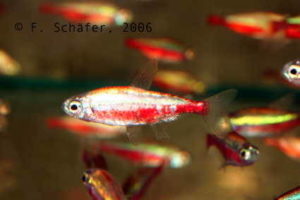
Cheirodon spec. „Gold Neon“
At present we can offer some Cardinals of the variety „Gold Neon“. This is one of some more in the wild rarely existing colour forms of Cheirodon axelrodi. Actually it is not clear whether this colour forms are distinct species or varieties of the cardinal. At the “Gold Neon” the blue colour strip is replaced […]
-
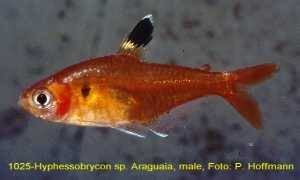
Hyphessobrycon haraldschultzi (= spec. „Araguaia“)
Red fish always attract interest amongst hobbyists, especially the intensively red coloured ones. Five years ago when we received the first animals of this tetra by the name of “Hyphessobrycon serpae – the real one” (wildcaught from Rio Araguaia), we were immediately enthusiastic, too. At first sight (still inside the transport bag) these tetras looked […]
-
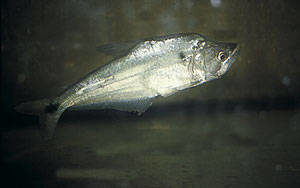
Cynopotamus atratoensis
Only three of these predatory characins found their way to Aquarium Glaser. This group of characins form the subfamily Cynopotaminae within the family of real American characins (Characidae). The representatives of this subfamily are relatively large fish, which can reach a total length between 15 and 30 cm in adulthood. Cynopotamus have large mouth openings […]
-
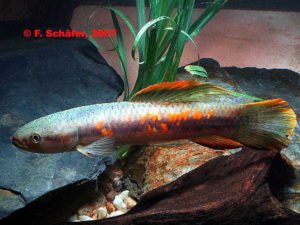
Erythrinus erythrinus
June 2007: Last week we imported from Peru a small amount of probably the most beautiful of all wolf characins. A big advantage of Erythrinus erythrinus is it’s size, that stays with about 25 cm in a tolerable area. It doesn’t have excessive claims with water-chemistry. In it’s homeland, it lives next to small streams […]
-
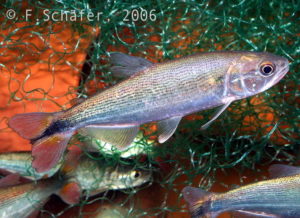
Salminus brasiliensis (formerly: maxillosus)
April 2004: At present Aquarium Glaser can offer Salminus brasiliensis (formerly: S. maxillosus) as a further characin rarity. This up to 1 m and over 20 kg growing fish is a migratory species. These migrations take place from October to January, and are correlated with the rise of the water levels as well as the […]
-
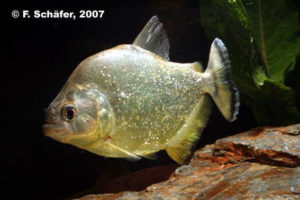
Serrasalmus cf. brandtii
From the Rio Sao Francisco originates this with Serrasalmus brandtii closely related species. They are quite aggressive and as young fish they can be held as a shoal in the species aquarium. Adults with a size of over 30cm length need then naturally very large tanks. At first freshly imported Piranhas accept usually only living […]
-
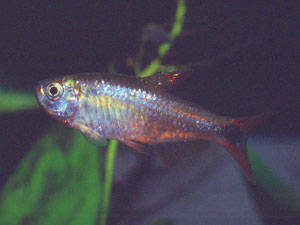
Hasemania sp. „Red“
This small characin is a very attractive fish and a fast swimmer as well. It could be determined as a representative of the Hasemania genus, because it misses the characteristic adipose fin, which is one of the features that determine characins. Up to now we used to have only one species belonging to this genus, […]
-
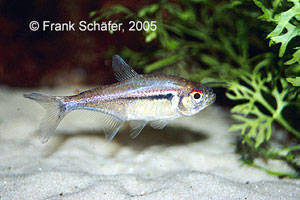
Hyphessobrycon agulha
This very attractive Tetra originates from the Rio Madeira, which runs into the Amazon River downstream from Manaus in Brazil. This Characin species will probably not grow much larger then 6 cm. They are friendly and lively schooling fish, very suitable for a community tank. These fish are not difficult in keeping and will tolerate […]
-
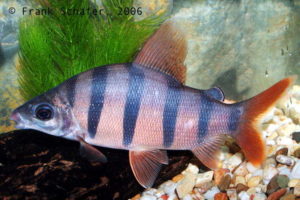
Distichodus sexfasciatus
From the Congo River basin in the Democratic Republic of the Congo (formerly Zaire) originates Distichodus sexfasciatus. This in the aquarium to approximately 30 cm growing characin is a pronounced herbivore. This has to be regarded for the basin setup, since most smooth leaved plants are regarded as food. Some hardy plants as Anubias- or […]
-

Hemibrycon spec. „Paraguay“
In the last years some quite difficult to classify new species of characins arrived from Paraguay. Usually they belong to the genera Creagrutus, Hemibrycon and Piabarchus. As a common characteristic a high swimming activity can be called for all species of this relationship. They need thus tanks, with a large free swimming area. Thus long […]
-
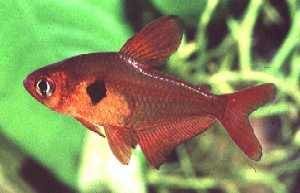
Red Phantom tetra, Hyphessobrycon sweglesi
Until a few years ago Red Phantom tetra, Hyphessobrycon sweglesi was easy to identify, even though under the name of Megalamphodus sweglesi. Lately “Red Phantom Tetras” appear more often, which are very similar to it, but also show other characteristics. It stays (temporarily) unclear, if they are own species, subspecies or “local forms”. Interested hobbyists, […]
-
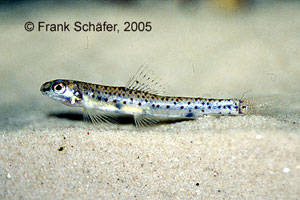
Ammocryptocharax sp. „spotted“
This scientifically undescribed ground tetra originates from Peru. This is a peaceful species also when housed with delicate fish. This is a medium size tetra fish, which probably does not grow larger then 5 cm. If more then one male of this ground tetra inhabits the tank then they can become somewhat territorial and therefore […]
-
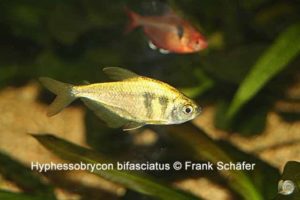
Hyphessobrycon bifasciatus
The Yellow Tetra originates like its close related Von Rio Tetra from coastal rivers in southeast Brazil. With its pretty yellow basic colour it forms a beautiful contrast to it and other reddish characin species. As a schooling fish the Yellow Tetra should be kept only in larger swarms. Particularly in not too brightly lit […]
-
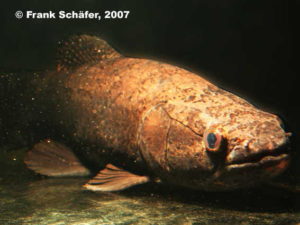
Hoplias macrophthalmus
With Hoplias macrophthalmus we could import from Colombia one of the biggest predatory fishes of the Amazon river system. Contrary to the regular imported Hoplias malabaricus these arrive only extreme rarely in the trade. As an adult with a weight of over 40 kg and a length of more than 120cm they belong to the […]
-
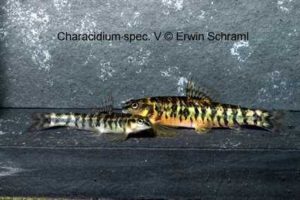
Characidium spec. V
This prettily drawn representative of the genus Characidium reached us over Rio de Janeiro, its actual occurrence area is unknown. A classification of the more than 50 Characidium species is difficult, for orientation we here adopt the numbering of the Aqualog photo collection. As natural biotope small clear watercourses are to be assumed. The water […]
-
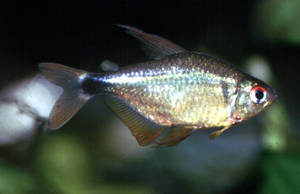
Hyphessobrycon cf. loweae
It was illustrated on the homepage of Canadian fish exporter “Below Water” and designated as “Kitty” Tetra (“a new Hemigrammus-species, caught in Mato Grosso in November 2000). It is presented as Hyphessobrycon loweae in the February/March-issue of “Aquaristik Fachmagazin & Aquarium heute”. According to Dr. Géry there are “good correspondences” with Hyphessobrycon loweae (Costa & […]
- « Previous Page
- 1
- …
- 4
- 5
- 6
