
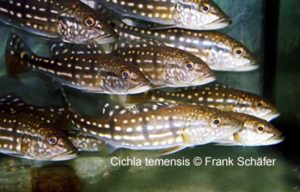
Cichla temensis does not represent a fish for everyone. We could import them from Venezuela, where they are estimated fishes for consumption and sold under the name Tucunare. In its natural environment they can reach an overall length of 1 m with a weight of approximately 10 kg. They grow to be the largest of […]
25e. Perchlike fishes (5): Remaining Cichlids from South and Central America (310)
-
-
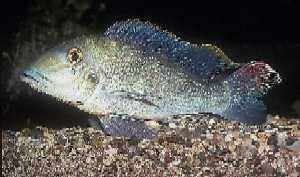
Retroculus lapidifer
To take sensibly care of Retroculus lapidifer, which comes from Rio Tocantins/Rio Araguaia catchment area, you should own quariums with a base of 150 x 60cm minimum, as this species can grow very big (25-30cm). But despite its size you should not socialize it with aggressive cichlids, because it has only a certain self-assertion among […]
-
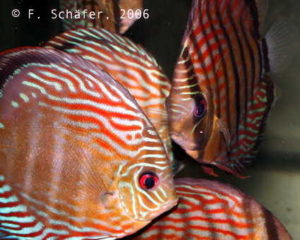
Diskus Semi royal, Rio Moju
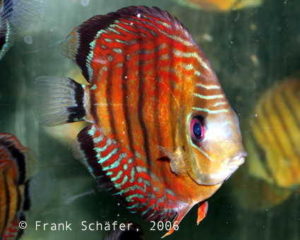
Like the introduced before Discus from the same area (Rio Moju) the “Semi Royal” variant shows a strong red coloration at the seam of their body and their fins. With them the wave pattern is nearly continuous distributed over the entire body. (Photo F. Schäfer, Text K. Diehl)
-
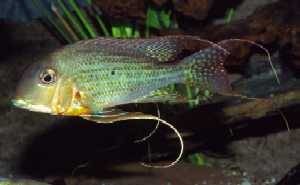
Geophagus altifrons
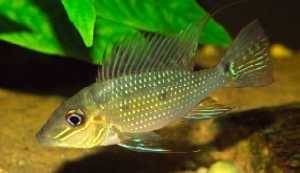
You can surely excellently argue about taste, but the various populations of Geophagus altifrons could justly conquer a solid place among Cichlid lovers. And one of the most beautiful variants might be Geophagus altifrons “Tapajos”. Additionally, G. altifrons is an easy-to-keep cichlid. It requires aquariums with at least 500 ltr. capacity due to its size […]
-
Diskus „Nhamunda rosé”
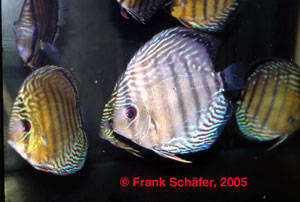
Nhamunda Rosé is the trade name of a strain of the brown discus Symphysodon aequifasciatus axelrodi originated in the Rio Nhamunda (northern influent of Amazon, west the city Alenquer). Now again some Nhamunda Rosé are available. Characteristic for this variety is the partially laminar high red part of the brown primary colour. Thus they are […]
-
Satanopera acuticeps
Normally the durable care of Satanopera acuticeps is only possible in soft and sour pH-value. But as it was finally successful to breed this eartheater inside the aquarium, it could be that the bred ones are easier to keep and even easier to breed. So far the breeding was possible furthermore only in soft (< […]
-
Diskus „Red Inferno/Rio Moju“
In the following pictures you see some impressions from our discus installation. Seldom could we offer a so large selection on magnificently coloured, perfectly acclimatized Discus. The animals originating from different areas are even in our facility hardly to exceed in colour splendour. Since all of them attained full growth, breeders can fast extend their […]
-
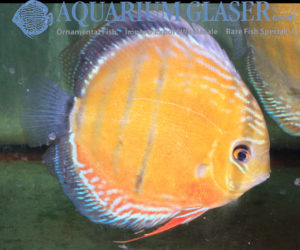
Diskus „Wild Lago Inanum“
This very beautiful discus fish is traded as well under the name „Semi Royal Blue“. Wild caught discus fish are just beautiful! It is remarkable that still new wild type varieties are found and imported. Wild caught discus fish will not be feeling themselves well if not kept under optimal conditions. This malcontent will be […]
-
Acarichthys heckelii
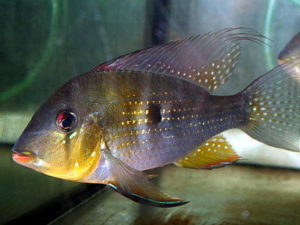
January 2007: At present we can offer particularly beautiful Acarichthys heckelii from the region around Santarem. These fish are characterised by an intensive yellow colouring of the body. It forms a beautiful contrast to the red eyes and their magnificent fin rays. Acarichthys heckelii has a large area of origin along the Amazon and the […]
-
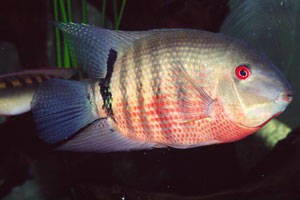
Heros severus
Despite the fact that Heros severus is the type species of the Heros genus, this species is the most uncharacteristic representative of this group. This is mainly caused by its reproducing behaviour, which is mouthbreeding and untypical for Heros, because they are all substrate breeding. Also the coloration is different from the other members of […]