
25. Perchlike fishes (917)

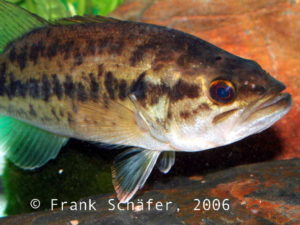
  • Channa maculata

    6. July 2007

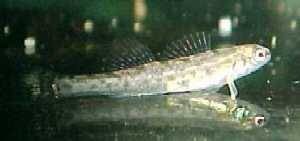
    Channa maculata is a snakehead which origins of the border area of China and Viet Nam. It is there very common and offered on markets in large numbers, naturally as a food fish. In their habitat C. maculata lives in ponds, lakes and ditches, usually over sandy or muddy bottoms. With a final size of […]

  • Nannacara spec. -Sourourou-

    6. July 2007

    From the Crique Sourourou in French Guyana originates this beautiful new Nannacara variant. We are pleased to be able to offer some offspring to you. According to information of an experienced Nannacara specialist their maintenance is unproblematic, even in middle hard water. The breed however succeeds only in soft and sour water according to their […]

  • Mesonauta insignis

    Mesonauta insignis

    6. July 2007

    This cichlid, which is growing up to approx. 20cm is living along the catchment area of the Orinoco, whereit mostly lives in slowly flowing or even standing waters. You often find it right in front of the shore, where it inhabits the upper water layer. Regarding the nutrition M. insignis is totally uncomplicated, because these […]

  • Osphromenus exodon

    Osphromenus exodon

    6. July 2007

    Even this fish looks like the common gourami, it is really something special & rare. As far as we know, this species was never before importet to Germany. When they have the size of about 30-40cm, they turn their lips inside out and show many small white teeths. Unfortunately this stadium is only shown in […]

  • Nandopsis salvini

    6. July 2007

    December 2006: At present we can offer a very beautiful, strongly red coloured variant of Nandopsis (Cichlasoma) salvini to you. They origin from South Mexico, Belize and Guatemala, where they live in to the Atlantic ocean heading streams. Like most Central American cichlids they are very easy to keep in middle hard water at pH […]

  • Vieja maculicauda

    6. July 2007

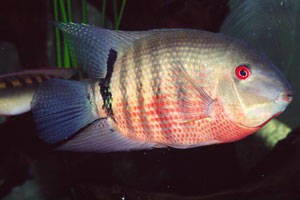
    Vieja (Cichlasoma) maculicauda the Blackbelt Cichlid is one of the larger Central American cichlids. Males can reach about 35 cm overall length. According to its size one needs voluminous aquaria, where their interesting social behaviour can be observed. In their distribution area (Atlantic slope, from the Usumacinta River drainage in Guatemala to the Chagres River […]

  • Eretmodus cyanostictus „Kigoma“

    6. July 2007

    Eretmodus cyanostictus is among the group of cichlids called gobies. Gobies only occur naturally in the surge habitat of Lake Tanganjika, which is the upper meter of the water at the shoreline. They unique in that their swim bladder is non-functional, meaning that when they’re not swimming, they drop to the bottom like a rock. […]

  • Pterophyllum altum

    6. July 2007

    The new season began, Pterophyllum altum (Orinoco) is available again. Deep Angels can reach 20cm length and up to 35cm in height. This has to be considered with the tank purchase, it should have a height of at least 70cm. A decoration with large bogwood, provides structure and retreat possibilities for them. Since they are […]

  • Discus „Red Inferno/Rio Moju“

    6. July 2007

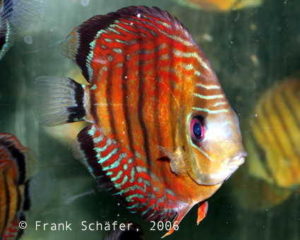
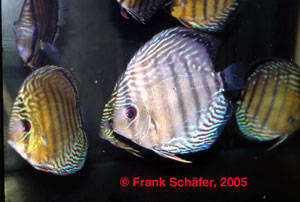
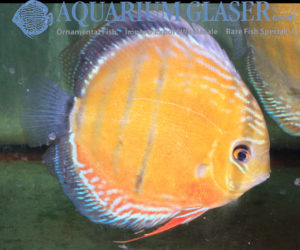
    Only one example of at present in extraordinarily good quality arriving Diskus is the “Red Inferno” variant coming from the Rio Moju. On their fins and flanks the animals show a strongly red-orange basic colour, which stands in beautiful contrast to the bluish green wave pattern. The icing on the cake are their cherry-red eyes, […]

  • Channa stewartii

    6. July 2007

    This often under the name Channa cf. barca traded Snakehead originates from the Indian province Assam. C stewartii can reach a length of 30 cm and as predators they should kept together only with fishes whose length exhibits at least 2/3 of their body length. Beside living and dead fish they accept food as insects, […]

  • Haplochromis sp. Mburo Blacky

    Haplochromis sp. Mburo Blacky

    6. July 2007

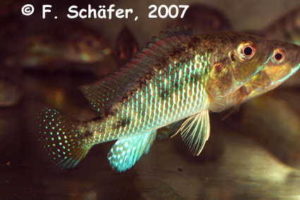
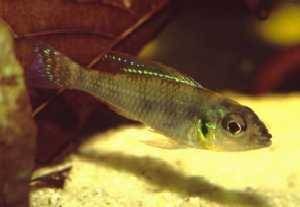
    The “Mburo Blacky” is coming from Lake Mburo in Uganda. This species is undescribed until now and grows up to 12cm. It does not dig and do not eat plants, but it is rather agressive and therefor those fish need bigger tanks (1 meter in length and up) in which they can find places to […]

  • Pelvicachromis spec. „Blue Fin“

    6. July 2007

    November 2005: From Guinea the import of a still undescribed Pelvicachromis species surprised us. This species seems to mediate within the genus Pelvicachromis between P. roloffi and P. rubrolabiatus, since it carries characteristics of both species. Particularly the name giving bright blue-green dorsal fin of females is noticeable. Maintenance in pairs is appropriate, in larger […]

  • Geophagus sp. „Pindare“

    Geophagus sp. „Pindare“

    6. July 2007

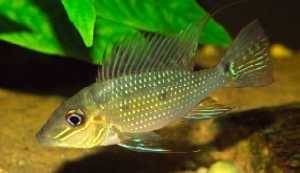
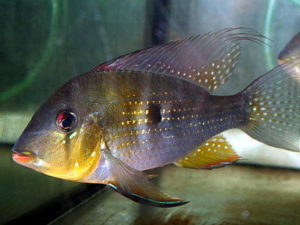
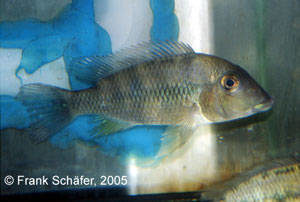
    Among the “Eartheaters”, species Geophagus, G. sp. “Pindare” is one of the most recommendable ones. Growing up to approx. 15cm only, it stays rather small and also shows a beautiful marking with red and blue lines on its flanks. The care of this species is really quite simple, because it does not care about the […]

  • Pterophyllum altum deutsche Nachzucht

    Pterophyllum altum german bred

    6. July 2007

    November 2003: Lately we received German bred Pterophllyum altum. It is worth mentioning that this was a natural brood, eg both parent took care for eggs and the young. Even spawning of the Altum Angel is a remarkeble event. This species tends to get panic attacks when the fish is fully grown. Thus they tend […]

  • Diskus Nhamunda rosé

    6. July 2007

    Nhamunda Rosé is the trade name of a strain of the brown discus Symphysodon aequifasciatus axelrodi originated in the Rio Nhamunda (northern influent of Amazon, west the city Alenquer). Now again some Nhamunda Rosé are available. Characteristic for this variety is the partially laminar high red part of the brown primary colour. Thus they are […]
  • Crenicichla spec. ITAPEMIRIM

    Crenicichla spec. ITAPEMIRIM

    6. July 2007

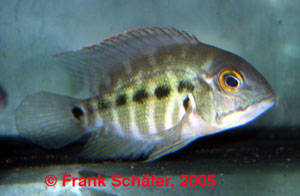
    We received this extremely colorful species of Crenicichla from the southeastern part of Brazil. In adults the sexes can be distinguished quite easily. Females (see main photo) have an ocellus in the dorsal fin which is missing in males (see additional photo). Moreover, in males the deep red spots are scattered over the body, whereas […]

  • Acentrogobius viridipunctatus

    Acentrogobius viridipunctatus

    6. July 2007

    This magnificent goby, it´s scientific name is Acentrogobius viridipunctatus, has now been successfully imported from India for the first time in greater numbers. The species attains a length of maximum 15 cm. Fully grown males have a very thick skull. In breeding mood, the fish become complete black in base colour, on which the emerald […]