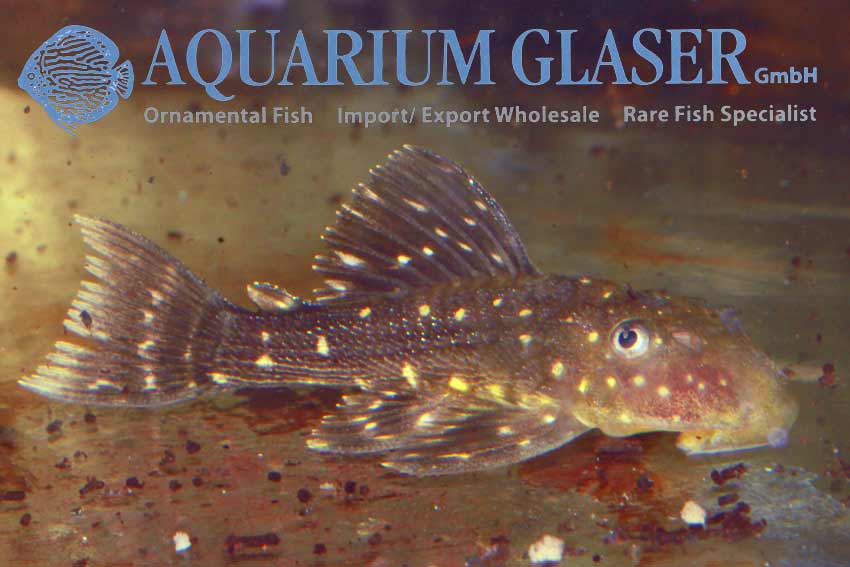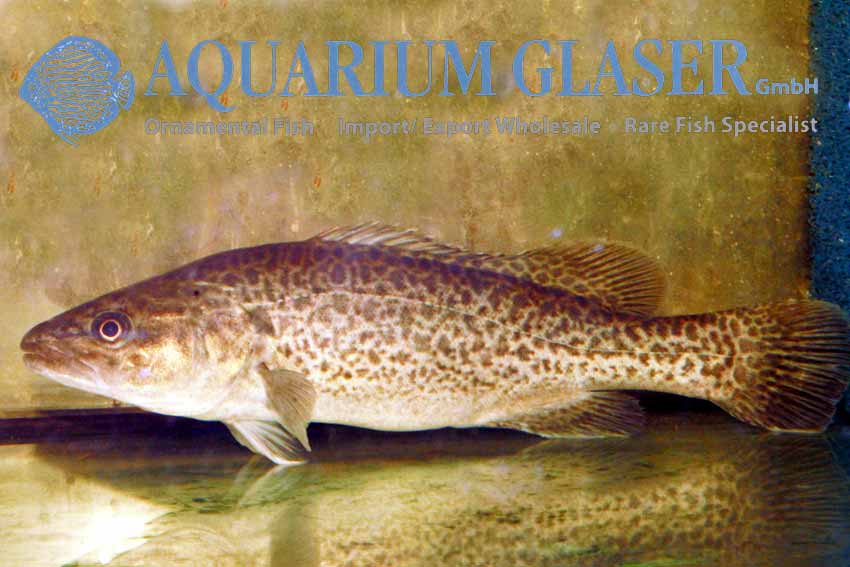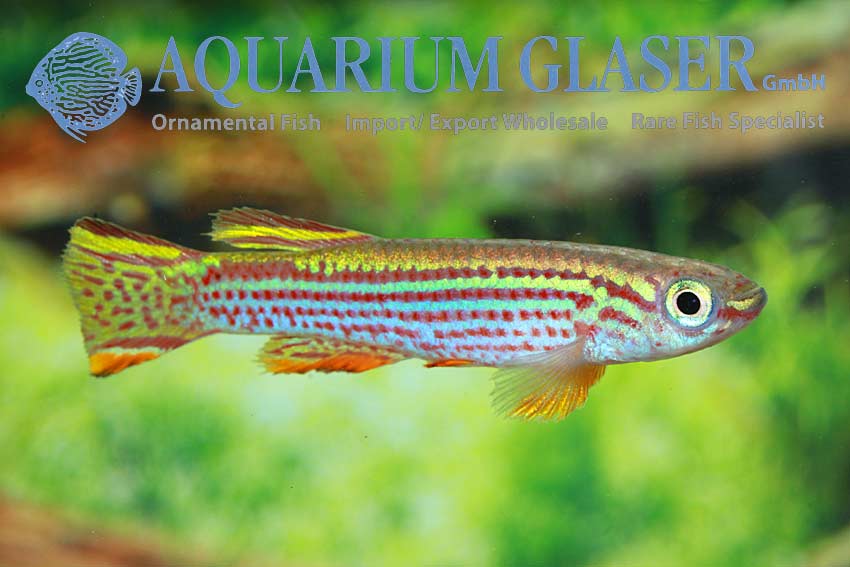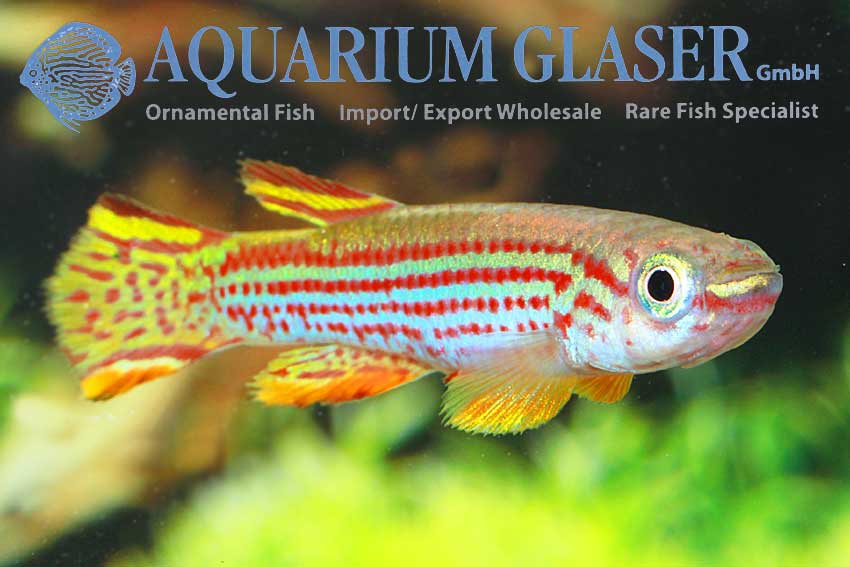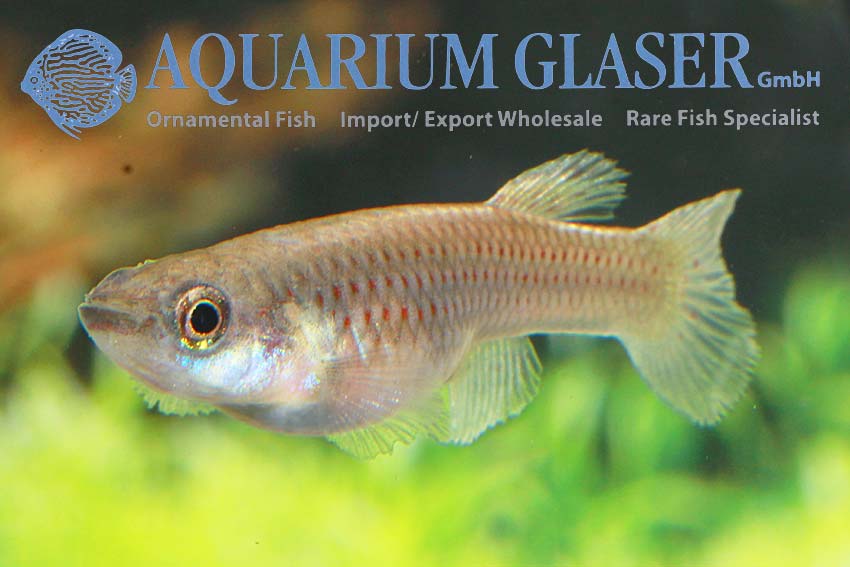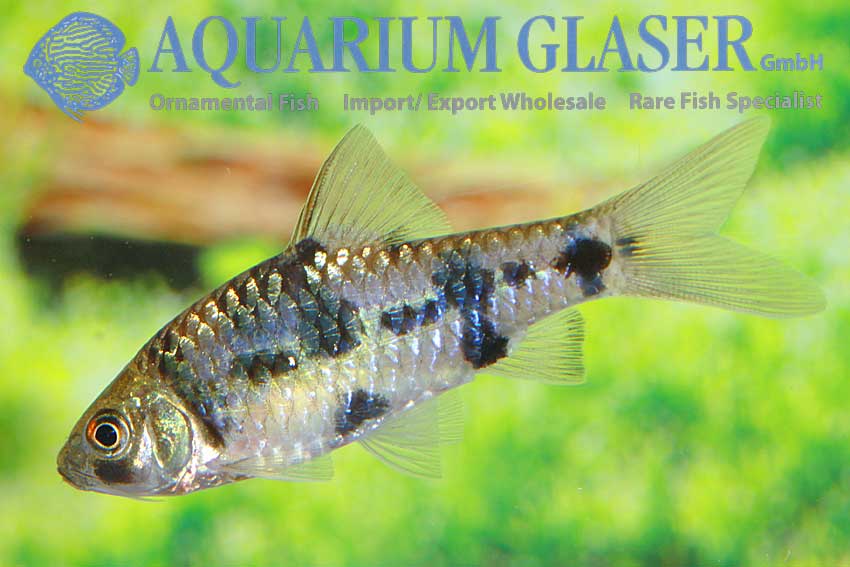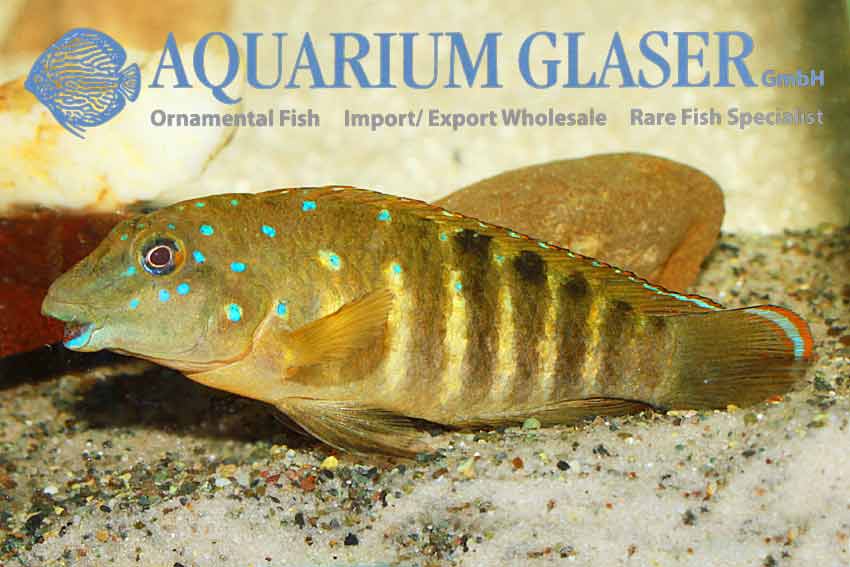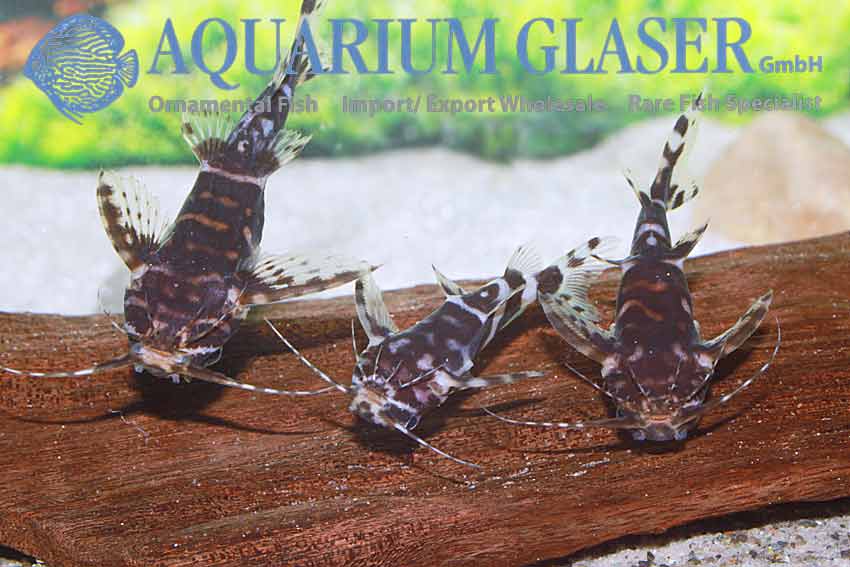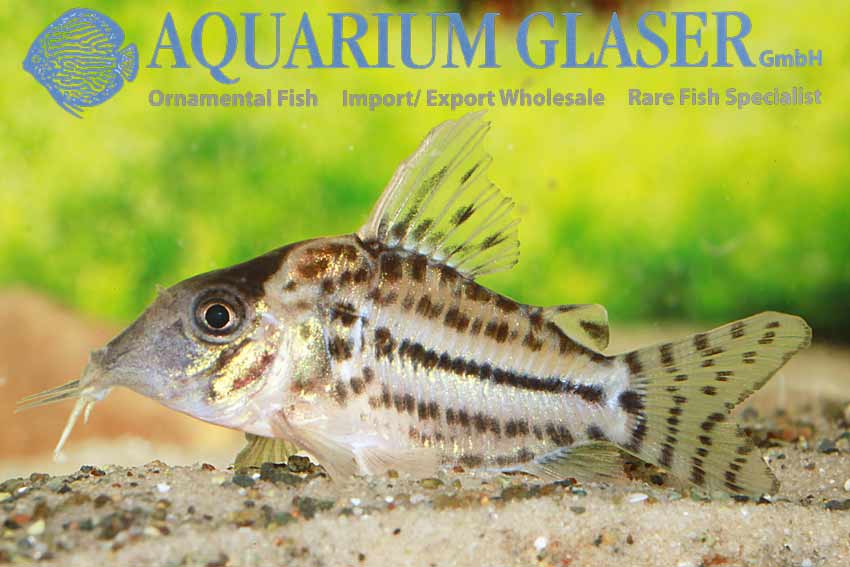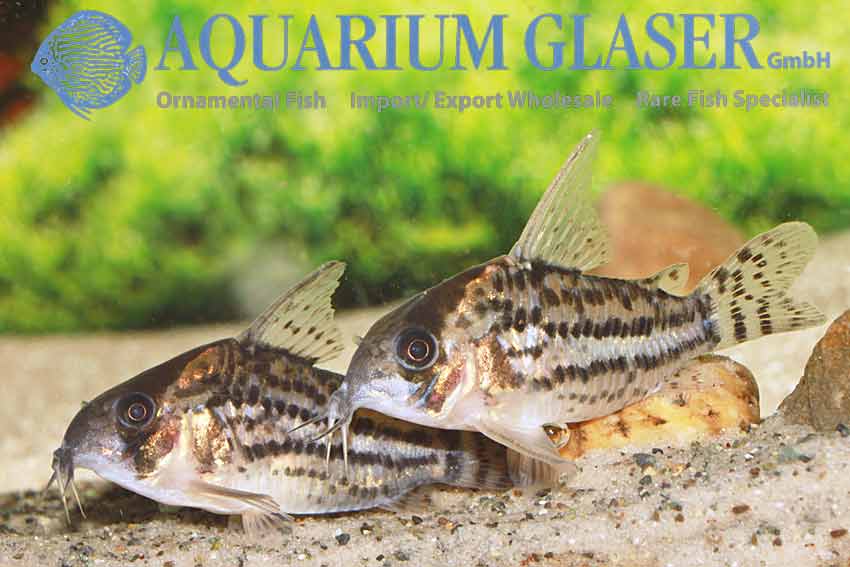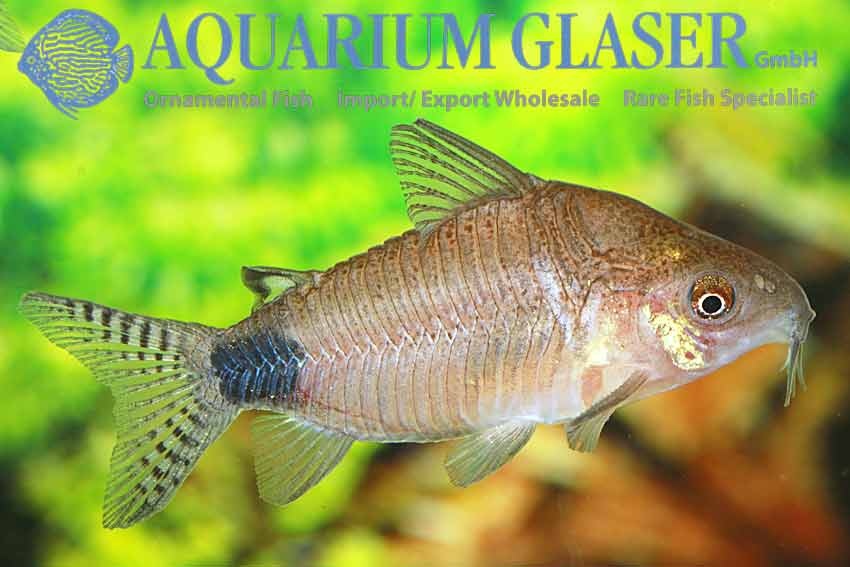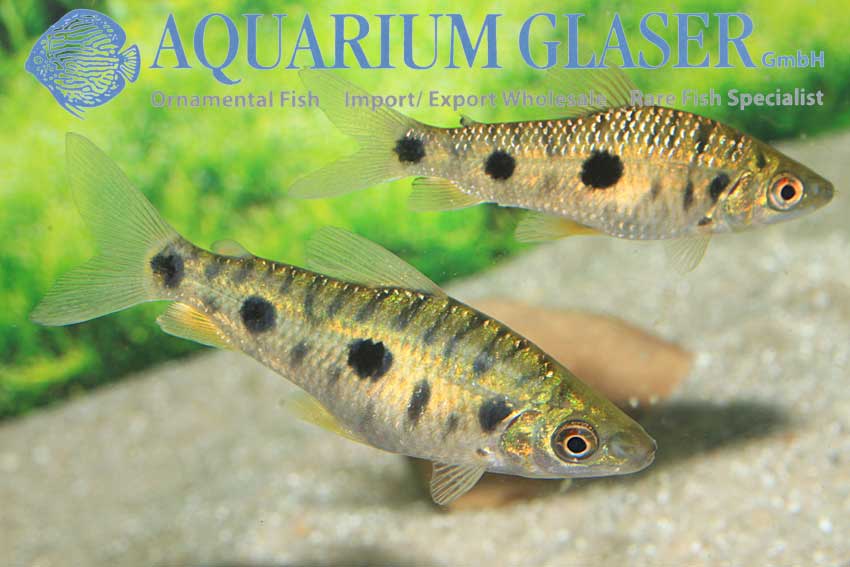

For the first time ever we could import juveniles of this very rare species. For more information, please check: http://www.aquariumglaser.de/en/archiv.php?news_id=345
| Angaben zum Tier | |
|---|---|
| Herkunft | Venezuela |

For the first time ever we could import juveniles of this very rare species. For more information, please check: http://www.aquariumglaser.de/en/archiv.php?news_id=345
| Angaben zum Tier | |
|---|---|
| Herkunft | Venezuela |

We currently have this amazing large cichlid in good numbers and an ideal size in stock. The specimens orginate from Venezuela and most of them are 3-5 cm long. This is a perfect size for the acclimatization of these fish in home aquaria.
Besides this we also have a few specimens 5-7 cm long in stock and a wonderful, already mature pair which is 18-25 cm long. One can observe the unique sexual dichromatism of Cichla orinocensis in this pair: males look rather like Cichla ocellaris, while females have a colour pattern that reminds one in C. temensis.
Cichla orinocensis is a typical member of its genus and can reach a maximum size of about 70 cm. Maturity is usually attained at a length of 20-25 cm. All species of Cichla are – as far as it is known – openbrooders and perform a bipartental broodcare.
Youngsters can be fed with white mosquito larvae and bloodworm; however, feeder fish are ideal. From a size of about 10 cm on the young Cichla can be fed with frozen smelt as the basic food. Smelt can be used even for largest specimens.
For our customers: C. orinocensis has code 636551 (3-5 cm), 636552 (5-7 cm), and 636558 (18-25 cm) on our stocklist. Please note that we exclusively supply the wholesale trade.
Lexicon: Cichla: this is a name that has been used in ancient Greece for a nowadays unknown fish. orinocensis: means “originating from the Rio Orinoco”.
Text & photos: Frank Schäfer
| Angaben zum Tier | |
|---|---|
| Herkunft | Venezuela |
| Verfügbare Größe in cm | 4-6 |
Currently we can offer Apple Snails in many interesting colours. These beautiful snails are easy to keep and can get a size of about 5 cm in diameter. In the aquarium, they should be fed regularly like fish, for Apple Snails are heavy feeders and cannot survive with the remains of the fish only. There is no danger of a infestation in Apple Snails, for the eggs are deposited outside the water and can be removed easily as long as no offspring is wanted. The egg cluster remains one a bit in an oversized raspberry due to its colour and shape. Apple Snails are not hermaphrodites, like many other snails. The sexes cannot be distinguished externally, so one has to buy a number of animals to make it likely that both sexes are represented.


From Peru we received once more juveniles of the fantastic predatory catfish B. juruense. Adults of this species attain a maximum length of around 60 cm and have a very nice, zebra-like striped pattern. The coloration of the body of the juveniles is very variable. There do exist spotted ones, striped ones or even uniformly dark ones. All have in common the large, white caudal fin. On the upper lobe of the caudal fin is a filament that is as long as the body of the fish. Juveniles – the photographed specimens are 5-8 cm long – are already predators. Sometimes they swim free in the water column, the head turned upside, against the current. Now the caudal filament works as a stabilizer, comparable to the tail of a kite. Another, species-specific behaviour of the fish is to sit on the bottom, braced on the ventral fins and looking against the water surface. It seems likely that in this position the long tail filament works as a fishing rod that attracts small fish.
For our customers: the fish have code 211200 (5-8 cm) and 211201 (7-10 cm) on our stocklist. Please note that we exclusively supply the wholesale trade.
Lexicon: Brachyplatystoma: from ancient Greek, means “short Platystoma”; Platystoma is another genus of catfish. juruense: after the Rio Jurua, the type locality.
Suggestion of a common name: Gold zebra catfish
Text & photos: Frank Schäfer
| Angaben zum Tier | |
|---|---|
| Herkunft | Peru |
| Verfügbare Größe in cm | 5 - 10 |
This species of catfish is a predator and becomes easily longer than 60 cm. So it is suited only for specialized aquarists and public aquaria. Our current importation from Peru contains one specimen that is even as a youngster very attractive colored.
| Angaben zum Tier | |
|---|---|
| Herkunft | Peru |
| Verfügbare Größe in cm | 10-12 |

The gardenpond season starts up! The Tench, a species initially native in Europe and western Asia, is a perfect pond and aquarium fish. Nowadays the Tench has a worldwide distribution, because it is a very delicious food fish, too. The Tench is very tolerant regarding the water temperature: it is totally winter hardy on the one hand and has no problems at all in summer, when the temperature rises up to 26°C on the other. Due to its low oxygen requirement the Tench inhabits muddy waters in the wild.
Currently we have two sports of the Tench in stock, the wild coloured – also called Green Tench – and the wonderful golden sport. Among the latter ones are many three-coloured specimens, which are very rare (not assorted available!). The Tench can reach a length of about 40 cm (the largest one reported had 70 cm). Our specimens are currently 8-10 cm long and thus fit also perfectly for coldwater aquaria.
The Tench is not only a beautiful fish, but also very useful. Among all fish species native in Europe the Tench is spezialized most in feeding on small molluscs. Thus the Tench can be used in any pond or tank where snails become to numerous. However, in the absence of snails the Tench also feeds readily on any usual type of fish food. Against other fish, may they belong to the own species or not, the Tench is completely peaceful. Males can be distinguished from the females by the shape of the ventral fins, which are much larger in males. The Tench is an egg-scatterer that does not take care for its eggs at all.
For our customers: the Tench has code 878802, the Golden Tench 879003 on our stocklist. Please note that we exclusively supply the wholesale trade.
Lexicon: Tinca: this name was already in use in ancient Rome for the Tench.
Common names: Tench or Green Tench (for the wild coloured sport), Golden Tench (for the golden or threecoloured sports)
Text & photos: Frank Schäfer
| Angaben zum Tier | |
|---|---|
| Herkunft | Nachzucht / bred |
| Verfügbare Größe in cm | 10 - 12 |

Priapella olmecae
For the first time ever we have this beautiful livebearer in stock. The genus Priapella currently comprises 6 described species, of which P. intermedia and P. compressa are found occasionally in the ornamental fish trade. All Priapella species are surface dwellers that live in the wild in comparatively strong current. Here they swim in swarms, head against the current and jump for small insects that form the biggest part of their natural diet. The blue eyes of all species are very conspicuous. They shine so brightly that one is reminded of the lampeyes of the genus Aplocheilichthys.
Keeping these nice fish in a home aquarium is not difficult at all. However, they should be always kept in groups. The fish are very peaceful. The tank should be well lightened and filtered, the water temperature should be between 21 and 26°C. Medium hard to hard water and a pH over 7.5 is preferred. Priapella olmecae feeds readily on any usual food for ornamental fish, but never from the bottom. Plants are not harmed by this species.
For our customers: the fish have code 444513 on our stocklist. Available in limited numbers only! Please note that we exclusively supply the wholesale trade.
Lexicon: Priapella: means “tiny penis”, referring to the male‘s gonopodium. intermedia: means “in between”. compressa: means ” compressed”. olmecae: refers to the indigenous people in Mexico, the Olmecs. Aplocheilichthys: means “fish that is similar to Aplocheilus”; Aplocheilus is another genus of fish.
Common name: Olmecan Blue-Eye
Text & photos: Frank Schäfer
| Angaben zum Tier | |
|---|---|
| Herkunft | Nachzucht / bred |
| Verfügbare Größe in cm | 4-5 |

We have this large barb that originates from the south of China and the north of Vietnam in stock for the first time. The usual length of the fish is up to 40 cm. At this length they weigh about 1.5 kg. However, the largest S. denticulatus captured so far had a weight of about 30 kg. Spinibarbus denticulatus is one of the most important food fishes for aquaculture in its native range, for it grows fast, has a high tolerance regarding water temperature (the range of water temperature in its natural environment is between 9-16°C in winter and 25-30°C in summer), and the species is a specialized plant feeder that is able to transform worthless weeds, grass etc. in protein of high value.
However, we are less interested in the quality of the flesh of the fish, but in its potential use as aquarium or garden pond fish. Our specimens currently are 10-12 cm long and look rather dull. But the common name Chinese Phoenix barb has been given with some reason on the fish. When the fish grows it becomes – starting on the head – fire red. A picture of a larger fish can be found here:
http://fugupuff-fugupuff.blogspot.de/2011/02/spinibarbus-denticulatus.html
For our customers: the fish have code 455893 on our stocklist. Please note that we exclusively supply the wholesale trade.
Lexicon: Spinibarbus: means “barb with a spine”; this refers to the dorsal fin spine. denticulatus: means “with small teeth”; this refers to the structure of the dorsal fin spine.
Suggestion of a common name: Chinese Phoenix barb
Text & photo: Frank Schäfer
| Angaben zum Tier | |
|---|---|
| Herkunft | China |
| Verfügbare Größe in cm | 10 - 12 |

This brandnew, fascinating sport of the swordtail is a real eyecatcher. The basic colour of the fish is a shining, plain white. About two thirds of the body are jet-red. However, it is not easy to breed such beauties, thus the price is comparatively high, but these graces are worth every cent of it. This swordtail is available in very limited numbers only!
For our customers: the fish have code 421243 on our stocklist. Please note that we exclusively supply the wholesale trade.
Text & photos: Frank Schäfer
| Angaben zum Tier | |
|---|---|
| Herkunft | Nachzucht / bred |
| Verfügbare Größe in cm | 5-6 |

We have one of the rarest livebearers in stock. Only limited numbers are available! The beautiful fish reach about 4 cm (males) and 6 cm (females) total length. It is a very peaceful species.

For our customers: the fish have code 475802 on our stocklist. Please note that we exclusively supply the wholesale trade.

For the first time ever we received youngsters of this highly interestingly fish species. Maximum length reported for Elopichthys is about 2 m. This species is one of the very few real predators among the carp-like fish. Currently the genus Elopichthys is regarded to be monotypical, but there might exist a second species in the north of Vietnam, which is characterized by larger scales and and a more anteriorly placed dorsal fin.
Elopichthys bambusa occurs in China and Siberia. So it can be kept easily in garden ponds and has no problems during the winter in central Europe.
As everybody knowns, carps have no maxillary teeth at all. Elopichthys has solved that problem and developed strong horny sheets along the maxilla. So the mouth of the fish works like a strong scissor. Moreover the mouth´s tip has a hook on the lower jaw and a notch in the upper jaw; so the predator is enabled to hold strongly its prey.
In the wild Elopichthys bambusa prefers to hunt nearby waterfalls and rapids. Against conspecifics the fish are completely peaceful, at least in our facility.
For our customers: the fish have code 414903 on our stocklist. Please note that we eclusively supply the wholesale trade.
Lexicon: Elopichthys: means “fish like an Elops”; Elops is another genus of fish. bambusa: means “belonging to bamboo”.
Common name: Yellowcheek
Text & Photos: Frank Schäfer
| Angaben zum Tier | |
|---|---|
| Herkunft | Asien / Asia |
| Verfügbare Größe in cm | 6-8 |

262621 Hypostomus luteus, BRED, 3-4 cm

636576 Cichla piquiti, BRED, 14-18 cm

636336 Cichla kelberi, BRED, 18-22 cm

636395 Cichla melaniae, BRED, 12-15 cm

148353 Megalops cyprinoides, 12-15 cm

426095 Maccullochella peelii, 15-20 cm

414903 Elopichthys bambusa, 8-10 cm

455893 Spinibarbus denticulatus, 10-12 cm
All species are available in limited numbers only!
Please note that we exclusively supply the wholesale trade.

We received beautiful bred specimes from Thomas Weidner, who published this Geophagus in the German magazine “Amazonas” No 36 (July/August 2011) on page 76 for the first time. The photo of the juveniles shows the fish we currently have in stock, the photos of the adults depict the breeders.

For our customers: the fish have code 682312 on our stocklist. Available only in limited numbers! Please note that we exclusively supply the wholesale trade.
Text: Frank Schäfer, photos: Thomas Weidner and Frank Schäfer

This new sport of the guppy is characterized by its caudal fin coloration. This fin is yellow at its base and becomes deep red at the edges. Thus the name “Sunrise” is a perfect description of the fish.
For our customers: the new guppy has code 418413 on our stocklist. Please note that we exclusively supply the wholesale trade.
Text & photos: Frank Schäfer
| Angaben zum Tier | |
|---|---|
| Herkunft | Nachzucht / bred |
| Verfügbare Größe in cm | 3-4 |
Currently we have this beautiful fish bred by German breeders in stock. Sadly the killifish as a whole are often still regarded as sensitive, short living fishes that cannot be kept in community tanks. However, this is wrong. The Aphyosemion species that attach the eggs on substrates and hatch the eggs under water (in other species – the so-called annual species – the eggs have to be kept dry for a while) do live as comparatively long as other fish of similiar size, eg 2-3 years. A striatum belongs to the long-living group.
And the fish are not very sensitive. But they look only good when kept in the correct environment. The tank setup has to be quite dark and it should contain a lot of underwater plants. Now the fish feel safe and display their bright colours.
And finally: of course Aphyosemion are a bit shy and slow. So it is a very bad idea to keep them along with tough and fast swimming fish, like many cichlids or the Tiger barb. On the other hand, small and peaceful fish, like many tetras, rasboras, anabantoids or small catfish species are perfect tankmates for Aphyosemion striatum.
Hardness and pH are of lesser meaning for a successful keeping of these fish, but in general the water should be poor in bacteria and the pH should not be higher than 7.5. The water temperature can be between 22 and 28°C, the lower degrees should be preferred. Aphyosemion striatum feed on any type of regular ornamental fish food.
For our customers: the fish have code 314503 on our stocklist. Please note that we exclusively supply the wholesale trade.
Common name: Red Striped Killi
Text & photos: Frank Schäfer
| Angaben zum Tier | |
|---|---|
| Herkunft | Nachzucht / bred |
| Verfügbare Größe in cm | 4-5 |

Only a few specimens of one of the most remarkable knifefishes of the New World reached us from Peru: Compsaraia samueli. The males of this “pelicano knifefish” develope grotesque long snouts. The males are absolutely intolerant against each other. They fight with mouths wide open in a manner that is known from fighting male deer.
The maximum size of the species, which has been described scientifically only in 2009, is about 23 cm. Males become sexually ripe with about 19, females with 15 cm length. In our fishhouse, the fish are fed with Tubifex and small feeder fish (Tanichthys). Regarding the water the knifefish, which are collected in the vicinity of Iquitos, are quite undemanding. However, it is best to keep the fish in soft and slightly acidic water and temperatures between 22 and 26°C.
For our customers: the fish have code 218205 on our stocklist. Please note that we exclusively supply the wholesale trade.
Lexicon: Compsaraia: from ancient Greek, means “with elegant fin ray”; the genus name refers to the anal fin structure. samueli: dedication name for Samuel Albert.
Suggestion of a common name: Pelicano Knifefish, Samuel´s Ghost Knifefish
Text & photos: Frank Schäfer
| Angaben zum Tier | |
|---|---|
| Herkunft | Peru |
| Verfügbare Größe in cm | 15 - 18 |

This Platy is a very attractive sport. The body colour is plain blueish-white with sharp contrasting black spots. The eye shines in a beautiful blue. The intensity of the latter depends on the light.
This new Platy represents in all probability a close relative of the “Bleeding Heart Platy”, which is a descendent of the nowadays lost plain white “Ghost Platy”. Both existing sports, as well as the mentioned “Ghost” sport, are bred exclusively on the zoological species Xiphophorus maculatus.
For our customers: the fish has code 442153 on our stocklist. Please note that we exclusively supply the wholesale trade.
Lexicon: Xiphophorus: from ancient Greek, meaning „the one that bears a sword“. maculatus: Latin word for „spotted“
Text & photos: Frank Schäfer
| Angaben zum Tier | |
|---|---|
| Herkunft | Nachzucht / bred |
| Verfügbare Größe in cm | 4-5 |

| Angaben zum Tier | |
|---|---|
| Herkunft | Nachzucht / bred |
| Verfügbare Größe in cm | 3-4 |
The island of Borneo is divided, politically speaking, in three parts: Kalimantan belongs to Indonesia, Sarawak and Sabah belong to Malaysia and Brunei represents an independent state. Kuching is the biggest town on Borneo. It is located in the northwest, in Sarawak (Malaysia). Ornamental fish are collected there only very occasionally. However, recently we were able to manage an import from there that contained a number of very interesting fish species. Among them were barbs that were sent under the name of Barbus kuchingensis. This species really exists, but shows only two vertical bands on the anterior body and a black spot right above the anal fin. Our fish looked completely different from that and showed a much more contrasting pattern.
Our research showed that our new fish in all probability represents the first (?) import of the “real” Barbus everetti. It is already known for some time that all fish in the hobby that are termed “B. everetti” in reality belong to the species Barbus dunckeri. This correct name is only slowly adopted by hobbyists worldwide due to the fact that the real B. everetti was not present in aquaria so far and thus there was no need for a change of the name.
Our new entries are beautiful fish in any way. It can be supposed that they will reach a similar size as the close relative B. dunckeri, eg 10-12 cm, and that they will reach sexual maturity at a length of about 6-8 cm. Keeping is totally problem free. The water should be soft to medium hard, pH range should be between 6.5-7.5 and the water temperature should be between 24-28°C. Fish that are kept under the described conditions are very lively and colourful. These barbs feed readily on any type of usual fishfood.
For our customers: the fish have code 369862 on our stocklist.We have only a very limited number in stock. Please note that we exclusively supply the wholesale trade.
Lexicon: Barbus: Latin, means “the bearded”. everetti: dedication name for Alfred Hart Everett (1848-1898), the collector of the species. dunckeri: dedication name for Georg Duncker (1870-1953), ichthyologist and former custos of the Naturhistorisches Museum Hamburg (= Hamburg museum for natural history).
Suggestion of a common name: Kuching-Clownbarb
Text & photos: Frank Schäfer
| Angaben zum Tier | |
|---|---|
| Herkunft | Indonesien / Indonesia |
| Verfügbare Größe in cm | 4 - 7 |

For our customers: the fish have code 261634 on our stocklist. Please note that we exclusively supply the wholesale trade.
Photo: Frank Schäfer
| Angaben zum Tier | |
|---|---|
| Herkunft | Nachzucht / bred |
| Verfügbare Größe in cm | 4-5 |

Dwarf cichlids from western Africa are bit out of fashion currently. Nobody knows a real good reason why, as usual in fashion. However, anyone who sees the gorgeous Pelvicachromis taeniatus “Nigeria Red” we can offer right now as German bred ones, will become crazy for a new fashion immediately and place a tank with these beauties in the fishhouse.
For our customers: the fish have code 562304 on our stocklist. Please note that we exclusively supply the wholesale trade.
Lexicon: Pelvicachromis: Latin, means about “Chromis with a specially coloured pelvis”; Chromis is an old catch-all name for perches. taeniatus: Latin, means “striped”.
Common name: makes no sense, the fish is commonly known by enthusiasts as the “taeniatus Nigeria red”.
Text & photos: Frank Schäfer
| Angaben zum Tier | |
|---|---|
| Herkunft | Nachzucht / bred |
| Verfügbare Größe in cm | 6-8 |

This beautiful Pyrrhulina also reached us recently from Guyana: it can be recognized best by the broad dark lateral band. However, the species has a very wide distibution and we sometimes received them also from Colombia. Maximum size reported for P. filamentosa is 10 cm. So this species is a beautiful, representative aquarium inhabitant.
For our customers: the fish have code 286762 on our stocklist.Please note that we exclusively supply the wholesale trade.
Suggestion of a common name: Broadband-Pyrrhulina.
Text: Frank Schäfer, photo: Dieter Bork
| Angaben zum Tier | |
|---|---|
| Herkunft | Guyana |
| Verfügbare Größe in cm | 8 -10 |

Regarding the coloration this Pyrrhulina may look a bit inconspicous at the first glimpse, but if one gives the fish a chance to settle down it developes a bright, beautiful pastel. In any other respect this fish is a true Pyrrhulina and enables lots of interesting observations in the aquarium. This species prefers to swim in schools more than other Pyrrhulinas, so it is an ideal community fish for the upper water column.
For our customers: the animals have code 286643 on our stocklist. Please note that we exclusively supply the wholesale trade.
Suggestion of a common name: Pastel-Pyrrhulina
Text & photos: Frank Schäfer
| Angaben zum Tier | |
|---|---|
| Herkunft | Guyana |
| Verfügbare Größe in cm | 4-5 |

This gem from Peru is without any doubt the most colorful species in the genus Pyrrhulina. In breeding mood the males get red-orange fins and on each scale appears a cherry-red spot. One should keep this up to 6 cm long species in larger tanks. Under these conditions it is possible to keep more than one territorial male. Now the tank becomes the scene of neverending (but harmless) quarrels – it is simply amazing to observe the behaviour of this beautiful fish. Keeping and breeding is equal to that of P. laeta.
For our customers: the fish has code 286754 on our stocklist. Please note that we exclusively supply the wholesale trade.
Suggestion of a common name: Redfin-Pyrrhulina
Lexicon. Pyrrhulina: means “small bullfinch”, because the males develope much red coloration during courtship, exactly as the bullfinch male (Pyrrhula pyrrhula) does. brevis: Latin, means “short”.
Text & photos: Frank Schäfer
| Angaben zum Tier | |
|---|---|
| Herkunft | Peru |
| Verfügbare Größe in cm | 5-6 |

We received gorgeous, large Sturisoma robustum from Paraguay and the quirky S. nigrirostrum from Peru. In the Peruvian Whiptail S. nigrirostrum the male developes an upturned “nose”. The sense of this feature is unknown. For more information on S. robustum, please click http://www.aquariumglaser.de/en/fish-archive/catfish-en/loricariidae-en/_en-3/.

For our customers: Sturisoma robustum has codes 294874 (12-15 cm) and 294875 (14-18 cm), S. nigrirostrum has code 294854 (12-15 cm) on our stocklist. Please note that we exclusively supply the wholesale trade.
Text & photos: Frank Schäfer

We recently received this beautiful dwarf cichlid from Guinea. The species is a close relative of P. humilis and was known in the hobby as P. sp. “Bandi 1” before its scientific description.
Maximum size in males is around 10 cm, females stay always smaller. As in almost all Pelvicachromis there is an extreme sexual dichromatism. Persons that are not educated in the hobby can easily think that males and females belong to different species. The spot on the belly of the females looks incredibly; there is already a saying in our fishhouse that goes like this: “who has put the lamp inside the belly of this fish?”
These fish originate from forest creeks and should be kept at comparatively low temperatures, around 22 to 24°C, and soft and slightly (!) acidic water. It is important to offer the fish sand as gravel, for they love to dig.
For our customers: the fish have code 560454 on our stocklist. Please note that we exclusively supply the wholesale trade.
Lexicon: Pelvicachromis: the Latin word pelvis means “pelvis”; chromis is another genus of perch; the generic name refers to the coloration of the belly. signatus: Latin, means “signed”. humilis: Latin, means “depressed”.
Suggestion of a common name: Bandi dwarf cichlid
Text & photos: Frank Schäfer
| Angaben zum Tier | |
|---|---|
| Herkunft | Guinea |
| Verfügbare Größe in cm | 8 -10 |

The needle suckers (Farlowella) belong to the most specialized Loricariids at all. Their whole life is dedicated to the trick to look like a stick.
Currently we received fantastic, up to 18 cm long Farlowella platorhynchus from Peru. There is a lot of variation observable regarding coloration. Males and females can be distinguished best by a look from the top: males have a much broader head. In contrast to many other Loricariids, Farlowella are not cave brooding, but spawn open on the surface of things, quite often on the glass of the tank. Here the male guards the eggs until the fry hatch.
Keeping Farlowella is not difficult, but one has to note some essential things. First of all, Farlowella are slow feeders. They are used to feed on Aufwuchs in the wild, and so the keeper has to make sure that the needle suckers get enough food. Tablet food and frozen Cyclops do very well. Also the gravel should be fine, best sand, for otherwise the fine food particles vanish too fast in the ground. Finally: please note that Farlowella are very bad swimmers, so they can become entangled easily in dense plants etc.. So furnish the tank for Farlowella only neatly arranged.
For our customers: the animals have code 253875 on our stocklist. Please note that we exclusively supply the wholesale trade.
Lexicon: Farlowella: dedication name for W. G. Farlow, former professor at Harvard University, USA. platorhynchus: from ancient Greek, means “with a broad snout”.
Suggestion of a common name: Broadsnouted Needle Sucker
Text & photos: Frank Schäfer
| Angaben zum Tier | |
|---|---|
| Herkunft | Peru |
| Verfügbare Größe in cm | 15 - 18 |

The flatfishes (Pleuronectiformes) are a quite successfull order of fishes, comprising 11 families, 108 genera and about 572 species. Most of them are marine, only 4 species are known to live completely in fresh water, but many species are found in the brackish water of the lower reaches of rivers at least during their youth. Many species are of great importance as food fish for human consumption, but in the aquarium hobby these fish are almost unknown.
We were able now to import a species from Colombia for the first time ever, which probably represents a member of the genus Cyclopsetta. Our specimens are currently between 8 and 12 cm long and thrive very well in slightly brackish water (2.5 g salt/litre).
There are four accepted species in Cyclopsetta and our specimens are most similar to C. querna, which has a wide distribution in the western Pacific from the Gulf of California to Peru. C. querna is the largest species of the genus and can reach a maximum length reported of about 40 cm; however, the common length of fish collected in the wild is around 25 cm.
It is extremely fascinating to observe these fishes in the aquarium. They are predatory fish that prefer small fish as prey. As soon as a Cyclopsetta has discovered a potential prey, it erects from the bottom by stretching the back. Then it literally explodes from the bottom like a bullet and catches the food fish – even fast swimmers like zebra barbs have no chance to escape. After the hunt the flatfish slides back to the bottom.
For our customers: the fish have code 290903 on our stocklist. Please note that we exclusively supply the wholesale trade.
Lexicon: Cyclopsetta: the name refers to the cycloid scales of the members of this genus, combined with the genus name “psetta”, which is another genus of flatfish. querna: Latin, means “oaken” or “tanned”.
Suggestion of a common name: Toothed Flounder
Text & photos: Frank Schäfer
| Angaben zum Tier | |
|---|---|
| Herkunft | Kolumbien / Colombia |
| Verfügbare Größe in cm | 8-12 |

Currently we have one of the most attractive species of Corydoras from Peru in stock. This species caused – along with some other species – the Corydoras boom that started more than 15 years ago. At this time C. viriginiae was still undescribed was called “C4”.
This Corydoras is a schooling fish. Moreover it is a very lively species. It looks best when kept in blackwater over a light, fine sand. All in all this Corydoras is a beautiful and easy to keep aquarium fish that can reach a maximum length of around 6 cm.
For our customers: the fish have code 240604 on our stocklist. Please note that we exclusively supply the wholesale trade.
Lexicon: Corydoras: from ancient greek, means „with helmet and spear“. This refers to the strong armor and fin spines. virginiae: dedication name for Virginia Schwartz.
Suggestion of a common name: Miguelito cory
Text & photos: Frank Schäfer
| Angaben zum Tier | |
|---|---|
| Herkunft | Peru |
| Verfügbare Größe in cm | 4-5 |
You think you know quite well the rosy barb? Please take a look on our photos of the fantastic wild collected ones we currently have in stock and think about it. In fact wild collected rosy barbs – our specimens originate from the vicinty of Calcutta, the type locality of Barbus conchonius – look completely different compared with the aquarium strains. Males of the wild ones become metallic black and get a red caudal peduncle. Each scale is ornated with a bright silver spot – gorgeous!
Obviously the aquarium strains of the rosy barb do not belong to the species Barbus conchonius at all, but this is a different story.
Regarding keeping the wild collected rosy barb there is no difference compared with the domesticated ones. They are pretty hardy fish and very easy to keep.
For our customers: the fish have code 364335 on our stocklist. Please note that we exclusively supply the wholesale trade.
Lexicon: Barbus: Latin, means “the bearded one”, referring to the barbels. conchonius: after the common name of the fish in Bengal.
Text & photos: Frank Schäfer
| Angaben zum Tier | |
|---|---|
| Herkunft | Indien / India |
| Verfügbare Größe in cm | 6-8 |
![]() |
|
At least we managed to import a small number of one of the most beautiful pike cichlids at all. Breeding fish become deep red all over the body, and even outside the breeding season the fish are spectacular.
For our customers: the animals have code 670715 on our stocklist. Please note that we exclusively supply the wholesale trade.
Text & photos: Frank Schäfer
…and please do not forget to visit our homepage to get weekly updates ! |
|
|

There are species of fish that are so commonly seen in the trade that we sometimes forget to look at them with the eyes of a child. One of these species is the red eye tetra, one of the top classics among the ornamental fish species They can be found in any pet shop around the World. Now we had the rare occasion to obtain wild collected ones from Paraguay. Usually these fish that appear in the trade are tank reared. So we took a closer look and – be honest! – aren’ t they real beauties?
For our customers: the fish have code 269314 on our stocklist. Please note that we exclusively supply the wholesale trade.
Lexikon: Moenkhausia: dedication name for W. J. Moenkhaus, a friend of Eigenmann, the describer of the genus. sanctaefilomenae: refers to the collection site of the type specimens (“lagoon near St. Filomena at the Parnahyba”).
Text & photos: Frank Schäfer
| Angaben zum Tier | |
|---|---|
| Herkunft | Paraguay |
| Verfügbare Größe in cm | 4-5 |

We received this pretty new species currently from Peru in small numbers. The Tahuayo river, a tributary of the Amazon river, was given as collecting site. Our specimens are 10-12 cm long. They cannot be assigned for sure to any known species. Obviously it is a close relative of Tatia nigra from the central Amazon basin, but this species is known so far from preserved specimens only, so we prefer not to put a scientific name on our new Tatia at the moment.
Keeping this new species is comparable to other Tatia. Like in all Tatia species the males have a modified anal fin that allows an internal fetilization. So the females spawn fertilized eggs in absence of the males. Many species of Tatia have successfully been bred under aquarium conditions, so hopefully this will also happen in this pretty and large new species.
For our customers: the fish have code 295934 on our stocklist. Please note that we exclusively supply the wholesale trade.
Lexicon: Tatia: Tatia: dedicated to Charles Tate Regan, who was ichthyologist at the British Museum. nigra: Latin, means “black”.
Suggestion of a common name: Golden Caparison Tatia
Text & photos: Frank Schäfer
| Angaben zum Tier | |
|---|---|
| Herkunft | Peru |
| Verfügbare Größe in cm | 10 - 12 |

Currently we received the cute freeswimming dwarf glass cat Tridensimilis brevis from Peru. The fish attains a maximum length of 3 cm. It belongs to the notorious candiru relationship, but is no blood sucker at all. This tiny catfish is that translucent that it is possible to observe the way of the food from the mouth to the vent. T. brevis can be kept problem free with small tetras, but one should better keep no Corydoras – especially C. pygmaeus – along with Tridensimilis. For our customers: the fish has code 298151 on our stocklist. Please note that we exclusively supply the wholesale trade.
Text & photo: Frank Schäfer

Another recent first importation from Peru: a new species of Erythrinus! It is clearly distinguished from the other two species of Erythrinus known so far from Peru, eg Erythrinus erythrinus (see http://www.aquariumglaser.de/en/erythrinus-erythrinus-_de_1009.html) and E. sp. Madre de Dios (see http://www.aquariumglaser.de/en/erythrinus-sp-madre-de-dios_de_1324.html) by the fine, whiteish-blue seam on the caudal fin. Our specimens are still too small (6-8 cm) to say anything on the adult coloration.
Keeping Erythrinus is quite easy. The fish easily accept deep frozen fish (smelt) as main food item. As the fish have an accessory breathing organ, the water quality is of lesser meaning. Temperature should not raise over 25°C over a longer period, for at least the Peruvian Erythrinus are somewhat sensitive in this respect.
For our customers: the fish have code 253382 on our stocklist. Please note that we exclusively supply the wholesale trade.
Lexicon: Erythrinus: ancient Greek, means about “the reddish”.
Suggestion of a common name: Whiteseam wolf fish
Text & photos: Frank Schäfer
| Angaben zum Tier | |
|---|---|
| Herkunft | Peru |
| Verfügbare Größe in cm | 6-8 |
For the first time ever we received now this interesting doplhin catfish from Peru. In contrast to many of its congeneers this species stays relatively small and reaches only 12 cm in total length. Thus it is suitable also for normal sized home aquaria. However, one should always keep in mind that these catfishes are predatory fish and that tankmates must not be too small. Otherwise the dolphin cat is a peaceful species.
During breeding season the males develope very long dorsal spines that are used while mating to fix the female. There is an internal insemination, but most details regarding the natural history of these interesting fishes are still unknown.
For our customers: the fish have code 202902 on our stocklist.Please note that we exclusively supply the wholesale trade.
Lexicon: Ageneiosus: from ancient Greek, means “without a beard”; this refers to the fact hat the barbels are usually hidden and cannot be observed externally. atronasus: Latin, means “with a black nose”.
Suggestion of a common name: smut nose dolphin cat
Text & photos: Frank Schäfer
| Angaben zum Tier | |
|---|---|
| Herkunft | Peru |
| Verfügbare Größe in cm | 5 - 6 |

We received beautiful Crenicichla lugubris from Venezuela in three sizes. It is astonishing how drastically these fishes change their coloration during their onotgenesis. Juveniles that show the typical “French fries pattern” are schooling fish that feel very unsafe when kept alone. Then the fish come in the age of puberty. Now they see congeneers only as competitors and try to bite and kill them whenever they have the opportunity to do that. Finally the fish become sexually mature. Now they form pairs that live most often in peace and harmony over long periods. The elder the fish become, they more beautiful they are. The Orinoco variety of C. lugubris has a high amount of red in the coloration. This population also has characteristically a lot of spots in the face which can lead to confusion with C. lenticulata that lives in the same area. C. lugubris “Orinoco” is one of the largest species of the genus and can attain a length of around 50 cm. So it is an magnificent subject for very large or public aquaria.
For our customers: the fish has code 670723 on our stocklist. Please note that we exclusively supply the wholesale trade.
Lexicon: Crenicichla: Crenicichla: ancient Greek, means “Cichla with a comb”; Cichla is another genus of cichlid. lugubris: Latin, means “the one that wears mournig”, this refers to the coloration.
Suggestion of a common name: Giant Orinoco Pike Cichlid
| Angaben zum Tier | |
|---|---|
| Herkunft | Venezuela |
| Verfügbare Größe in cm | 8-15 |

The charming licorice gouramis are ideal inhabitants of nano tanks. They can not compare with other fish and so they settle even in nature extreme habitats. The water there is very poor in nutrients, very soft and acidic. These dwarfs among the anabantoids become astoundingly old and can easily reach an age of 5 or more years. So they compensate the low number of eggs they produce per spawning – usually less than 20. These tiny fish should be kept in one-species tanks. They can be fed exclusively with live brine shrimp nauplii (Artemia).
Our P. cf. bintan “Sintang” originate from around a village on Sumatra, which is bordering Jambi and Palembang. The males display a very strong blue coloration. There is no doubt that these fish belong to the bintan-species group. The fish attain a length of about 3 cm. In all licorice gouramis the sexes can be distinguished even in fright coloration. Both males and females look like Betta-females in that mood, but the caudal fin of the females is completely hyaline whereas in the caudal fin of the males always a iridescent shine can be observed that reflects the courtship-coloration.
For our customers: the fish have code 441133 on our stocklist. Please note that we exclusively supply the wholesale trade.
Lexicon: Parosphromenus: means “stands beside Osphromenus”; Osphromenus is another genus of anabantid. bintan: after the island of Bintan, the type locality.
Suggestion of a common name: Blue Sintang Licorice Gourami
Text: Frank Schäfer, photo: Martin Hallmann
| Angaben zum Tier | |
|---|---|
| Herkunft | Indonesien / Indonesia |
| Verfügbare Größe in cm | 2-3 |

It was only last year that this beautiful Indian barb has been described scientifically. It originates from the south of India. Presently it is only known from hill streams in the Kanyakumari District, Tamil Nadu. It differs from the other Indian barbs of its closer relationship (eg D. arulius, D. assimilis, D. exclamatio, D. filamentosa, and D. tambraparniei) by the coloration. Especially diagnostic is the shape of the caudal spot, which is teardrop-shaped in D. rohani and circular in D. assimilis and D. filamentosa, the two species that look most similiar to D. rohani. Moreover, the caudal fin of D. rohani has no pattern, whereas in D. assimilis and D. filamentosa this fin has black markings.
Males and females can be easily distinguished by the shape of the dorsal fin which is filamentous in males. Like all these Indian barbs D. rohani is a wonderful schooling fish for larger aquaria. The species attains a length of around 8-12 cm.
For our customers: the fish has code 370914 on our stocklist. Please note that we exclusively supply the wholesale trade.
Lexicon: Barbus: Latin, means “the bearded”. rohani: dedication name for Rohan Pethiyagoda, an ichthyologist that works mainly on the freshwater fishes of Sri Lanka and India. Dawkinsia: dedication name for the biologist Richard Dawkins (“The Selfish Gene”).
Suggestion for a common name: Golden Scaled Indian Barb
Text & photos: Frank Schäfer
| Angaben zum Tier | |
|---|---|
| Herkunft | Indien / India |
| Verfügbare Größe in cm | 8 -10 |

The wonderful L387 is only very occasionally available. Currently we have young adults of 5-7 cm length in stock (females are smaller than the males). Our animals are German bred ones. For more information, please check http://www.aquariumglaser.de/en/ancistomus-sp-l387—beautiful-bred-ones-available_en_1284.html

Text & photos: Frank Schäfer
Code 273208

| Angaben zum Tier | |
|---|---|
| Herkunft | Peru |
| Verfügbare Größe in cm | 30 - 35 |

Fundulopanchax cinnamomeus
We are glad that we are able to offer more and more species of the colourful group of killifish from German breeders. New in stock: Fundulopanchax cinnamomemus. This is a very nice species that reaches about 6 cm in total length. The fish belongs to the large group of Aphyosemion relatives. The species originates from Cameroon. Some of the Aphyosemion (in the largest sense) need rather low water temperatures. Luckily F. cinnamomeus is not demanding in this respect and thrives well at temperatures between 22 and 26°C (best: 23°C). The pH should be in a slightly acidic range. The fish feed on any type of fishfood, but prefer frozen and live food. To avoid shy and dull coloured fish the tank should not be lightened too much and have a dark gravel; it should also well planted and tankmates should never be hectic or aggressive. The longvivety of these killis can be compared with that of other fish of the same size; they are not annual. F. cinnamomeus spawns in the bottom (peat).
For our customers: the animals have code 636303 on our stocklist. Please note that we exclusively supply the wholesale trade.
Lexicon: Aphyosemion: from ancient Greek, means „small fish with flag-like fins“. cinnamomeus: means “coloured like cinnamon”. Fundolopanchax: combined from the generic names Fundulus and Panchax; the name should suggest that the members of the genus show features of both other genera.
Common name: Cinnamon Killi
Text & photos: Frank Schäfer
| Angaben zum Tier | |
|---|---|
| Herkunft | Nachzucht / bred |
| Verfügbare Größe in cm | 4-5 |

For the first time ever we were able to import this charming dwarf catfish from Paraguay. The species looks quite similar to the well known “Otocinclus Negros” (the correct specific name of that fish is Otothyopsis piribebuy) and can be kept the same way. The most obvious difference between the two species is the coloration of the caudal fin; besides this, H. nigricauda becomes a bit bigger (4-5 cm). The import season for Paraguay ends now and so it is most probably not only the first, but also (for this season, of course) the last time we can offer that charming nano fish this year.
The species should be kept always in small groups (at least 5 specimens). Besides Aufwuchs the fish feed on food tablets and frozen Cyclops. The species originates from subtropical regions (the natural distribution are the river basins of the Paraná/Paraguay and Uruguay) it can be kept without an additional heater. On the other hand, it thrives also quite well at temperatures up to 28°C.
For our customers: the fish have code 258433 on our stocklist. Please note that we exclusively supply the wholesale trade.
Lexicon: Hisonotus: nigicauda: Latin, means “with a black tail”. Otothyropsis: means “similar to Otothyrops”; Otothyrops is another genus of catfish. piribebuy: after the type locality, the rio Piribebuy, an affluent to the rio Paraguay.
Suggestion of a common name: Redtail Otocinclus
Text & photo: Frank Schäfer
| Angaben zum Tier | |
|---|---|
| Herkunft | Paraguay |
| Verfügbare Größe in cm | 3-4 |

Due to its extremely prolonged dorsal fin this fascinating species has also been placed in a genus on its own for a long time, namely Heterobagrus. The catfish becomes around 20-25 cm long. It is a very peaceful species; however, fish of small size will be taken as food, but neither congeneers nor any other tankmate will be attacked by M. bocourti otherwise.
For the first time ever we received with the current shipment two specimens that have anormally developed dorsal fin; in any other respect the two fish are absolutely identical with the other M. bocourti. Maybe this represents a sexual dimorphism and the fish with the normal dorsal fins are females? Nothing is mentioned in literature about that…
Mystus bocourti comes from the river basins of the Mekong and the Chao Phraya in Thailand, Laos, and Cambodia. The fish feed readily on any usually frozen or live fish food and most often the animals don´t even refuse dried fish food.
For our customers: the fish have code 437455 on our stocklist. Please note that we exclusively supply the wholesale trade.
Lexicon: Mystus: not known for sure, but most probably dervied from the ancient Greek word for “beard”. bocourti: dedication name for F. Bocourt who collected the type specimens. Heterobagrus: means “different Bagrus”; Bagrus is another genus of catfish.
Suggestion of a common name: Highfin King Cat
Text & photos: Frank Schäfer
| Angaben zum Tier | |
|---|---|
| Herkunft | Thailand |
| Verfügbare Größe in cm | 12 - 15 |

Code 26480-L400x-2
| Angaben zum Tier | |
|---|---|
| Herkunft | Nachzucht / bred |
| Verfügbare Größe in cm | 8 -10 |

Code 672534
| Angaben zum Tier | |
|---|---|
| Herkunft | Venezuela |
| Verfügbare Größe in cm | 15 |

Code 670005
| Angaben zum Tier | |
|---|---|
| Herkunft | Venezuela |
| Verfügbare Größe in cm | 15 |

| Angaben zum Tier | |
|---|---|
| Herkunft | Venezuela |
| Verfügbare Größe in cm | 15 |

Code 576002
| Angaben zum Tier | |
|---|---|
| Herkunft | Tanganjikasee / Lake Tanganyika |
| Verfügbare Größe in cm | 6-8 |

Code 520502
| Angaben zum Tier | |
|---|---|
| Herkunft | Tanganjikasee / Lake Tanganyika |
| Verfügbare Größe in cm | 6-8 |
The dwarf rasbora that is traded under the name of “Boraras micros RED” for some years already, has been described now scientifically and has been named Boraras naevus. The species is distinguished from all other spotted Boraras species known so far by the sexual dichromatism. The B. naevus males develope a much bigger shoulder spot than the females. Regarding keeping and breeding the charming dwarfs do not differ in any way from their congeneers. This means, they should be kept in small, well planted tanks with a dark ground in soft and acidic water. Under these conditions the dwarf rasboras are astonishingly long-living and enjoy their keeper for many years. Boraras naevus reaches a maximum length of 1.5 – 2 cm.
For our customers: Boraras naevus has code 452822 on our stocklist. Please note that we exclusively supply the wholesale trade.
Lexicon: Boraras: Boraras: anagram of Rasbora, referring to the reverse ratio of abdominal and caudal vertebrae in Boraras compared with Rasbora. naevus: Latin, means “spot” or “mark on the skin”; refers to the prominent shoulder spot of the species.
Suggestion of a common name: Strawberry rasbora
Text & photos: Frank Schäfer
| Angaben zum Tier | |
|---|---|
| Herkunft | Thailand |
| Verfügbare Größe in cm | 1 - 2 |

For the first time ever we were able to import this beautiful, large tetra from Venezuela. The fish can reach a maximum size of 25-30 cm. It can be found in the basins of Orinoco river and the rio Negro. The coloration of the fish is quite variable, depending on the origin. The orange spot under the eye on the operculum is nevertheless quite characteristic for the species. Depending on the origin the lateral stripe might be solid or formed by spots. The intensity of the red coloration of the finnage and the throat also depends on the origin of the fish. Our specimens – we currently have three of them – have a length of 15-20 cm and are almost fully grown. So now there is the first chance to observe the behaviour of the fish under aquarium conditions.
For our customers: the fish have code 265745 on our stocklist. Please note that we exclusively supply the wholesale trade.
Lexicon: Leporinus: Leporinus: Latin, means “hare-nose”. brunneus: Latin, means “dark, dusky”
Suggestion of a common name: robin hare snout
Text & photos: Frank Schäfer
| Angaben zum Tier | |
|---|---|
| Herkunft | Venezuela |
| Verfügbare Größe in cm | 15-20 |

We currently received this cute driftwood catfish from Brazil. Initially we thought all fish of the import would belong to the same, highly variable coloured species; but in the meantime we found that in fact two species were involved, namely T. sp. “Jutai” and Auchenipterichthys punctatus.
Most probably Trachelyichthys sp. “Jutai” becomes as big as the similiar species T. exilis: 6-8 cm. The latter species has already been bred in aquaria. The fish have an internal fertalization and the female lays the sticky eggs without the presence of a male.
Trachelyichthys are peaceful, night active catfish that feed readily on any usual type of fishfood.
For our customers: the fish have code 297482 on our stocklist. Please note that we exclusively supply the wholesale trade.
Lexicon: Trachelyichthys: ancient Greek, means translated “extreme fish”; however, the name rather refers to the close relationship to the genera Trachelyopterus and Trachelyopterichthys. exilis: Latin, means “weak”.
Suggestion of a common name: Jutai bug catfish
Text & Photo: Frank Schäfer
| Angaben zum Tier | |
|---|---|
| Herkunft | Brasilien / Brazil |
| Verfügbare Größe in cm | 3-5 |
The barracuda tetras (Acestrorhynchus) from South Americ are beautiful predators, which are much sought for among specialized aquarists with large tanks. Several of the approximately 14 species accepted currently become 20 to 40 cm long, but there do exist also small species in the genus that become never larger than 10 cm.
We received from Peru one of these dwarfish species. The pattern and the low number of scales correspond very well with the species described as A. minimus. However, that species is not listed so far to occur in Peru, so we decided to name the fish “cf. minimus”.
Acestrorhynchus are comparably peaceful predators and should be kept in schools. A. minimus becomes only 6-8 cm long and so the species fits very well in a 200 litre tank. On the other hand the tank should not be much smaller, as barracuda tetras are active hunters and thus need some space. They should be fed with small feeder fish.
For our customers: the animals have code 202254 on our stocklist. Please note that we exclusively supply the wholesale trade.
Lexicon: Acestrorhynchus: from ancient Greek, means “needle snout”. minimus: Latin, means “the smallest”.
Suggestion of a common name: Dwarf barracuda tetra
Text & photo: Frank Schäfer
| Angaben zum Tier | |
|---|---|
| Herkunft | Peru |
| Verfügbare Größe in cm | 6-8 |

Currently we have a limited number of the very rare cichlid Teleogramma brichardi from the Congo in stock. For our customers: the fish have code 576303 on our stocklist. Please note that we exclusively supply the wholesale trade.
| Angaben zum Tier | |
|---|---|
| Herkunft | D.R. Congo |
| Verfügbare Größe in cm | 6-8 |
Currently we received one of the most beatiful varieties of Apistogramma agassizii in limited numbers. The variety “Flamenco” is collected in the wild, but according to our exporter it does not represent a local population. The Flamenco variety is selected from other “normal” Apistogramma agassizii catches.
It is well known that under aquarium conditions it is quite easy to establish stable colour varieties from Apistogramma-species that show a high degree of polychromatism in the wild (for example A. agassizii, A. bitaeniata, A. cacatuoides). So it seems very likely that fish like the Flamenco variety represent the ancestors of the pretty A. agassizii “Redback”, which is unknown from the wild so far.
For our customers: the fish have code 614182 on our stocklist.Please note that we exclusively supply the wholesale trade.
Lexicon: Apistogramma: ancient Greek, means “with unreliable line”. It is not known wether the lateral line organ or the pattern is meant. agassizii: dedication name for Jean Louis Rodolphe Agassiz (1807-1873), an important naturalist.
Text & photos: Frank Schäfer
| Angaben zum Tier | |
|---|---|
| Herkunft | Peru |
| Verfügbare Größe in cm | 4-5 |

One of our proofed breeders supplied us with a very nice collection of some Goodeids, which are very seldom available in the trade. However, we have only limited numbers in stock. One of the pretties species is Skiffia multipunctata. The males vary a lot regarding coloration, so a tank with Skiffia multipunctata is very intersting to look at.
Goodeids are livebearing fishes. They are kept best in unheated aquaria. During the warm season the fish are particularly suitable for outdoor aquaria. Skiffia multipunctata reach a maximum size of about 6 cm, males always stay smaller than the females. In the wild Skiffia feed a lot on algae. In aquaria they readily take any usual fishfood, but a good flakefood has proofed to be the best for the species.
For our customers: the fish have code 455353 on our stocklist. Please note that we exclusively sipply the wholesale trade.
Lexicon: Skiffia: dedication name for F. J. V. Skiff, a former director of the Field Columbian Museum in Chicago. multipunctata: Latin, means “with many spots”.
Suggestion of a common name: Black spotted splitfin
Text & photos: Frank Schäfer
| Angaben zum Tier | |
|---|---|
| Herkunft | Nachzucht / bred |
| Verfügbare Größe in cm | 3-5 |

Code: 183003
| Angaben zum Tier | |
|---|---|
| Herkunft | Tanganjikasee / Lake Tanganyika |
| Verfügbare Größe in cm | 12 - 15 |

Code: 258606
| Angaben zum Tier | |
|---|---|
| Herkunft | Venezuela |
| Verfügbare Größe in cm | 30 - 40 |

We obtained this wonderful, glittering eartheater from Venezuela. The size is 15-18 cm. Members of the genus Satanoperca are also called “devilfishes”, but despite this horrible name the fish are extremely peaceful. They live over sandy bottoms which they browse through in search for food. In such a habitat it makes no sense to defend a territory. Devilfishes are biparental, ovophilous mouthbrooders, which means that bot parents take alternating the young fish in the mouth. So one of the parents is always able to feed. Only in high danger the young fish are allowed to enter the mouth of both parents. However, the eggs are incubated by the female fish alone.
The name “devilfish” has been given to these nice cichlids by native fishermen in Amazonia. In the original description of S. jurupari, Heckel writes (1840): ” … his name Juruparí pindá means devil´s fishing rod in Lingua geral”. It is thought that the fishermen were disgusted by the fact that the fish seemed to give birth to the offspring through the mouth and so associated the harmless creature with the devil.
For our customers: Satanoperca: Latin, means “devil´s perch”. mapiritensis: after the type locality, the Rio Mapirito
Suggestion of a common name: Glitter Devilfish
Text & photos: Frank Schäfer
| Angaben zum Tier | |
|---|---|
| Herkunft | Venezuela |
| Verfügbare Größe in cm | 15-20 |

We currently have a limited number of the very pretty and rare Synodontis sp. aff. nigriventris ZEBRA in stock. The species differs from the “common” Upside Down Catfish by the extremely contrasting pattern. The species is – as far as it is known – restricted to the Mai Ndome region in the DR Congo. Size of our specimens: around 4 cm.
For our customers: the fish have code 183414 on our stocklist. Please note that we exclusively supply the wholesale trade.
Text & photos: Frank Schäfer
| Angaben zum Tier | |
|---|---|
| Herkunft | D.R. Congo |
| Verfügbare Größe in cm | 3-5 |

By chance we had the opportunity to get wonderful, large (6-8 cm) Xenopus laevis from a German breeder. Available only in limited numbers! For our customers: the animals have code 192505 on our stocklist. Please note that we exclusively supply the wholesale trade.
| Angaben zum Tier | |
|---|---|
| Herkunft | Nachzucht / bred |
| Verfügbare Größe in cm | 6-8 |

For the first time ever we received this tiny and charming dwarf fish from Malaysia. It reaches only 3-4 cm in length. The species is adopted to black water habitats in nature, where the water is very soft and acidic. However, in our facility they have proofed so far to be unproblematic and quite gregarious. Research in the field showed that the stomach of the fish contained remains of bloodworm, insects, scales, and pieces of fin. Obviously the fish are unspecialized feeders, which corresponds very well with our observations.
Parakysis verrucosus represents an interesting new species for nano aquaria.
For our customers: the animal has code 441273 on our stocklist. Please note that we exclusively supply the wholesale trade.
Lexicon: Parakysis: means “besides Akysis” (referring to the supposed relatiobship): Akysis is another genus of catfish. verrucosus: Latin, means “warty”.
Suggestion of a common name: Chocolate dwarf catfish
Text & photos: Frank Schäfer
| Angaben zum Tier | |
|---|---|
| Herkunft | Singapur / Singapore |
| Verfügbare Größe in cm | 3-4 |

The black tiger shrimp is a cultivated variety of the tiger shrimp that originates from southern China. The tiger shrimp itself is a very variable species and possibly belongs to the species described as Caridina cantonensis. The bright shining eyes and the fantail in the same colour are very characteristic for the animal.
We have these beautiful dwarfs – maximum length is around 2 cm – for the first time in stock now. They are very easy to keep, but who is interested in breeding them should keep them over a period of some weeks (best in winter) at a temperature around 15°C. Like all dwarf shrimps the black tiger should be kept in groups (10 specimens or more).
For our customers: the shrimps have code 485442 on our stocklist. Please note that we exclusively supply the wholesale trade.
Lexicon: Caridina: from ancient Greek, means “little crab”. cantonensis: means “deriving from Canton (nowadays Guangdong)”.
Text & photos: Frank Schäfer
| Angaben zum Tier | |
|---|---|
| Herkunft | Nachzucht / bred |
| Verfügbare Größe in cm | 2-3 |

We managed to import a few specimens of the exteme rarely imported, blood sucking Candiru-catfish species Plectrochilus erythrurus, which have currently a length of 12-15 cm, from Peru. For our customers: the fish have code 280754 on our stocklist. Please note that we exclusively supply the wholesale trade.
Text & photos: Frank Schäfer
| Angaben zum Tier | |
|---|---|
| Herkunft | Peru |
| Verfügbare Größe in cm | 12 - 15 |

The Cherry red shrimp belongs to the most popular dwarf shrimps in the hobby. Keeping and breeding is very easy and can be done even by beginners. The tiny animals produce such a lot of offspring that the species is sometimes even used as a feeder animal. Neocaridina heteropoda originates from East Asia (China, Japan, Taiwan). The specimens that were imported for the first time for the aquarium hobby originated probably from Taiwan.
Taiwan is also the place where the latest sport of N. heteropoda comes from. The pretty red-and-white shrimps are sold under the names of “kili-shrimp” or “kohaku.shrimp”. We have the variety now in stock for the first time. The kili shrimp is obviously pure breeding although every individual looks a bit different in respect of the white and red parts. This makes a tank with those dwarf shrimps very attractive to look at.
For our customers: the animals have code 484208 on our stocklist. Please note that we exclusively supply the wholesale trade.
Lexicon: Neocaridina: means “new caridina”. Caridina is another genus of shrimp. heteropoda: means “with different types of feet”.
Suggestion of a common name: Koi dwarf shrimp
Text & photos: Frank Schäfer
| Angaben zum Tier | |
|---|---|
| Herkunft | Nachzucht / bred |
| Verfügbare Größe in cm | 2-3 |

It is a very rare occasion that predatory tetras of the genus Cynopotamus are imported, due to their sensibilty against stress and transportation. So we are extremely happy and prous that we have been able to manage an importation of not less than eight specimens from Venezuela. The fish have a size of 18-22 cm and are very healthy.
Cynopotamus atratoensis attains a total length of about 35 cm. Together with C. essequibenis, C. magdalenae, and C. venezuelae it belongs to a group of externally very similar fish that can be distinguished only on the basis of scale counts, finray counts etc.. Especially C. atartoensis and C. venezuelae can hardly be distinguished. However, C. venezuelae has slightly less rays in the anal fin, so our specimens probably belong to the species C. atratoensis.
Cynopotamus are predatory tetras that feed on other, small fish. Against conspecifics they are – at least in our fishhouse – peaceful. Hardness and pH of the water are of little importance, but it seems that the fish prefer slightly higher temperatures than usual: 26-28°C.
For our customers: the fish have code 251346 on our stocklist. Please note the we exclusively supply the wholesale trade.
Lexicon: Cynopotamus: from ancient Greek, means “river dog”. atratoensis: after the type locality, the Rio Atrato in Colombia. essequibensis: after the type locality, the Essequibo river in Guyana. magdalenae: after the type locality: the Rio Magdalena in Colombia. venezuelae: after the type locality, Venezuela.
Siggestion of a common name: Doublespot Riverdog
Text & photos: Frank Schäfer
| Angaben zum Tier | |
|---|---|
| Herkunft | Venezuela |
| Verfügbare Größe in cm | 15-20 |

For the first time ever we received this splendid snakehead, which obviously represents a species unknown to science so far. I reminds one strongly to the far spread and variety rich species C. gachua, but the “Fireback” is much bigger, reaching 15 -20 cm, it lacks the stripes in the pectoral fins, which are so characteristical for gachua and of course the “Fireback” has the broad, bright orange seams in the dorsal and the caudal fin that are responsible for its popular name.
Probably this species is – like all members of the C. gachua relationship – a mouthbrooder with biparental broodcare. Males and females can be distinguished best by a look from above. The males have a much broader head than the females.
With the exception of the breeding season these snakeheads are strictly solitary fish and keeping them together with other fish – it does not matter whether these fish are conspecifics or belong to a completely different group of fish – is always a high risk. As long as the “Fireback” is kept in indoor tanks it needs no additional heater. The temperature should be raised only for breeding. Channa sp. Laos Fireback are large, predatory fish that need substantial food, like feeder fish, earthworms, mealworms, crickets and so on.
For our customers: the fish have code 409394 on our stocklist. Please note that we exclusively supply the wholesale trade.
Lexicon: Channa: ancient Greek, means “snapper”, probably referring to the airbreathing. gachua: after a native name for the fish in Bengal.
Text & photos: Frank Schäfer
| Angaben zum Tier | |
|---|---|
| Herkunft | Laos |
| Verfügbare Größe in cm | 15-20 |

Currently we have extreme beautiful Tropheus sp. “Yellow” in stock which already display bright colours when young!
For our customers: the fish have code 586302 on our stocklist. Please note that w exclusively supply the wholesale trade.
| Angaben zum Tier | |
|---|---|
| Herkunft | Taiwan |
| Verfügbare Größe in cm | 3-5 |

We received magnificent M. rubripinnis from Venezuela, which we call “sp. rubripinnis RED” due to their intensive red colours. Code: 270392. Our specimens are 4-7 cm long. Please note that we exclusively supply the wholesale trade.
Text & photos: Frank Schäfer
| Angaben zum Tier | |
|---|---|
| Herkunft | Venezuela |
| Verfügbare Größe in cm | 4 - 7 |

Just in: one of the most beautiful of all species of snakehead, available only in limited numbers. Size up to 40 cm, our fish currently are 20-25 cm long.
For our customers: the fish have code 409014 on our stocklist. Please note that w exclusively supply the wholesale trade.
| Angaben zum Tier | |
|---|---|
| Herkunft | Indien / India |
| Verfügbare Größe in cm | 20 - 25 |

One could term this beautiful cory also the long-nose schwartzi. Obviously the species has not been described scientifically yet. It is not known from which river the fish originates. Sometime C141 is confused with C. ornatus, but the latter has never a cream-white dorsal spine. C141 attains a length of about 6 cm.
Code: 241724
Text & photos: Frank Schäfer
| Angaben zum Tier | |
|---|---|
| Herkunft | Brasilien / Brazil |
| Verfügbare Größe in cm | 4-5 |

This good old fashioned, but still very beautiful cory originates from the system of the Rio Purus in Brazil. In contrast to the other species mentioned here the dorsal spine is only occasionally cream-white. The species belongs to the group of stout Corydoras with round noses. It can be quite easily recognized by the black spot under the dorsal fin. C. schwartzi becomes around 5 cm long.
Code: 244503
Lexicon: Corydoras: from ancient Greek, means „with helmet and spear“. This refers to the strong armor and fin spines. schwartzi: dedication name for the exporter Willy Schwartz.
Text & photo: Frank Schäfer
| Angaben zum Tier | |
|---|---|
| Herkunft | Brasilien / Brazil |
| Verfügbare Größe in cm | 4-5 |

This species of fish is among the rarest of all L-numbers. It belongs not only to none of the species described so far, but also cannot be applied to any described genus. L261 was imported initially from the Orinoco in Venezuela. The individual we were able to import now for sure belongs to the same species. But due to minor difference in coloration (L261 has tiny white spots on the snout, our fish is lacking them) and the known collecting site (the Rio Ventuari is a large tributary of the Orinoco in Venezuela) we have decided to place an “a” behind the L-number.
Maximum length of the species should be 20-25 cm. The large mouth with the very tiny teeth shows clearly that the species feeds on Aufwuchs?. Thus keeping L261 should be comparable to that of Ancistrus spp., although the temperature should be slightly higher, as it is found in nature: 26-29°C.
For our customers: the fish has code 26480-L-261A-6 on our stocklist. Please note that we exclusively supply the wholesale trade.
Suggestion of a common name: Black Orinoco Pleco
Text: Frank Schäfer, photos: Taner Alkovac and Frank Schäfer
| Angaben zum Tier | |
|---|---|
| Herkunft | Venezuela |
| Verfügbare Größe in cm | 14 - 16 |

We received wonderful specimens of Eigenmannia from Guyana. They show three black longitudinal stripes on a smokey ground. This fits perfectly to the pattern described in the species E. trilineata, which is known so far only from the Paraguay-Paraná system (Argentina, Brazil, Paraguay, Uruguay).
May that be as it is: Eigenmannia are fantastic aquarium fish that show an incomparable elegance. Males can reach about 40 cm in length, which is double as long as females can become. Females have also a much shorter snout. Breeding of Eigenmannia is possible if a rainy season is imitated. As soon as the fish are in the right condition, they spawn in the roots of swimming plants.
Knife fishes need well structured tanks with a good number of hiding places. Feeding them is pretty easy, for the fish accept readily any type of live and frozen food. Many specimens also accept granulates.
For our customers: the fish have code 252905 on our stocklist. Please note that we exclusively supply the wholesale trade.
Lexicon: Eigenmannia: dedication name for Carl H. Eigenmann (1863-1927). trilineata: Latin, means “with three stripes”.
Suggestion of a common name: Smokey Glass Knifefish
Text & photos: Frank Schäfer
| Angaben zum Tier | |
|---|---|
| Herkunft | Guyana |
| Verfügbare Größe in cm | 15-20 |

Finally we are able to offer once more this beautiful, but sadly only very occasionally available tetra. However, even now we have only a limited number of them.
Although the fish is really beautiful – one of the most attractive features is the deep red adipose fin – this is not the main excitement for the keeper of Rachoviscus crassiceps. Each aquarist should have had at least once in a lifetime the opportunity to observe the fantastic dance the male performs during displaying, may it be while having a harmless fight with another male or during courtship.
In nature, R. crassiceps inhabits brooks with soft and acidic water in the south of Brazil. This means that they are subtropical fish that need no additional heater in indoor aquaria with the exception of breeding season. The regular water temperature can lie between 16 and 24°C. The very peaceful tetras feed on any usual type of fish food.
For our customers: the animal has code 286902 on our stocklist. Please note that we exclusively supply the wholesale trade.
Lexicon: Rachoviscus: dedication name for Arthur Rachow. crassiceps: composed from a Latin and an ancient Greek word, means “with thick head”.
Suggestion of a common name: Cherryfin tetra
Text & photos: Frank Schäfer
| Angaben zum Tier | |
|---|---|
| Herkunft | Nachzucht / bred |
| Verfügbare Größe in cm | 3-4 |

Sadly this charming cory is only occassionally available. We recieved once more a small number of the fish. For our customers: the species has code 230504 on our stocklist. Please note that we exclusively supply the wholesale trade.
Photo: Frank Schäfer
| Angaben zum Tier | |
|---|---|
| Herkunft | Brasilien / Brazil |
| Verfügbare Größe in cm | 4 |
This small (maximum length up to 20 cm) knifefish from Venezuela is only rarely imported and again we were able to obtain only a few specimens. It is a very nice and peaceful species. The genus Adontosternarchus currently comprises four accepted species which can be distinguished best by differences in the head profile in combination with the shape of the mouth.
Like all South American knifefishes, this species is weakly electrical and communicates with conspecifics via electrical impulses. Of course, these impulses are also used for orientation. Knifefishes develop most activity at dawn and so the tank should not be too much illuminated and should contain a good number of hiding places.
The fish feed basically on Tubifex and frozen fishfood. Regarding the water chemistry they seem to be undemanding. However, soft and acid water should be preferred against hard and alcaline water. The water temperature should be a little higher than usual, about 26-28°C will do best.
For our customers: the fish have code 202782 on our stocklist. Please note that we exclusively supply the wholesale trade.
Lexicon: Adontosternarchus: ancient Greek, means “Sternarchus without teeth”; Sternarchus is another genus of knifefish. clarkae: dedication name for Ms. Kate Clark, who was the first collector of the species.
Suggestion of a common name: Marbled Knifefish
Text & photos: Frank Schäfer
| Angaben zum Tier | |
|---|---|
| Herkunft | Venezuela |
| Verfügbare Größe in cm | 8 -10 |

The magnificent Panaque species which belong to the P.-nigrolineatus-complex are much sought for ornamental fishes. All species seem to become around 40 cm long. One of the most spectacular ones originates from Peru and received the L-number 418. Characteristic features of the fish, which is called Shampupa by the exporters, is the broad light band in the caudal fin und the turquoise-green basic coloration.
Shampupa is a very rare fish and available only in very limited numbers. Like all Panaque, it is a specialized feeder that feeds in the wild almost exclusively on dead wood. So it is absolutely necessary to decorate a Panaque tank with lots of roots. However, the fish take in captivity also a lot of different types of regular fishfood.
For our customers: the fish have code 26480-L-418-5 on our stocklist. Please note that we exclusively supply on the wholesale trade.
Lexikon: Panaque: derived from the native name for P. nigrolineatus in Venezuela.
Suggestion of a common name: Shampupa Royal Pleco.
Text & Photos: Frank Schäfer
| Angaben zum Tier | |
|---|---|
| Herkunft | Peru |
| Verfügbare Größe in cm | 10-15 |
Sadly this beautiful dwarf cichlid is only occasionally available, but currently we were able to import once more beautiful, fully grown specimens. The fish are very stable and display all the behaviour that makes the keeping of these fish so desirable. Like its close relative A. uaupesi, which differs from A. iniridae mainly due to the lyra-shaped caudal fin in the former species, the males are displaying their sailfin-like dorsal fins in harmless hierarchy fights – a wonderful look.
As in most Apistogramma species, the coloration is quite variable. There are specimens with much orange (mainly in the caudal fin), others look rather blueish. This seems not to represent different populations, but obviously the different colour varieties live side by side.
This up to 7-8 cm long species (females always stay 2-3 cm smaller than the males) should be kept in soft, acidic and warm water (26-30°C). They feed readily on any type of frozen and live food. The females can become very aggressive against the males during broodcare, so it is best to keep the fish in well planted tanks that have a lot of hiding places.
For our customers: the fish has code 622554 on our stocklist. Please note that we exclusively supply the wholesale trade.
Lexicon: Apistogramma: ancient Greek, means “with unreliable line”. It is not known whether the lateral line organ or the pattern is meant. iniridae: after the type locality, the Rio Inirida. uaupesi: after the type locality, the Rio Uaupes.
Common name: Inirida dwarf cichlid
Text & photos: Frank Schäfer
| Angaben zum Tier | |
|---|---|
| Herkunft | Venezuela |
| Verfügbare Größe in cm | 6-8 |
One expects blind species of fish from cave systems or the deep sea. But in the rapids of the lower Congo river not less than 5 different species of blind fish exist (among them the only blind species of cichlid of the World, Lamprologus lethops) – and nobody can explain why these fish are blind. One of them is Caecomastacembelus brichardi, which we were able to import once more after many years.
The scientific paper, in which the Blind Spiny Eel is described, is accompanied by a biotope photo. Here one can see large rocks, sometimes protruding from the water, and it is in crevices among these that the Blind Spiny Eel prefers to live.
The species grows to about 15 cm in length (the largest specimen in the type series was 11 cm long); its colour varies from snow-white to a whitish grey, and it prefers a diet of worms and frozen foods. It is important that the food has a strong aroma.
Against conspecifics the fish is completely peaceful. In general, spiny eels are peaceful fish that ignore other species as long as they don´t serve as food.
For our customers: the fish have code 109003 on our stocklist. Please note that we exclusively supply the wholesale trade.
Lexicon: Caecomastacembelus: Latin, means “blind Mastacembelus”; Mastacembelus is another genus of spiny eel. brichardi: dedication name for Pierre Brichard (1921 – 1990).
Common name: Blind Spiny Eel
Text & photos: Frank Schäfer
| Angaben zum Tier | |
|---|---|
| Herkunft | D.R. Congo |
| Verfügbare Größe in cm | 10-15 |

This is by far the most attractive species of all banjo cats – and the rarest. We recently received the fish for the first time from Peru. It is also one of the most variably coloured species of banjo cat. Most specimens have a sharp black-and-white contrasting pattern, being white anterior and black posterior. But there are also variations, some specimens are almost completely black, others brownish.
Maximum length of Pterobunocephlaus depressus is around 9 cm. Like all banjo cats the species is absolutely peaceful against any tankmate. Fine sand that allows the fish to borrow themselves is recommended, but not absolutely necessary. Banjo cats are strictly night active fish, so one must feed – at least during acclimatisation – the fish after the light has been switched off. The fish feed readily on any usual type of live, frozen or dried food.
For our customers: the fish have code 212922 on our stocklist. Please note that we exclusively supply the wholesale trade.
Lexicon: Pterobunocephalus: from ancient Greek, means “Bunocephalus with a fin”, referring to the comparatively long anal fin; Bunocephalus is another genus of banjo cat. depressus: Latin, means “flattened”.
Suggestion of a common name: Domino banjo cat
Text & Photos: Frank Schäfer
| Angaben zum Tier | |
|---|---|
| Herkunft | Peru |
| Verfügbare Größe in cm | 5-7 |

Gorgeous, large specimens of this livebearing halfbeak reached us from Borneo (Sarawak) recently. The species can hardly be told apart from the better known relative, H. pogonognathus. However, we have the feeling that it is a bit stouter. But our determination bases mainly on the origin (Sarawak).
Like all other Hemirhamphodon, H. kuekenthali is a pure freshwater fish that prefers soft and acidic water. Feeding the animals is very easy, as they accept readily any type of flake food or freeze-dried food. But one must keep in mind that the fish feed exclusively from the water surface. Fruitflies (Drosophila) are a delicacy for the halfbeaks.
Males of Hemirhamphodon are quite territorial, so it is wise to keep only one male per tank. The sexes can be easily distinguished by the shape of the anal fin. Males become about 6 cm long, females stay always smaller – at least this is true for fish in the wild. It is, of course, possible that they become a little bit larger in the aquarium.
For our customers: the species has code 421443 on our stocklist. Please note that we exclusively supply the wholesale trade.
Lexicon: Hemirhamphodon: from ancient Greek, means about “with teeth on the halfbeak”. kuekenthali: dedication name for Willy Georg Kükenthal (1861 – 1922) who discovered the species.
Suggestion of a common name: Sarawak Forest Halfbeak
Text & Photos: Frank Schäfer
| Angaben zum Tier | |
|---|---|
| Herkunft | Indonesien / Indonesia |
| Verfügbare Größe in cm | 6-8 |

Platys with black dots are known quite long already. Initially they were termed Salt´n´Pepper-Platys, later Moskow Platys. Our reliable breeder has now developed two extreme nice strains of black dotted platys, which we call “Leopard Platys”.
The first variety has a blue-green body and an intensive red tail (including the tail fin). This variety we call “Red Tail Green Leopard”, Code 442653.
The second variety is a wagtail, e.g. all fins are black. It also has a blue-green body base colour. This variety we call “Wagtail Neon Green Leopard”, Code 441983.
These platys are beautiful fish and for sure any hobbyist enjoys them.
Text & photos: Frank Schäfer
| Angaben zum Tier | |
|---|---|
| Herkunft | Nachzucht / bred |
| Verfügbare Größe in cm | 4 - 5 |

Scardinius erythrophthalmus GOLD
The rudd (Scardinius erythrophthalmus) is the only species of freswater fish native in Central Europe that is specialized in feeding on soft water plants and algae. Thus it is a perfect helper for garden ponds where algae and especially duckweed should be reduced. As the rudd likes to swim in the upper regions of the water column it is easier to observe it than koi or goldfish, which often like to swim near the bottom. The rudd is an indigenous fish species and thus completely frost restistant.
The rudd usually grows to a length of 15-20 cm. The fish becomes sexually mature in its second year of life. At that age it is usually 8-10 cm long. Maximum length given for the rudd in literature is about 50 cm, but it is very likely that most often such giants are hybrids of the rudd with other cyprind fishes.
The golden rudd is a sport ot the rudd that is bred in fishbreeding facilities.
For our customers: the fish have code 878553 on our stocklist. Please note that we exclusively supply the wholesale trade.
Lexicon: Scardinius: derived from Scarus, which was a name for a nowadays unidentifiable species of fish in ancient Greece. erythrophthalmus: Latin, means “with red eyes”.
Common name: Golden rudd
Text & photos: Frank Schäfer
| Angaben zum Tier | |
|---|---|
| Herkunft | Nachzucht / bred |
| Verfügbare Größe in cm | 8 -10 |

Currently we have magnificent (German pond bred!) specimes of that cichlid, which is almost a dwarf cichlid (our fish are between 5-7 cm long and fully mature and in colour) in stock. There is still no agreement among the specialized aquarists, if this form represents a population of Gymnogeophagus meridionalis, G. rhabdotus or if the fish belong to a still undescribed new species. In the literature this population is also named “Gymnogeophagus sp. Rosario II” or “Gymnogeophagus sp. Arco Iris”. Read more about this fantastic cichlid under http://www.aquariumglaser.de/en/-gymnogeophagus-meridionalis-_de_710.html
For our customers: the fish have code 679813 on our stocklist. Please note that we exclusively supply the wholesale trade.
Lexicon: Gymnogeophagus: from ancient Greek, means “naked Geophagus”, referring to the unscaled snout. Geophagus is another genus of cichlid. meridionalis: Latin, means “southern”. rhabdotus: from ancient Greek, means “striped”.
Suggestion of a common name: Small rainbow eartheater
Text & photos: Frank Schäfer
| Angaben zum Tier | |
|---|---|
| Herkunft | Nachzucht / bred |
| Verfügbare Größe in cm | 5-7 |

At the first glimpse this pretty Rasbora may look a bit colorless; however, if the fish is kept in the perfect milieu (blackwater conditions and dimmed light) it looks really beautiful.
Due to a number of anatomical specializations, the species has been recently placed in a new genus, namely Kottelatia; so the most actual scientific name is Kottelatia brittani.
Obviously K. brittani has been often confused with another small cyprinid, Pectenocypris korthausae. The latter has an identical coloration, but is much more slender and has a more prolonged snout.
Our animals (wild collected) are about 3 – 3.5 cm long, sexually mature and the females exhibit a belly full of eggs. So the maximum length for that species given in literature (around 5 cm) seems to be a bit exaggerated.
For our customers: the fish have code 451112 on our stocklist. Please note that we exclusively supply the wholesale trade.
Lexicon: brittani: dedication name for M. R. Brittan, who revised the genus Rasbora in 1954. Kottelatia: dedication name for Maurice Kottelat, one of the most experienced ichthyologists specialized in the freshwater fish of Southeast Asia. Pectenocypris: from ancient Greek, means something about “Comb-Carp”. korthausae: dedication name for Edith Korthaus, who was editor of the German aquarium magazine “Das Aquarium” and discovered the species.
Suggestion of a common name: Taillight rasbora
Text & photos: Frank Schäfer
| Angaben zum Tier | |
|---|---|
| Herkunft | Singapur / Singapore |
| Verfügbare Größe in cm | 3-4 |

Rasbora lacrimula
For the first time ever we can offer this beautiful Rasbora, which has been described scientifically only in 2009. R. lacrimula is endemic in the Mahakam basin, Kalimantan Timur Province on Borneo.
Regarding coloration this new Rasbora reminds one in R. reticulata and R. vulcanus, but R. lacrimula stays much smaller. Maximum length observed is around 4 cm.
The new species is a lively, undemanding schooling fish and a perfect addition (not at least due to the unique orange fins) to any tank for Southeastern Asian fish.
For our customers: the fish have code 452803 on our stocklist. Please note that we exclusively supply the wholesale trade.
Lexicon: Rasbora – the native bengali name for Rasbora rasbora. lacimula: Latin, means “little teardrop”, referring to the drop-shape of the lateral band on the caudal peduncle.
Suggestion of a common name: Dwarf volcano rasbora
Text & photos: Frank Schäfer
| Angaben zum Tier | |
|---|---|
| Herkunft | Indonesien / Indonesia |
| Verfügbare Größe in cm | 3-4 |

The genus Gymnocorymbus comprises only three species, one of which – the Black Skirt tetra, G. ternetzi – is among the most popular ornamental fish. The other two species are absolute rarities. So we are glad to be able to offer one of them, the rare Gymnocorymbus socolofi from Colombia, once more.
This tetra reaches a maximum length of about 5.5 cm and is, like its famous relative, a pretty and undemanding schooling fish. At a length of about 2 cm the species exhibit the prettiest colour. However, even fully grown fish look very nice de to their unusual body shape and the golden back.
Currently it is discussed, if G. socolofi is identical with the species described as Phenacogaster bondi. If so, the latter name as the elder one will be the valid one due to priority and the fish has to be named Gymnocorymbus bondi.
For our customers: the fish have code 254792 on our stocklist. Please note that we exclusively supply the wholesale trade.
Lexicon: Gymnocorymbus: from ancient Greek, means something about “with naked peak”, referring to the scaleless anterior back. socolofi: dedication name for Ross Solocof (1925 – 2009). ternetzi: dedication name for Carl Ternetz. Phenacogaster: from ancient Greek, means about “with elusive belly”. bondi: dedication name for Frank E. Bond, who organized a expedition to the Orinoco where the species was discovered.
Suggestion of a common name: Goldback Skirt tetra
| Angaben zum Tier | |
|---|---|
| Herkunft | Kolumbien / Colombia |
| Verfügbare Größe in cm | 2-3 |

At least we successfully imported one of the most mysterious species of freshwater pufferfish: Carinotetraodon borneensis. Although the species as been described already in 1903, it was considered over decades as a junior synonym of a closely related species, C. lorteti. However, both species look extremely similar in alcohol.
In live the fish look quite different. Like all crested puffers the fish can change its coloration amazingly. In contrast to its close relatives (C. lorteti: Thailand, Vietnam, Cambodia, Laos, Malaysia; C. irrubeso: Sumatra and Borneo (Kalimantan); C. salivator: Borneo (Sarawak); C. borneensis: Borneo (Sarawak)) we can observe no clear sexual dichromatism in our specimens. All fish look very similar to each other.
Of course this up to 5 cm long species is mainly of interest for specialized aquarists. But there can be no doubt that such rarities are the extra something for the hobby. Almost nothing is known so far about this interesting species. Observations of live fish in the aquarium can considerably help to understand the life history of the species. And this is one of the main goals of the aquarium hobby at all.
For our customers: the fish have code 408102 on our stocklist. Please note that we exclusively supply the wholesale trade.
Carinotetraodon borneensis is a pure freshwater species that lives in the wild in soft and acidic water.
Lexicon: Carinotetraodon: Latin, means “Tetraodon with a keel”; Tetraodon is another genus of pufferfish. borneensis: means “coming from Borneo”.
Suggestion of a common name: milkcoffee crested puffer
Text & Photos: Frank Schäfer
| Angaben zum Tier | |
|---|---|
| Herkunft | Indonesien / Indonesia |
| Verfügbare Größe in cm | 5 - 6 |

Leporinus steyermarki is a beautiful large tetra. It can reach a maximum size of about 30 cm and originates from Venezuela. In German, the fish is now and then named “Grey Leporinus” which is for sure not describing accurately the coloration of the animal. Maybe this name bases on a confusion with another of the numerous species of Leporinus.
Like all Leporinus, this fish is an omnivorous animal that takes a lot plant of material for food. Our specimens currently are 4-6 cm long and very peaceful against each other.
For our customers: the fish have code 265883 on our stocklist. Please note that we exclusively supply the wholesale trade.
Lexicon: Leporinus: Latin, means “hare-nose”. steyermarki: named for Julian A. Steyermark who led the 1953 botanical Venzuela Expedition of the Chicago Natural History Museum; the fish was discovered during this expedition.
Suggestion of a common name: Golden Spotted Leporinus
Text & photos: Frank Schäfer
| Angaben zum Tier | |
|---|---|
| Herkunft | Kolumbien / Colombia |
| Verfügbare Größe in cm | 4 - 6 |

This pretty little fish is a challenge for experienced hobbyists. The species originates from Borneo. In contrast to the widespread prejudice halfbeaks of the genus Hemirhamphodon do not appear in brackish water; they are strictly bound to very soft and acidic water! These fishes are commonly found along with chocolate gouramis and small rasboras.
The other species of Hemirhamphodon are livebearers. Not so H. tengah: this is an egg-laying species. Breeding H. tengah is in most respects similar to breeding killifishes of the Apyhosemion-type. The females like to spawn in java moss, peat or in artificial breeding mops made of wool.
The fish are strictly surface-dwellers. They are not very demanding regarding food, but never take food from the bottom. So they should be fed with flakes and different types of live food. Small fruit flies (Drosophila) are a delicacy for Hemirhamphodon. Maximum length of the fish is about 6 cm.
For our customers: the fish have code 421552 on our stocklist. Please note that we exclusively supply the wholesale trade.
Lexikon. Hemirhamphodon: from ancient Greek, means about “with teeth on the halfbeak”. tengah: after the province Kalimantan tengah on Borneo, where the species has been collected initially.
Suggestion of a common name: Egglaying halfbeak
Text & photos: Frank Schäfer
| Angaben zum Tier | |
|---|---|
| Herkunft | Indonesien / Indonesia |
| Verfügbare Größe in cm | 4 - 5 |
Finally we were able once more to import this very nice and unique member of the specious genus Ancistrus: L309. The species has not been described scientifically yet and originates from the Rio Tapajós. The fish is so different from the other members of the genus that is was even thought at times that it would belong to the genus Baryancistrus!
The beautiful fish have a relatively flat body and stay rather small. Maximum size given in literature is between 10 and 12 cm, the biggest fish in our importation are around 8 cm (total length) and sexually fully differentiated. The males develope only a small “beard”, compared with other Ancistrus species.
These nice Ancistrus have a very variable pattern. They are a bit more demanding than other Ancistrus and prefer higher temperatures (26-30°C), relatively soft and acidic water.
For our customers: the fish have code 26480-L 309-2 on our stocklist. Please note that we exclusively supply the wholesale trade.
Lexicon: Ancistrus: from the ancient Greek word for “fishhook”. This refers to the hooked spines that are placed on the movable Interoperculum (a bone between the gill-covering bones), called interopercularodontodes, which are spread in case of danger.
Common name: L309
Text & photos: Frank Schäfer
| Angaben zum Tier | |
|---|---|
| Herkunft | Brasilien / Brazil |
| Verfügbare Größe in cm | 5-7 |

There are more exotic fishes that can be kept and bred at least seasonally in garden ponds than most aquarists think of. Among these species are for sure the different types of Brazilian Pearl Cichlids, the Geophagus-brasiliensis-complex.
The group is only poorly understood scientifically, but who cares for names if one looks at these glorious fishes? As soon as the water temperature is constantly above 10°C the fish can be put in the garden pond. Geophagus iporangensis reaches about 25 cm in length and is not shy at all. So it is possible to make fascinating observations on the behaviour of the fish in the pond. G. iporangensis is an openbrooding cichlid with a biparental broodcare and for sure a pair will have the one or the other offspring during summertime. The specimens we currently have in stock are German garden pond bred ones.
Depending on the weather the fish have to be put in a large indoor-tank usually from October on. This tank should stand cool (temperature between 10 and 15°C). Luckily Brazilian Pearl Cichlids are peaceful fish as long they don´t defend their brood, so over-wintering is not a problem at all.
For our customers: the fish have code 676534 on our stocklist. Please note that we exclusively supply the wholesale trade.
Lexicon: Geophagus: from ancient Greek, means “eartheater”. brasiliensis: means “coming from Brazil”. iporangensis: after the place where the types have been collected.
Suggestion of a common name: Red Finned Brazilian Pearl Cichlid
Text & photos: Frank Schäfer
| Angaben zum Tier | |
|---|---|
| Herkunft | Nachzucht / bred |
| Verfügbare Größe in cm | 4 - 15 |

This pretty predatory tetra is only imported very occasionally to Europe, although the up to 30 cm long species is quite common in the southern parts of South America (Argentina, Brazil, Paraguay, Uruguay). The photographed specimen originates from Paraguay.
Basically speaking, Oligosarcus is nothing else but a Banded Astyanax (Astyanax fasciatus) that has been developed to a specialized predator. Oligosarcus jenynsii looks very much like a Banded Astyanax: the orange fins, the broad, platinum-shining vertical band, the humeral spot and the rhombic spot on the caudal fin base, all looks like in the Banded Astyanax. It is, however, not known whether this identical coloration is due to phylogenetic relationship or only a type of camouflage for the Oligosarcus that might be used to come near to its prey in company of the harmless Astyanax.
Oligosarcus jenynsii is – like most predatory fish – absolutely peaceful against other fish that cannot be eaten; so it is a nice task for aquarists so answer this question on the basis of aquarium observations. Oligosarcus prefers to prey on small fish that are not longer than the head of the respective Oligosarcus.
For our customers: the fish has code 27300 on our stocklist. Please note that we exclusively supply the wholesale trade.
Lexicon: Oligosarcus: from ancient Greek, means about “with few flesh”. jenynsii: dedication name.
Suggestion of a common name: Orange Finned Pike Tetra
Text & photo: Frank Schäfer
| Angaben zum Tier | |
|---|---|
| Herkunft | Paraguay |
| Verfügbare Größe in cm | 10 |

The dwarfish catfishes of the genus Otocinclus are usually kept due to their algae-eating activities and their nice behaviour. The coloration of most of the species is only rather dull. Otocinclus are very famous for cleaning especially the waterplants without hurting them.
Could it be that there exists a species that is not only very useful, but also beautiful? Yes, there is! Otocinclus cocama, the zebra otocinclus, has both: all the positive aspects of its congeneers and a very attractive pattern. Regarding care, the up to 4 cm long fish is as undemanding as all other Otocinclus. Another unique aspect in O. cocama is the fact that all specimens have an individual pattern.
Males become larger than the females and when spotted from top the females are much more heavily built. Otocinclus spawn in the same way as Corydoras do, eg they scatter the eggs on the environment or the glasses of the tank, most often at the place where the filtered water flows back in the tank. Otocinclus do not take care for their brood.
For our customers: Otocinclus cocama has code 274155 on our stocklist. Please note that we exclusively supply the wholesale trade.
Lexicon: Otocinclus: ancient Greek, means “with latticed ear”; referring to a bone in the skull, which is visible externally and placed where in humans would be the ear; this bone has a latticed structure. cocama: “named after the Cocama-Cocamilla Indians that used to be dominant in the lower Ucayali and Marañon rivers….During the last century, the Cocama culture has been mostly assimilated by the regional society, losing their language and identity, being thus threatened as a group.” (Reis, 2004).
Common name: Zebra otocinclus
Text & photos: Frank Schäfer
| Angaben zum Tier | |
|---|---|
| Herkunft | Peru |
| Verfügbare Größe in cm | 3-4 |

After a long time we were able now to import once more this beautiful tetra from Peru. It was not possible so far to place it in a known genus or described species. We chose the name “Hasemania” only because the basic coloration of the fish is somewhat reminescent to that of the well known silvertip-tetra (Hasemania nana). However, our new fish cannot belong to genus Hasemania due to its adipose fin which is always lacking in Hasemania.
The males are extremely attractive due to their brass-yellow to copper-red shine on the body, the brillant red spots on the caudal peduncle and the white fintips. The females are a bit duller in coloration, but also very nice fish.
Keeping these new fish is very easy and can be compared with other, well known small tetras (maximum length in our fish: 3-4 cm).
For our customers: the fish have code 225453 on our stocklist. Please note that we exclusively supply the wholesale trade.
Lexicon: Hasemania: dedication name for J. D. Haseman. nana: Latin, means “dwarfish”.
Suggestion of a common name: Peruvian brass tetra
| Angaben zum Tier | |
|---|---|
| Herkunft | Peru |
| Verfügbare Größe in cm | 3-4 |
All species of bumblebee gobies (Brachygobius) are small or very small fishes. The debate which is the smallest fish of the world (and coincidently the smallest vertebrate of the world) is still going on; however, it is quite difficult to decide, whether it makes sense to debate about differences of tenth of millimeters in live organisms. May this be as it wants: we are proud to present to you one of the smallest species of fish at all, which we were able once more to import from Vietnam: Brachygobius aggregatus.
The males of this tiny bumblebee goby become (at least in the wild) about 10 mm long, females 15 mm. It may be that they grow a little bit larger under aquarium conditions, but this does not matter at all.
Brachygobius aggregatus is a freshwater goby and very easy to keep. It is absolutely undemanding regarding water chemistry. Medium hard water and a pH around 7 may be ideal. The water temperature may be between 18 and 28°C. Fishes of that size are best fed with live brine shrimp nauplia (Artemia). Of course they feed also happily on any other type of live and frozen food, but live food is often difficult to obtain and frozen food difficult to dose. Thus the easy to breed brine shrimp nauplia are the best choice. It is no problem to feed the Brachygobius aggregatus exclusively with this food.
For our customers: the animals have code 407101 on our stocklist. Please note that we exclusively supply the wholesale trade.
Lexicon: Brachygobius: from ancient Greek, means “short Gobius”; Gobius is another genus of goby. aggregatus: Latin, means “aggregate”, for the fish were found to be schooling.
Suggestion of a common name: Mekong dwarf bumblebee goby, for there is a scientific investigation going on, whether the Mekong species (which we have currently imported) is really identical with B. aggregatus, which is described from the Philippines.
Text & photos: Frank Schäfer
| Angaben zum Tier | |
|---|---|
| Herkunft | Vietnam |
| Verfügbare Größe in cm | 1 - 2 |

This tiny, hardly 10 cm long species originates from North America. The overall coloration is similar to that of the European minnow (Phoxinus phoxinus) in its eclipse plumage, thus the popular name “Fathead minnow” was chosen for the fish. However, there are important differences regarding life history between the two species.
While the European minnow is a stenoecious fish that needs cool and oxygen-rich environments, the fathead minnow can be found in a rich variety of habitats and is one of the most undemanding coldwater fishes at all. Water temperature may be between 4 and over 30°C. The fish can be found as well in cool and clear springs as in muddy and warm pools. As Pimephales promelas is widely used as bait, it can be found in most parts of North America.
This opportunism makes the fathead minnow an ideal fish for small garden ponds. The golden sport of the fish is in fact the only “goldfish” that can be kept with a good conscience in such miniature pools. Here the fathead minnow is very useful as it feeds on mosquito larvae. However, in regions with winter temperatures below 0°C the fish have to be hibernated in a cool and dark, but frost free bucket or aquarium. In large ponds that are deep enough and do not freeze to the bottom in winter the hardy fish can also hibernate in the pond.
Pimephales promelas is also a very interesting and easy to keep aquarium fish. Males develop odd stingy warts during the breeding season and become almost black. The species belongs to the rare cyprinids that care for the brood. The eggs are laid under or on roots, stones etc. and the male guards them until the fry swims free. Thus it seems very likely that the warts on the head are somehow connected with the broodcare. Maybe the males use them in a similar matter against potential eggfeeders as cattle do with their horns against a potential aggressor.
For our customers: the wild colored fish have code 870014, the golden sport code 870004 on our stocklist. Please note that we exclusively supply the wholesale trade.
Lexicon: Pimephales: abbreviation of the ancient Greek Pimelecephales which means “fat head”. promelas: from ancient Greek, means “black ahead”. Phoxinus: a name used for a river fish in ancient Greece; it is not identifiable nowadays anymore.
Common name: Fathead minnow
Text & photos: Frank Schäfer
| Angaben zum Tier | |
|---|---|
| Herkunft | Nachzucht / bred |
| Verfügbare Größe in cm | 4 - 6 |
One of our reliable killifish breeders will be able to supply us with a small number of these Aphyosemion in autumn, which are by far the most complicated ones to breed. Luckily keeping these crown jewels among the ornamental fish is pretty easy as the three males we obtained for photographing purposes in advance show in an impressive manner.
Text & photos: Frank Schäfer
| Angaben zum Tier | |
|---|---|
| Herkunft | Nachzucht / bred |