Author Archives: Paul_

Pelvicachromis taeniatus „Lokundje“

6. July 2007

From Pelvicachromis taeniatus are numerous variants and local forms existing in the western parts of Africa. One of the most beautiful variants is surely Pelvicachromis taeniatus „Lokundje “(a river in the south of Cameroon). At the moment we can offer very beautiful breds from the same breeder as the already introduced Apistogramma agassizi „Fire Red “ and Rineloricaria melini. The above presented photo shows an impressive male, in the picture database is a picture of the not less beautiful female stored.(Photo F. Schäfer, Text K. Diehl)

Angaben zum Tier
Herkunft Kamerun

Mesonauta insignis

6. July 2007

Mesonauta insignis

This cichlid, which is growing up to approx. 20cm is living along the catchment area of the Orinoco, whereit mostly lives in slowly flowing or even standing waters. You often find it right in front of the shore, where it inhabits the upper water layer. Regarding the nutrition M. insignis is totally uncomplicated, because these are classic all-eaters . But they are not suitable for plant aquariums, as they often start to pull at the plants as they get older. On the other hand smaller fish are not safe from this species either and can thouroughly extend their menu. Mesonauta insignis – like all other flagcichlids – belongs to the kinds, which should not be kept under 26°C, as they would fade. If you increase the temperature to 30°C, however, they will show themselves in their most beautiful robe. Also slightly sour and soft waters increase their colour. M. insignis is a open breeder, who lay their eggs on plant leaves or roots. The leading of the young fish of flagcichlids is interesting to watch time and time again, since the shoal of young fish mostly stays above the body of the parental animals and not, as it is typical for cichlids, below the parents.(Photo & Text T. Weidner)

Angaben zum Tier
Herkunft Venezuela, Kolumbien
Lateinischer NameLateinischer Name Mesonauta insignis

Macrobrachium brasiliensis

6. July 2007

July 2006: From the Amazon area we could import an rarely imported Macrobrachium species. Macrobrachium brasiliensis has a large area of origin from French Guyana to Peru in the basins of the Amazon and Orinoco. There they inhabit predominantly small creeks full of leaf litter. They feed mainly on detritus and are an important member in the food chain of these by nutrient poverty characterized waters. Because they are rarly kept in captivity we have no reports on their maintenance in tanks. Their requirements might be similar as for other Macrobrachium species. On the presented picture the larger male can easily be recognized by its striking color pattern.(Photo F. Schäfer, Text K. Diehl)

Angaben zum Tier
Herkunft Französisch Guyana - Peru

Oziothelphusa ceylonensis

6. July 2007

Oziothelphusa ceylonensis

An amazing variety of crustaceans can be found in tropical fresh- and brackish water areas. Only few species however are imported regularly. Recently this species was imported which comes from Sri Lanka, as one could guess from its name. O.ceylonensis is a pure freshwater species, with a carapax width of 6 cm and a colour varying from brown to red. Most crustaceans develop from free swimming larvae, a so called zoea phase, towards the adult and sessile phase. The zoea larvae of most brackish- and freshwater crustaceans float after hatching from riverine systems towards the sea where they spend their youth in seawater and migrate back to brackish or freshwater when they reached their sessile form. O.ceylonensis however stays its whole life in freshwater and has a direct development without a zoea phase. This makes this crab of course very suitable for the home aquarium.(Photo: Frank Schäfer, Text: Izaak den Daas)

Angaben zum Tier
Herkunft Sri Lanka

Leptobarbus hoevenii

6. July 2007

Leptobarbus hoevenii the Cigar Shark or Mad Barb is a giant within the barbs. With a length of approx. 1 m and a weight of up to 10 kg the Cigar Shark already places a very special requirement: It needs a lot of space. For the maintenance of adults one should own a tank of at least 3 m length. They originate from Southeast Asia, and are found most often in freely flowing rivers and streams and seasonally on floodplains. Since they are schooling fishes one should own a group of at least 7 individuals, which can form a magnificent swarm. As omnivore fishes they are unproblematic in their nutrition, also in terms of water chemistry they place no special requirements. Over its breeding in aquariums nothing is known to us, in Asia they are artificially bred for raising in aquacultures.(Photo F. Schäfer, Text K. Diehl)

Angaben zum Tier
Herkunft Thailand bis Borneo

Corydoras armatus „spotted“

6. July 2007

Corydoras armatus „spotted“

April 2005: These beautiful animals where imported from Columbia. The literature however give Peru and Brazil as their place of origin. For more then 125 years ago these fish were described by Günther and since then hardly ever imported. The characteristic features of this catfish is the extreme long dorsal fin of which the first ray is coloured darkly. With exception the ventral side of the fish the whole body is marked with dark spots which are arranged in vertical line pattern. The head has no spots at all. The body form is high if you compare it with the very familiar looking C. loretoensis. From Brazil familiar animals have been imported however not with such marked pattern as these fish from Columbia.(Text: I. den Daas, Photo: F. Schäfer)

Angaben zum Tier
Herkunft Kolumbien

Poecilia caucana

6. July 2007

With an overall length of 3 – 5 cm the Cauca Molly (Poecilia caucana), originating from Colombia and Venezuela, belongs to the smaller living-bearers. Remarkably is the yellow – orange coloured dorsal fin and a violet metallically shining longitudinal line. The water equivalents (pH values of 8,2- 8.6, LF 360 and 420 Mikrosiemens/cm), based on different places where the animals are found in the area of the Rio Cauca, makes them to suitable aquarium inhabitants for the most Central European tap waters. They appreciate higher temperatures between 26 and 28°C. As industrious algae eater Cauca mollies are constantly on the search for food. All usual kinds of fish food are greedily eaten. With appropriate care a new generation will appear sooner or later.(Photo: Erwin Schraml, Text: Klaus Diehl)

Angaben zum Tier
Herkunft Kolumbien, Venezuela

Characidium spec. V

6. July 2007

This prettily drawn representative of the genus Characidium reached us over Rio de Janeiro, its actual occurrence area is unknown. A classification of the more than 50 Characidium species is difficult, for orientation we here adopt the numbering of the Aqualog photo collection. As natural biotope small clear watercourses are to be assumed. The water should be well aerated and be sufficient for the general requirements on water chemistry (pH around 7, GH max.15). It concerns here a ground inhabiting omnivore fish. Considering the small mouth opening however not to large pieces of food should be offered to the animals. For the keeping of groups, tanks should be used by 100cm length, since the animals like to built up small territories. Breeding might not be difficult as with other Characidium species too.(Photo: Erwin Schraml, Text: Klaus Diehl)

Angaben zum Tier
Herkunft Brasilien

Hyphessobrycon cf. loweae

6. July 2007

Hyphessobrycon cf. loweae

It was illustrated on the homepage of Canadian fish exporter “Below Water” and designated as “Kitty” Tetra (“a new Hemigrammus-species, caught in Mato Grosso in November 2000). It is presented as Hyphessobrycon loweae in the February/March-issue of “Aquaristik Fachmagazin & Aquarium heute”. According to Dr. Géry there are “good correspondences” with Hyphessobrycon loweae (Costa & Géry). Similar to Hyphesobrycon elachys , the clearly lengthened belly fins of the males, a widely extended back fin as well as a widened, bent anal fin are particularly remarkable. Tail-, back-, belly- and anal fin(s) are transparent-yellowish to darkyellow-orange-red and lined in a deep shade of red. The animals measure a total length of approx. 39mm of female sex and 42mm of male sex (standard length 32 resp. 35mm). According to first experiences water around 10° dGH, ph 7 and temperature around 24°C is sufficient for the keeping. (Photo F. Schäfer, Text K. Diehl)

Angaben zum Tier
Herkunft Brasilien
Name Hyphessobrycon cf. loweae

Chromobotia macracanthus

6. July 2007

In our picture you see an interesting mutant of the clown loach, which reached us these days. Although Chromobotia macracanthus formerly known as Botia macracantha is a long time tank inhabitant, it is still not without mysteries. This applies particularly to the breed, so far we have only coincidence success. Also in the maintenance they can make problems, since they are very susceptible to stress. Catching and transfer should take place only in absolutely necessary situations, because they are particularly prone to whitespot disease (Ichthyophthirius multifiliis) when stressed in any way. When well acclimatized clown loaches are beautiful and interesting fishes. A certain behavior can surprise the inexperienced owner. Sometimes they lie on their side when resting – which may alarm those not familiar with it, as the fish may appear to be ill! They may also make audible clicking sounds, particularly at feeding time. They tend to be more active if kept as a small group, rather than singly or in pairs. Further there should be a lot of hiding places in the aquarium to keep the stress for the animals as small as possible.(Photo F. Schäfer, Text K. Diehl)
Angaben zum Tier
Herkunft Indonesien, Sumatra, Borneo

Cochliodon spec. var. marbled L 360a

6. July 2007

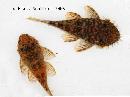
From the drainage basin of the Tapajos arrived a new, until now not imported loricariid catfish at our facility. Body form and yellow fin seams remind strongly of L 360, the body and parts of the fins however exhibit a veining atypical for L 360. In their maintenance requirements they might probably not differ from the recently here presented L 360. Whether it is a variant of L 360 or possibly a deviating species must at the present level of knowledge remain open.

(Photo F. Schäfer, Text K. Diehl)

Angaben zum Tier
Herkunft Brasilien, Tapajos

Glyptoperichthys joselimaianus L 1, L 22

6. July 2007

Glyptoperichthys joselimaianus the “White Spot – Glycopterichthys” originates from the Rio Araguaia, one of the main tributaries of the Rio Tocantins in Brazil. There it inhabits different habitats, it was found e.g. on deadwood and also on flooded meadows. Natural water conditions (white water) do not have to be copied for maintenance, L 1 are very adaptable fish. One condition for the maintenance of adult Glycopterichthys species is however the ownership of a very large aquarium. With an overall length of approximately 40 cm, which can be reached in aquaria too, they are really stately catfishes. It is very impressing to see such a fish sailing elegantly through the aquarium. Sail Fin Plecos are not shy compared with many other Loricariids. Their large appetite is noteworthy this requires a strong filtering unit. Wild caughts of this species are only rarely found in the trade, predominantly the offered animals are asiatic pond breeds.

(Photo F. Schäfer, Text K. Diehl)

Angaben zum Tier
Herkunft Brasilien
Name Glyptoperichthys joselimaianus L 1, L 22

Panaque spec. „New Royal Golden Thunder“

6. July 2007

September 2006: This week we succeeded in importing several of this beautiful new Panaque from Brazil. In their appearance they remind of L 27, are however flatter and slimmer than these. In addition they possess a larger mouth and their dorsal fin is smaller. These characteristics let assume that they originate from strongly flowing river sections. The comparison of different sized animals shows, that the strong gold colouring, as well as the for L 27 atypical, attractive dotting of the caudal fin increases with ageing. Scarcely said: For me at present the most attractive Panaque!

(Photo F. Schäfer, Text K. Diehl)

Angaben zum Tier
Herkunft Brasilien, Rio Xingu
Name Panaque spec. „New Royal Golden Thunder“

Heterotis niloticus

6. July 2007

As next the relative of the largest truly freshwater fish Arapaima gigas Heterotis niloticus has a large attractiveness. With a maximum length of scarcely about one meter it is however more suitable for the aquarium maintenance than its South American relatives. In Africa they originally inhabit different waters types south the Sahara.

A difference to all the other bonytongues lies in the way they nourish. It feeds mostly on plankton, being the only plankton-feeder of the Osteoglossidae.

Live red mosquito larvae have proven to be the ideal food for this species of fish. Even 30-40 cm long specimens eat this food enthusiastically.

For our customers: depending on their size, the animals have the code numbers 140500 (3-4 cm) to 140507 (25-35 cm) on our stock list. Please note that we only supply the wholesale trade.

(Photo F. Schäfer, Text K. Diehl)

Angaben zum Tier
Herkunft Zentralafrika

Scardinus erythrophthalmus Golden

6. July 2007

Scardinus erythrophthalmus Gold

March 2004: Just in time for the pond season this very attractive variety of the Rudd (Scardinus erythropthalmus) came to us. It is an excellent ecological algae destroyer for your garden pond. The Rudd is an endemic species for the whole of Europe and Asia up to the Aral Sea. It is a friendly schooling fish, which can be accompanied with related species, like for example Roach, European Chub and Ide. The Rudd is spawning in nature or garden pond from April until June. This fish is very productive and can produce more then 100,000 eggs. Between the ventral fins and the vent the Rudd has a sharp keel. The males can only be distinguished from the females during the breeding season by a white cloudy secrete on the head.(Text: I. den Daas, Photo: F. Schäfer)

Angaben zum Tier
Herkunft Europa

Enneacampus ansorgii

6. July 2007

Enneacampus ansorgii

The small freshwater pipefish originates from Western Africa, from Cameroon to Gabun and in the Zaire- and Ogowe River. These fish inhabit freshwater as well as brackish water habitats. Addition of sea salt (1-2 teaspoons per 10 litre of water) will therefore increase the vitality of these fish. This species, but actually all freshwater pipefish, need a special fish tank for its own in order to thrive because they are slow eating fish. They eat only life food like daphnia, cyclops, brine shrimps and the smallest fish fry. Breeding has been performed successfully in captivity on several occasions. The female lays her eggs over the breeding pouch of the male pipefish. The eggs are attached on the male animal behind the vent within an area bordered by 2 folds, which form the breeding pouch. These fish need regular water changes and a clean fish tank but will give their owner many pleasure by displaying beautiful colouration and an interesting behaviour. (Photo: Frank Schäfer, Text: Izaak den Daas)

Angaben zum Tier
Herkunft Kamerun-Gabun, Kongo, Angola

Hemichromis sp. Bangui

6. July 2007

Hemichromis sp. Bangui

Red Cichlids of the species Hemichromis are generelly regarded as aggressive, but this prejudice is based on past years, when 160 ltr tanks were considered to be bathtubs and you mostly had to be satisfied with 60 ltr aquariums. To keep them in pairs, an aquarium of this size is in fact sufficient for Hemichromis sp. “Bangui”. But if you want to socialize the fish, it should be at least 160 ltr. Hemichromis sp. “Bangui” belongs to the more peaceful Cichlids of the species Hemichromis, but when they get into the mood for brooding, they know – like almost all Cichlids – how to defend their children emphatically. The breeding is actually no big problem, as they are not bound to any special water conditions and therefore brood regularly. Also the feeding is unproblematic, so that they can be even recommended to beginners with sufficiently big aquariums. Plants are not getting damaged. The fish are full-grown with six (females) to eight centimetres (males). It still is not clear, if it is an independent species or if we are facing a location variant of a kind already known. However, this Red Cichlid of Bangui certainly is an interesting enrichment to the aquarists offer.(Photo & Text T. Weidner)

Angaben zum Tier
Herkunft Zentralafrikanische Republik

Nandopsis salvini

6. July 2007

December 2006: At present we can offer a very beautiful, strongly red coloured variant of Nandopsis (Cichlasoma) salvini to you. They origin from South Mexico, Belize and Guatemala, where they live in to the Atlantic ocean heading streams. Like most Central American cichlids they are very easy to keep in middle hard water at pH values in the neutral range. With a maximum size of 20 cm they belong not to the giants, need however nevertheless sufficiently large tanks (starting from 150 cm). They can be kept together with other cichlid species. A socialization with small fishes is to be avoided, since they, according to their nature, regard them as food. They should be fed with substantial food, a granulated food with a high rate of shrimps can thereby affect the development of the red colour. They are easy to breed and their territorial and brood care behaviour make them to interesting tank inhabitants. An aquarium with Central American cichlids becomes actually never boring.(Photo F. Schäfer, Text K. Diehl)

Angaben zum Tier
Herkunft Belize, Guatemala, Mexiko
Name Nandopsis salvini

Vieja maculicauda

6. July 2007

Vieja (Cichlasoma) maculicauda the Blackbelt Cichlid is one of the larger Central American cichlids. Males can reach about 35 cm overall length. According to its size one needs voluminous aquaria, where their interesting social behaviour can be observed. In their distribution area (Atlantic slope, from the Usumacinta River drainage in Guatemala to the Chagres River in Panama) they live in the lower sections where the current is slow and go also into brackish water. Since they are able to tolerate brackish and marine conditions, they are unproblematic regarding water chemistry in aquaria. Fish of this size cannot be nourished with flake food alone. Beside granulated food and sticks they should be variedly fed. Here you can let your fantasy go and experiment a lot. Worms and insects as well as their larvae are greedily eaten, also vegetables should be offered, but here some individual differences exist in the readiness to eat these. But this individuality is a part of the attraction with the care of large cichlids. Over years one becomes acquainted with them, so that sometimes they nearly belong to the family(Photo F. Schäfer, Text K. Diehl)

Angaben zum Tier
Herkunft Guatemala bis Panama

Palaemon concinnus

6. July 2007

Over an enormous range, that includes nearly the entire Indo Pacific those first as Macrobrachium “White Fingers” designated Palaemon concinnus can be found. Their bright white “shear-fingers” are very remarkable and give this from Sri Lanka imported species a special attraction. It is about a rather delicate, smaller species, thus one could try to socialise it with small fishes. Because it is a newly imported species we have no information to their behaviour in the aquarium as well as to their breeding. An opportunity to brake new ground is here offered to the Crustaceen Freak and surely interesting discoveries will approach.(Photo F. Schäfer, Text K. Diehl)

Angaben zum Tier
Herkunft Küstenregionen des Indopazifik

Barbus cf. callipterus

6. July 2007

This strongly at Barbus callipterus reminding barb reached us from the tropical west Africa. Whether it is a variant of the Clipper barb B. callipterus or a near related species could yet not be clarified. The further information refers to the general maintenance conditions of bigger barb species.They are social swarm fish, which should be held at the best in schools by at least 7 individuals. They prefer well – planted tanks (> 80cm) with open water for swimming. For the socialization further peaceful, active fish are suitable. Concerning their food barbs have usually no excessive requirements, but as other fish they like an occasional addition of frosted or living food to the commercial flake food diet. One is then often surprised, what energy is in a swarm of barbs, if e.g. living water fleas are offered to them.(Photo F. Schäfer, Text K. Diehl)

Angaben zum Tier
Herkunft Kamerun, Nigeria

Danionella translucida

6. July 2007

Danionella translucida would have earned an entry in the Guiness book of world records. The largest measured individual was only 12mm long, thus acts it with this species around the smallest vertebrate anima. Apart from their extreme smallness the absence of sheds, as well as the high transparency of the dwarves are noticeable. They origin from Myanmar the former Burma, where they inhabit slowly-flowing, well planted streams. They place no special requirements for care, should not however naturally not with lively fish be associated. A small aquarium (50cm) is sufficient for a group of these interesting fish. Breed attempts should be undertaken f the fish are well fed with Artemia Naupliae and sieved life food. According to the waters in their habitat the water should be soft and easily sour. Reports on successful breeding are not known. (Photo: Erwin Schraml, Text: Klaus Diehl)

Angaben zum Tier
Herkunft Myanmar

Corydoras baianinha

6. July 2007

Corydoras baianinha

March 2003: Some weeks ago we received a few pieces of Corydoras baianinha. This extreme rare Corydoras only occurs in a little number of small streams in the south of Brasil. The population of Cordoras baianinha is very much in danger, because its living space was already largely distroyed by environmental pollution and forest clearing! It would be highly appreciated if some aquarium hobbyists would try to breed this endangered species. This kind was not furtherly studied scientifically. It is known, however, that the animals occur in cool black water with low total hardness. We hope that the continued existence of this species can be ensured in this case. (Photo F. Schäfer, Text K. Diehl)

Angaben zum Tier
Herkunft Brasilien

Corydoras weitzmani

6. July 2007

Corydoras weitzmani

This is one of the most spectacular representative of the Corydoras genus recently imported. For us this is the ultimate Corydoras. Its closest relative is probably Corydoras panda. The body pattern is similar to the recently described Corydoras tukano. This species was caught by the authors in September 2004 in the riverine system of the Rio Madre de Dios in Peru. Recently the first importation of this fish was successful as well and is probably the first time this fish has been brought alive to Europe, albeit in low numbers. Around this species there are circulating several rumours. Especially the place of origin of the holotypes (out of the collection of C. Kalinowski from 1949) seems to be incorrect, because many years of searching in the area of Cusco this species could not be found. Not before 2004 Belinda and Lance R. Peck (Aquarium Gonewild, Peru) caught this rare catfish accidentally in a small area heavily destroyed by gold diggers. Often this fish is caught as individuals and despite many expeditions this species has only been imported in extreme low numbers. We participated in one of those expeditions and could catch only a couple of these Corydoras catfish. A larger importation to Germany was not possible during this period. Now this species has come available in amounts, which are suitable for the first breeding attempts. If these are successful this species can be distributed and made available for the aquarium hobbyists. Due to the destruction of the natural habitat of this catfish the future import will be doubtful. Aquarium Glaser is offering an exclusively part of the recently imported wild caught Corydoras weitzmani. (Text: P.+M. Hoffmann, Photo: P. Hoffmann)

Angaben zum Tier
Herkunft Peru, Madre de Dios

Crossoloricaria cf cephalaspis

6. July 2007

Crossoloricaria cf cephalaspis

The 5 species of the genus Crossoloricaria are all looking very similar to the flounder Loricariid genus Pseudohemiodon. These fish have as well a flattened body form, small eyes lying distally on the triangularly formed head. The difference between these two genii is the missing of the ventral bony plates of Crossoloricaria. Only at the medial line of the ventral side there is a small row of tiny bony plates. C. cephalispis does not grow larger then 20 cm. They absolutely need a sandy substrate, in which they can bury themselves as deep as possible. This means that they often are difficult to spot at all. When they are new in the aquarium they only come out of the sand during the night, but after a period of acclimatisation they appear at feeding time. This species also originates from the north of Colombia.(Text: I. den Daas, Photo: F. Schäfer)

Angaben zum Tier
Herkunft Kolumbien

Loricaria simillima

6. July 2007

Loricaria simillima has a very wide distribution in South America. It is found in the Orinoco-, Amazon- and La Plata basins. A result of this large area many different color forms are known, which differ clearly regarding coloration and pattern. The species occurs in different water types. Black water forms are more demanding in maintenance and breeding than fishes originating from white water. For keeping them middlehard water with a pH of 6 – 8 and temperatures between 24 – 27°C is sufficient. As omnivorous fishes they are rather undemanding in their nutrition, tablet food, flakes and frosted food are accepted. The aquarium should have a sandy soil, some dark corners made by stones and bogwood increase the comfort for the fish. With a total length of 25 cm they should be kept in not to small tanks, they are mouthbrooders, the male guards the eggs and larvae.(Photo F. Schäfer, Text K. Diehl)

For our customers: the fish have code 266653 on our stocklist.Please note that we exclusively supply the wholesale trade.

Lexikon: Loricaria: from the Latin word „lorica“which is the chest protector of the Roman legionnaire, eg „one that wears a chest protector“. simillima: Latin, means “very similiar”, which refers to the similarity of the species to L. cataphracta.

Suggestion of a common name: Royal Whiptail Cat

Angaben zum Tier
Herkunft Zentrales Südamerika

Pareiodon cf. microps

6. July 2007

This pencil catfish, a relative of parasitic the urethra of humans entering catfishes, is very rarely traded. The affiliation to the genus Pareiodon is rather clear, the species classification however is yet not clarifyed. As predators they should not be socialized with to small fishes. Due to their rarity no reports about their maintenance in the aquarium are present to us. For collectors of rarities: there is one albino in stock!

(Photo F. Schäfer, Text K. Diehl)

Angaben zum Tier
Herkunft Brasilien

Potamotrygon menchacai

6. July 2007

Potamotrygon menchacai

September 2006: From Potamotrygon menchacai, the tiger stingray, we could import a big, very beautifully patterned, female animal with approximately 60 cm in diameter. Tiger-rays can be colored quite differently and particularly can differ in the contrast. Our tiger rays come from Peru, through size and scrutiny, they certainly are among the most impressive “ornamental-fishes.” A basin with a big base is required for keeping these giants, at best several square meters should be provided for them.

Angaben zum Tier
Herkunft Brasilien, Rio Parana-Paraguay
Name Tiger Ray

Ancistomus sabaji L124 „Big Spot“

6. July 2007

Ancistomus sabaji – Hypostomus spec., Peckoltia spec.? A fish with many names! There is hardly another L number catfish where the confusion regarding the nomenclature is as large as with this species. This is a result of the generous allocation of numbers (L 75, L 124, L 301 and LDA 2) for this fish. One reason for this fact is the large area of origin where numerous deviating color forms exist. For the hobbyist this should be no real problem, since all varieties are attractive and can be easily kept. They can get larger than 20 cm and need therefore roomy aquariums. As expressed omnivors with only little aggression they are very well suitable for community tanks.

(Photo F. Schäfer, Text K. Diehl)

Angaben zum Tier
Herkunft Brasilien, Guyana

Hypostomus luteus

6. July 2007

Hypostomus luteus Hypostomus luteus Hypostomus luteus

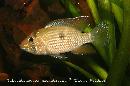
From southern Brazil and northern Argentina originates the probably most beautiful representative of the genus Hypostomus. Contrary to many other loricariids they become more beautiful with increasing age, since the portion of the yellow body parts constantly increases. Their southern area of origin suggests a tolerance in relation to low temperatures. They can be can maintained in the unheated room aquarium. Since a size of more than 30 cm can be reached a tank of appropriate size should be available.(Photo F. Schäfer, Text K. Diehl)
Angaben zum Tier
Herkunft Brasilien, Argentinien
Lateinischer NameLateinischer Name Hypostomus luteus

Panaque spec. „Papa Ojo Chico“ L 90a

6. July 2007

Panaque spec. „Papa Ojo Chico“ L 90a Panaque spec. „Papa Ojo Chico“ L 90a Panaque spec. „Papa Ojo Chico“ L 90a Panaque spec. „Papa Ojo Chico“ L 90a

With L 90a we can offer at present one of the most beautiful Panaque species. Especially the extremely long, orange colored filaments of the caudal fin are remarkable. In addition, the discrete black markings on the noble-grey colored body let them appear very elegant. With the purchase of these fishes their final size (over 30cm) should be considered. In to small tanks the fin filaments can be easily damaged. They need predominantly vegetarian food, besides that all kinds of wood are gladly eaten. Bogwood in the aquarium thus is obligation. They are easy to keep catfishes, owners of large tanks should absolutely try to breed them.(Photo F. Schäfer, Text K. Diehl)

Angaben zum Tier
Herkunft Peru
Name Panaque spec. „Papa Ojo Chico“

Betta prima

6. July 2007

Betta prima originates from South East Thailand and Cambodia and is a member of the Betta pugnax group. They are found foraging along the dense vegetation of brooks, swamps and calm rivers. B. prima is a small species, they can reach the size of about 6 cm. They like well planted, and since they are excellent jumpers also well covered aquaria. As for all air breathing fish there should be paid attention to a sufficiently high air temperature. Against the water chemistry B. prima places no special requirements. Breeding of these mouth breeders is not complicated, so that when diversified fed, if possible also with small living food, a new generation will appear sooner or later. For Aquarists which would like with to begin with the maintenance of wild – Bettas, B. prima thus represents an ideal fish.

(Photo F. Schäfer, Text K. Diehl)

Angaben zum Tier
Herkunft Kambodscha, Thailand

Dario dario

6. July 2007

Dario dario

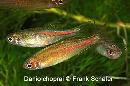
This species, which became well-known as Badis sp. SCARLET is still enjoying great popularity. This dwarf badis can be kept very well along with dwarf rasboras. It is is quite easy to keep and to breed, which was succesfully done several times already. (Photos & Text Dieter Bork)

Angaben zum Tier
Herkunft Indien

Pseudocrenilabrus philander

6. July 2007

May 2007: From the Congo we received Pseudocrenilabrus philander. The fish originate from the upper parts of the Congo river (Lualaba). Their area of circulation covers nearly the entire southern Africa, where they are to be found in practically all types of waters. As mouthbreeders in the female gender their courtship and broodcare run after the typical haplochromine pattern.

(Photo F. Schäfer, Text K. Diehl)

Angaben zum Tier
Herkunft Südliches, zentrales Afrika

Pterophyllum altum

6. July 2007

The new season began, Pterophyllum altum (Orinoco) is available again. Deep Angels can reach 20cm length and up to 35cm in height. This has to be considered with the tank purchase, it should have a height of at least 70cm. A decoration with large bogwood, provides structure and retreat possibilities for them. Since they are sensitive in relation to bad water quality and stress, they are not really suitable for community tanks. In no case they should be associated with too lively fish. For their maintenance middlehard water with a neutral pH is sufficient, for breeding attempts it should content nearly no minerals and pH values in the range of 5. Only a few hobbyists were able to breed them and it is remarkable that even at parents of a F2 generation a spawning season of a few months (in spring) is clearly present.(Photo F. Schäfer, Text K. Diehl)

Angaben zum Tier
Herkunft Kolumbien, Venezuela, Orinoco
Name Pterophyllum altum

Aegla platensis

6. July 2007

There are more than 60 species, all of them exclusively inhabitants of freshwater, in the genus Aegla, which belongs to the family Aeglidae. All Aegla species are inhabitants of southern South America. To date they have hardly ever been seen in the aquarium hobby. The specimens recently imported by Aquarium Glaser demonstrate, however, that Aegla are thoroughly interesting aquarium occupants. Aegla are relatively small crabs – A. platensis grows little longer than 5 cm. The tail is carried folded beneath the belly, as in the short-tailed crabs. A number of sexual differences are known in Aegla. The males have a longer, broader carapace, the pincers are larger and the left-hand and right-hand pincers are unequally developed. Aegla platensis is sexually mature at an early age. The eggs undergo direct development, and the hatching young immediately look very similar to the parents. There are no free-swimming larval stages. In Aegla platensis in particular egg-carrying females are found year-round, and this species is thus not restricted to breeding at particular times of the year. In the aquarium the first (obviously very short-term) observations indicate that these little creatures live a very secretive life. If they are given fine sand as substrate then they like to bury themselves, disappearing tail-first into the bottom. Aegla crabs don’t appear to have any special food preferences, and both frozen foods (mosquito larvae, Artemia) and dry are taken. The specimens now imported originate from a river called the Arroyo Pozo Hondo, 137 km to the east of Asunción (Paraguay). Like fishes imported from Paraguay, Aegla may also appreciate a slight “winter rest” at 16-18 °C, and in general they should not be kept too warm. If possible the maintenance temperature shouldn’t exceed 24°C even in summer. (Photo: Aquarium Glaser, Text: Izaak den Daas)

Angaben zum Tier
Herkunft Paraguay

Coenobita brevimanus

6. July 2007

The hermit crab C. brevimanus origins from coasts of the Indopacific, where it is found from the east coast of Africa to Tahiti. Coenobita brevimanus is the most terrestrial of all land hermit crabs. For the maintenance one needs a terrarium with only shallow water, because they do not like to get wet. Since they are very social, they should be held in a small group. A terrarium of 60 x 40 x 40cm for a small group would be ideal. The terrarium is good to secure, since hermit crabs are experienced escapees. Important are further a good ventilation and structuring of the terrarium. Since C. brevimanus climb gladly, also some stones or roots should be brought in. With a high sandy bottom you should give them a chance to dig. As expressed omnivores one can offer them different fruit and vegetables, as well as food with animal content. The species has code 483144 on our stocklist. (Photo F. Schäfer, Text K. Diehl)

Angaben zum Tier
Herkunft Küsten des Indopazifik

Macrobrachium idae

6. July 2007

January 2006: The long arm shrimp Macrobrachium idae reached us from Sri Lanka. Remarkable are their extreme long, name-giving “arms”, which can give the full grown animals an enormous broad reach. With that they are able to track small fish successfully, which naturally limits their use in the community tank. Together with larger fish species or in a shrimp aquarium they are however interesting animals. Like all Macrobrachium species they need good water quality, otherwise however they are not demanding. All usual kinds of food are eaten greedy. A shrimp aquarium should not be lit up too brightly, and/or be easily darkened with some swimming plants.The roots of the swimming plants offer protection to the new generation against their sometimes quite predatory parents. Further there should be a lot of hiding places, with bogwood, coconut bowls and rocks beautiful underwater landscapes can be arranged.(Photo F. Schäfer, Text K. Diehl)

Angaben zum Tier
Herkunft Sri Lanka - Australien

Corydoras weitzmani

6. July 2007

February 2006: We are pleased to be able to offer you the first offspring of a legend. Now offspring of the recently again discovered and in the last year for the first time to Germany imported Corydoras weitzmani are available. Fortunately this beautiful small, at Corydoras panda reminding species, could quite fast be spawned by engaged breeders. This appears particularly of importance before the background of its threatening extermination in the wild. The species is not very productive, therefore it would be welcome, if further Cory fans took care of them. In the maintenance they are unproblematic. Best they feel, if they can as a troop of conspecifics, sieve sand surfaces in the aquarium for food. Flake food, tablets and different frosted foods are gladly eaten. For breeding it may be somewhat more meaty. White Worms (Enchytraeus) and Tubifex promotes the spawn considerably. We hope to be able to offer further offspring of this species to you, since they deserve a further spreading in our aquaria.

(Photo F. Schäfer, Text K. Diehl)

Angaben zum Tier
Herkunft Peru

Hoplias macrophthalmus

6. July 2007

With Hoplias macrophthalmus we could import from Colombia one of the biggest predatory fishes of the Amazon river system. Contrary to the regular imported Hoplias malabaricus these arrive only extreme rarely in the trade. As an adult with a weight of over 40 kg and a length of more than 120cm they belong to the largest characins at all and leave the viewer with an enormous impression. For keeping them very large tanks are required and their tankmates have to be choosen with big caution.(Photo F. Schäfer, Text K. Diehl)

Angaben zum Tier
Herkunft Kolumbien

Nannostomous espei

6. July 2007

Nannostomous espei

Up to now this ornamental tetra is only known from western Guyana/Southamerica in the lower course of Mazaruni River. Full-grown fish reach a total length of approx. 40mm. When putting on spawn the females are getting much plumper. By using their dish-shaped anal fin the males fix the eggs to a substrate (e.g. bottom of a plant leave). During the pairing the males lose the bands marking except for little black spots. Peaceful fish, which mostly stand in the upper water area among the plants. The keeping is advantageous in well-planted tanks only with other peaceful fish. Breeding is possible in 10 litre tanks with a spawn substrate (Javamoss), the number of eggs is not very big. For keeping, please do not use too hard water, 10°german hardness, maximum, pH 5.5-7 and temperature around 24°C. (Photo & Text von P. & M. Hoffmann)

Angaben zum Tier
Herkunft Guyana

Oryzias celebensis

6. July 2007

Oryzias celebensis the Celebes rice fish originates, as the species name indicates, from Indonesia where it inhabits the island Celebes. It lives in standing to slowly flowing waters which are heavily planted. As an approximately 5 cm large becoming schooling fish it needs a free swimming area and retreat possibilities, since rice fish occasionally tend to become somewhat quarrelsome among themselves. With their maintenance it is to be considered that Oryzias celebensis prefers rather high pH values. Optimal water should exhibit a pH of 8 and also a not to small water hardness (DGH 10°). In such a water even the breeding of rice fish is possible. Interesting is that the female carries the eggs several hours before attaching them to a substrate. The raising of the fry should not be difficult.

(Photo F. Schäfer, Text K. Diehl)

Angaben zum Tier
Herkunft Indonesien, Celebes

Hypostomus sp. „Chaco“

6. July 2007

Hypostomus sp. „Chaco“

A close relative of the well known common plecos, is shown at the time of the importation not fully grown yet. This fish can easily grow up to 30 cm in length. This pleco is a harmless solitude fish, very well suited for the cichlid aquarium. It is an animal who has a nocturnal way of life and will show most activity at dawn and dusk. During the day it will rest at a shadowy place under a stone or piece of bogwood. The representatives of the pleco species live in fast streaming rivers but also in flooded areas. They feed in the aquarium preferably on vegetarian food like salad and boiled pees or Brussels sprouts, but this fish is not picky at all and will eat all kind of flake or tablet food as well.(Text: I. den Daas, Photo: F. Schäfer)

Chelus fimbriatus

6. July 2007

June 2006: Freshly arrived and very beautiful. From South America reached us few Mata matas. Their in jungle waters protruding camouflage lets it appear remarkable and bizarr in the aquarium.(Photo F. Schäfer, Text K. Diehl)

Angaben zum Tier
Herkunft Peru, Kolumbien, Brasilien
Name Mata mata

Labeo calbasu

6. July 2007

Labeo calbasu the Orange-fin shark is a real king sized labeo. In its homeland (Pakistan, India, Bangladesh, Myanmar, Nepal, Thailand and South West China) it is a fish for consumption and therefore of importance in the asiatic aquaculture. With a size of up to 1m it is not a fish for the “normal” aquarium. Aficionados of the East Asian fish fauna possessing really large aquariums, can hold him together with Channa or Osphronemus species. In the wild Labeo calbasu is selective in feeding. Juveniles show a positive selection for zooplanktonic organisms. The adult showa negative selection for the zooplankton and a positive selection for decayed organic matter and molluscs. According to their large appetite they load the water very strongly, thus they are grateful for regular large water changes. In their habitats they occur in diverse waters types and so they have no special demands on waterchemistry.(Photo F. Schäfer, Text K. Diehl)

Angaben zum Tier
Herkunft Südost Asien

Microphis lineatus

6. July 2007

Microphis lineatus

The species Microphis lineatus inhabits the (sub) tropical coastal waters of the American continent. This pelagic pipefish grows up to 22 cm lengths and has a very long slender snout with red spots and blotches. The body is brown or greenish above and pale below. There are very small white spots on the body and a dark line through both eyes. The brood care is practised by the males. Mature male Short-tail River Pipefish carry the eggs in a brood pouch on the ventral surface of the body. Large males can carry several hundred eggs. The breeding takes place in freshwater meanwhile they live most of the year in estuaries and coastal waters. Therefore salt should be added to the water. This pipefish takes only life food. Freshly hatched brine shrimps are taken eagerly. Flake or tablet food is generally not accepted.(Photo: Erwin Schraml, Text: Klaus Diehl)

Angaben zum Tier
Herkunft Tropisches Amerika

Lamprologus callipterus ALBINO

6. July 2007

Lamprologus callipterus ALBINO

August 2004: Now available: Lamprologus callipterus ALBINO. After several years, one of our breeder was successful in breeding this species. We have this fish for the first time in stock. You will find here more details soon.(Photo F. Schäfer, Text K. Diehl)

Angaben zum Tier
Herkunft Zuchtform

Geophagus sp. „Pindare“

6. July 2007

Geophagus sp. „Pindare“

Among the “Eartheaters”, species Geophagus, G. sp. “Pindare” is one of the most recommendable ones. Growing up to approx. 15cm only, it stays rather small and also shows a beautiful marking with red and blue lines on its flanks. The care of this species is really quite simple, because it does not care about the plants and it is easy to please with almost every water as long as it is biological clean. Of course it prefers frozen or live food, but it does not scorn dry food. It is only unsuitable for a Dutch plant tank, because being an “Eartheater” it needs sand to chew. Therefore a bigger zone of the aquarium should be covered with fine sand and the decorations should be roots, rocks and some deeply rooted plants. G. sp. “Pindare” is a larvophiler mouthbreeder, which puts its nest with eggs on a rock or root and only picks up the hatched larvas in its protecting mouth. (Photo & Text von T. Weidner)

Angaben zum Tier
Herkunft Brasilien, Rio Pindare

Pterophyllum altum german bred

6. July 2007

Pterophyllum altum deutsche Nachzucht

November 2003: Lately we received German bred Pterophllyum altum. It is worth mentioning that this was a natural brood, eg both parent took care for eggs and the young. Even spawning of the Altum Angel is a remarkeble event. This species tends to get panic attacks when the fish is fully grown. Thus they tend to eat eggs and young often even after relatively slight concerns. Behaviour in fish species is mostly passed on genetically. Now there is a good chance that these young Altum Angels are as good breeders as their parents.(Photo & Text K. Diehl)

Angaben zum Tier
Herkunft Kolumbien, Venezuela, Orinoko

Barbus congicus

6. July 2007

The Congo Barb is a rarely traded ornamental fish. As you can see by their name Barbus congicus originates from the Congo river in Central Africa. With a length of 7 – 8 cm it belongs to the medium sized barbs and should, according to its vivaciousness, not be maintained in to small aquariums. With the maintenance of active swarm fish sufficient free swimming areas should always be present, a dense planting of the tank background is to be aimed not only from aesthetic criteria. It is also a refuge for fry and suppressed individuals. Against food and water equivalents (neutral pH, Temp.: 24 – 27°C) Barbus congicus makes no special demands and should thus be an interesting fish for the engaged hobbyist.(Photo: Erwin Schraml, Text: Klaus Diehl)

Angaben zum Tier
Herkunft Congo, Congo river

Oreichthys crenuchoides (=spec. Hifin)

6. July 2007

This barb out of the relationship of Oreichthys cosuatis measures about 5 cm. They originate from northern India. This species is characterised by a pronounced sexual-dimorphism, the males are more larger than females, only them show the magnificent, flag-like increased dorsal fin. The fish tank should be decorated with dense patches of plants on the sides and back but should be kept with enough swimming space. Tank mates should be not to big, vigorous swimmers should be avoided. In captivity they feed on all kinds of available food and they even take flake or pellet food. Breeding is not difficult at all. The females spawn in an upside-down-postion und broad leves of underwater plant, as it is known from the harlequin barb.(Photo: Erwin Schraml, Text: Klaus Diehl)

Angaben zum Tier
Herkunft Indien / India

Corydoras sp. aff. kanei

6. July 2007

Corydoras sp. aff. kanei

This new and undescribed true mailed catfish differs from C. kanei by a golden band on the shoulder. The very attractive fish originate from the Rio Jamaxin (Brazil). Their final length is 5 cm. C. kanei has been bred successfully on several occasions and Seuß (Die faszinierende Welt der Corydoras, Landbuch Verlag Germany, 1997) reports that at a temperature between 23 and 25 degrees Celsius, 80 to 100 eggs are laid by a combination of 2 male and 1 female cory. The fertilisation rate between 80 and 90 percent and at 25 degrees Celsius the 1.8 mm eggs hatched after 4 days. The first food for the fry consisted of fresh hatched brine shrimps.(Text: I. den Daas, Photo: F. Schäfer)

Angaben zum Tier
Herkunft Brasilien

Hoplias malabaricus

6. July 2007

“Here's lookin' at you, kid,” – but be careful. Otherwise it could happen that it will be the very last what a tank mate will be looking at. Under these beautiful green eyes are not less impressive teeth that makes the wolf fish Hoplias malabaricus a feared hunter. The owners of these from Costa Rica to Argentina spread species should, when being busy in the aquarium, always have a view of their “favorite”, since it can come to bite injuries. Due to its large habitat some only difficult to distinguish subspecies of H. malabaricus exist. For those the statements of size differ, but it is to be assumed that H. malabaricus can reach a size of at least 50 cm and a weight of 1,5 kg. It is thereby no fish for everyone and completely nothing for a community aquarium. For experienced owners of large tanks which search for the unusual they may be a challenge which could be looked at.(Photo F. Schäfer, Text K. Diehl)

Angaben zum Tier
Herkunft Costa Rica-Argentinien

Astyanax leopoldi

6. July 2007

Astyanax leopoldi

Because of their rhomboid body form these animals remind one a little of African tetras of the species Phenacogrammus or Bathyaethiops. Except from Rio Oyapock Astyanax leopoldi are also said to be found in Rio Approuague. They were named in honour of King Leopold III of Belgium, who attended an ichthyological expedition to Rio Oyapock in 1962. Fortunately we soon succeeded in breeding, even though this tetra was not always unproblematic. Especially when doing too generous water changes with raising the pH-value fish of all ages occasionally respond with symptoms of a “shock” (body gets white), from which they somtimes do not recover. Apart from that these are very enduring, peaceful and “grateful” fish. Although they are not really coloured newcomers, they surely earn a permanent position in the aquarium hobbyists.(Photo & Text von P. & M. Hoffmann)

Angaben zum Tier
Herkunft Guyana, Rio Oyapock

Pseudoplatystoma corruscans

6. July 2007

The rarely traded largest shovelnose catfish Pseudoplatysoma corruscans originates from the Rio Sao Francisco in Brazil. This predator becomes quite large (approx. 180cm) and heavy (100 kg). They like to stay in groups and socialize well with rays, big charazins, cichlids or other catfishes.

(Photo F. Schäfer, Text K. Diehl)

Angaben zum Tier
Herkunft Brasilien

Pseudeutropius atherinoides

6. July 2007

Pseudeutropius atherinoides

The „shark cats“ of the genus Pangasius are highly seeked for aquarium fishes, because their swimming behaviour reminds one on a shark. Sadly all species grow very fast and none of the species stays smaller than 50 cm, some even reach 150 cm or even more. For some time now so-called „mini-pangasius“ are introduced to the market. One of these species (who, from a systematic point of view, are not close relatives of Pangasius) is the charming Eutropius atherinoides, that grows rarely longer than 6-8 cm. Actually this fish is quite cheap and available in greater numbers from India. They are very peaceful inhabitants for every community tank and take readily all types of the usual food for ornamental fishes. Plants will not become eaten or destroyed.(Photo F. Schäfer, Text K. Diehl)

Angaben zum Tier
Herkunft Indien

Amaralia hypsiura

6. July 2007

January 2001: At present we can offer Amaralia hypsiura for friends of the extraordinary . This rarely dealt catfish attains full growth with approx. 15 cm length. It originates from the Amzon and there it feeds mainly, as gastric examinations of freshly caught fishes documents, predominantly the spawn of other fish. Fortunately they are not dependend on this exquisite food. In tanks they can be fed with frosted or living red worms and other invertebrates. This predominantly night-active fish estimates not to bright lighting, also the aquarium should have some hiding places were they can find a place to hide.(Photo F. Schäfer, Text K. Diehl)

Angaben zum Tier
Herkunft Brasilien

Hyphessobrycon cyanotaenia, Lapis-Tetra

6. July 2007

Hyphessobrycon cyanotaenia, Lapis-Tetra

This tetra was introduced to us under the name of “Inpaichthys sp. Lapislazuli” in February 2002 by Mrs. Glaser-Dreyer (Aquarium Glaser GmbH). On the (Japanese) internet it is called Lapis tetra. It was imported in a bigger number of pieces without exact declaration of place of discovery. The males are growing up to at least 4cm and are far more colourful and stronger with a lengthened back- and anus fin than the lighter females, which are only approx. 3.5cm long. They are almost always moving, very voracious, peaceful and the males are constantly busy with fights for their territory among themselves. The breeding was a success for the authors.(Photo F. Schäfer, Text K. Diehl)

Angaben zum Tier
Herkunft Brasilien

Potamotrygon sp. „Mantilla ray“

6. July 2007

Potamotrygon sp. „Mantilla ray“

This freshwater ray originates from Paraguay. The multitude of forms and colours never stops to amazes one. In the past the scientific description of freshwater rays used to be done according drawings without any conserved specimens from natural museum history collections. The classifications of live animals by such limited descriptions are almost impossible to make.(Photo: Frank Schäfer, Text: Izaak den Daas)

Angaben zum Tier
Herkunft Paraguay

Epiplatys bifasciatus

6. July 2007

September 2000: At the moment, we can offer the Epiplatys bifasciatus. These approximately 5-6 cm long growing killifishes come from Guinea in West-Africa. There, they live in small savanna-brooks and swamps. No big aquariums are required for keeping of this fish, they should notbe socialized with active species since they can then become quite shy. The nutrition value should be attached to a not too nourishing diet. A high dosiss of black worms stimulates the well being and improves their fertility.

Angaben zum Tier
Herkunft Guinea

Peckoltia. spec. L 134

6. July 2007

Peckoltia. spec. L 134

From the Rio Jamanxim (Brazil) comes one of the most attractive members of the genus Peckoltia. L 134 is very variably marked: as well as individuals with stripes there are also specimens with large round spots on the body. It is not known whether this difference in colouration denotes sex, but in at least one pair showing the usual sexual differences (longer head and caudal peduncle, as well as enlarged and pointed pectoral and ventral fins in males) the male was striped and the female spotted. The L-number 134 was erroneously allocated a second time, to a Lasiancistrus-like catfish, which later received the replacement number 143. Our L 134 fish were imported with a shipment of mainly L 360. (Text: I. den Daas, Photo: F. Schäfer)

Angaben zum Tier
Herkunft Brasilien, Rio Tapajos, Jamanxim

Cirrhinus molitorella

6. July 2007

If you are interested in a larger growing fish, the mud carp Cirrhinus molitorella originating from Southeast Asia, could be the right thing for you. In the list of fishing world records it is quoted with a length by 1 m and applies in Thailand under the name Pa Keng as a strong fighter at the fishing rod. In the aquarium it will not reach this size and can be socialized for example with large representatives of the genera Labeo, Osphronemus or Channa. Owners of very large aquaria are here addressed, they can try to accommodate the Southeast Asiatic riverine fauna in biotope aquaria. With bamboo canes, roots, and large stones beautiful underwater landscapes can be arranged. In its habitat C. molitorella inhabits midwater to bottom depths of running waters. It is found there both in fast flowing sections as well as in calmer water, during the rain time even within flooding areas. As a omnivor it is problem-free in the nutrition, naturally large food quantities are needed.(Photo F. Schäfer, Text K. Diehl)

Angaben zum Tier
Herkunft Vietnam, China

Labeo longipinnis

6. July 2007

december 2005: For the first time in Europe we can present Labeo longipinnis from the Congo River to you. This about 30 cm long growing Labeo is not noticeable by a particularly spectacular design or colour. Due to its lively manner, beautiful form and fins it can become nevertheless a genuine “eye-catcher” in the community aquarium. Since so far for their behaviour in aquaria no references are present , there is still a lot to discover. For the maintenance only roomy containers are suitable, one should also start with a not too small number of animals, since we know nearly nothing about its social behaviour. Labeo species can become quite incompatible at the age and then it is always favourable, when the aggressions can be distributed within a group. At the nutrition Labeo`s place, except what the quantity concerns, no increased requirements, a generous filtering unit should be always present with large sized bottom feeders.(Photo F. Schäfer, Text K. Diehl)

Angaben zum Tier
Herkunft Kongo, Congo River

Potamorrhaphis guianensis

6. July 2007

Potamorrhaphis guianensis

These fish belonging to needlefish (Belonidae) reach the aquariums of interested hobbyists only very seldom. These robbers, called halfbeak, come from almost all over Amazonia. You can find them also in the Orinoco catchment area as well as in the Guyana countries. These specialized surface fish are only suitable for the the hobbyists with restrictions because of their rapacious habits. Especially regarding the nutrition they are making heavy demands on their nurse. In the beginning they mostly only react to living or struggeling prey and you should therefore already have built up a feedingfish breeding or you can feed them with living insects, which will be taken from the surface. The animals are particularly excited, if crickets, flies or insects like that touch the surface. After the settling you can try to get the fish used to dead food little by little. Especially frozen white blood worms are well-tried, as they are floating quite long in the water – too quickly sinking food is not getting noticed. They are rather undemanding to the further care, you only have to provide aquariums big enough for the surface robbers, which will grow to 40cm maximum and they feel best within a small group of 3-6 animals. Therefore aquariums having a base of 150x60cm are the absolute minimum. The height of the aquarium is not important as only the first 20cm und the waters surface are used as living space. A socialization is quite possible, but the other fish should on one hand not be one of their prey and should on the other hand not be so agressive that they could be dangerous for the peaceful Potamorrhapis guianensis.(Photo & Text von T. Weidner)

Angaben zum Tier
Herkunft Amazonasgebiet
Name Potamorrhaphis guianensis

Dario hysginon

6. July 2007

Dario hysginon

Compared with Dario dario this species is hardly known by the general aquarists, although the males who obtain and guard their territory are looking very beautiful. Although they do not display the coloration like D. dario, they definitely show the same intense red colour. Unfortenately D. hysginon only shows his full colour when he is feeling well, and will look rather pale in the shops. As with all representatives of the Badidae family, these fish can be somewhat difficult concerning feeding and live food is essential although they might eat frozen food. Flake food however will not be taken. In a well-decorated aquarium, with enough shady places, the male will start defending a territory thereby showing his finest colours and with the appropriate female reproduction will start soon. The eggs and fry are usually not guarded but due to guarding the territory a certain amount of young will survive if one chooses the other tank mates carefully. Because D. hyginon will not reach a length of more then 3 cm large companions should not be kept with this beautiful little fellow.(Text & Photo: Thomas Weidner)

Angaben zum Tier
Herkunft Myanmar

Crenicichla spec. ITAPEMIRIM

6. July 2007

Crenicichla spec. ITAPEMIRIM Crenicichla spec. ITAPEMIRIM Crenicichla spec. ITAPEMIRIM Crenicichla spec. ITAPEMIRIM

We received this extremely colorful species of Crenicichla from the southeastern part of Brazil. In adults the sexes can be distinguished quite easily. Females (see main photo) have an ocellus in the dorsal fin which is missing in males (see additional photo). Moreover, in males the deep red spots are scattered over the body, whereas in females these spots melt to two broad red stripes. These beautiful predators must not be kept together with small fish. (Photos: Frank Schäfer, text: Klaus Diehl)

Angaben zum Tier
Herkunft Brasilien
Name Crenicichla spec. ITAPEMIRIM

Barbus denisonii

6. July 2007

Barbus denisonii

This splendid fish is endemicly (i.e. only there and nowhere else) found in several coastal rivers of South India. That is why only small quantities may be caught and exported as aquarium fish. You keep this fish best, which is used to flowing waters, in biggest tanks possible in a shoal. The feeding with frozen food and flakes is unproblematic. These animals are peacefully to other fish and also among each other. So far there are no news about a succesful breeding. (Photo F. Schäfer, Text K. Diehl)

Angaben zum Tier
Herkunft Kerala / Indien

Nematobrycon lacortei

6. July 2007

The Rainbow Tetra is one of the most attractive characins of South America. They origin from western Colombia, where they are caught in the tributaries of the Rio San Juan. They belong to the same genus as the usually better known Emperor Tetra Nematobrycon palmeri. Rainbow Tetras can not be characterized as true schooling fishes, since the males try to establish and defend territories.Therefore their aquarium should contain larger structure-forming elements such as bogwood and large plants. For their maintenance middlehard water is sufficient, for breeding attempts however it should be soft and sour. A lot of foods will be eaten, for a good spawning condition black mosquito larvae (Culex) should be fed regularly .(Photo F. Schäfer, Text K. Diehl

Angaben zum Tier
Herkunft Kolumbien, Rio San Juan

Otothyris travassosi

6. July 2007

Otothyris travassosi

This rarely imported catfish species originates from the federal states Bahia and Espirito Santo at the coast of brazil. With only 3cm of total length it belongs to the smallest Loricariids. There habitats are small and fast running streams. They mostly stay in areas thickly covered with vegetation. Otothyris travassosi is not a fish for a beginner. It makes great demands on the water quality/hygiene. Also the temperature of the water should not be too high (19-25°C). According to several different authors it is found in White- as well as Clearwater. In details of the place where it was found ph-values just under 7 and conductivities between 100 – 150 µs/cm can be meas-ured. Make sure of a good care with vegetable foodstuffs, also fine living food is ac-cepted. Nothing is known about successful breeding.

(Photo: Erwin Schraml, Text: Klaus Diehl)

Angaben zum Tier
Herkunft Brasilien

Bunocephalus sp. „Black/White“

6. July 2007

Bunocephalus sp. „Black/White“

The banjocat new imported from Peru immediately attract attention due to their interesting colouring in contrast to other species of the same relation circle. Therefore some animals are almost unicoloured white while other specimens mainly show some irregular black markings. The care of this species does not differ from that of other relatives of this kind and so these animals have extreme hiding habits. During the day they bury themselves in fine sand or retire inside a foliage layer, which also can be imitateted in the aquarium. At night they leave their hiding place and in search of food. The nutrition is not too difficult, because among frozen food they easily accept dry food, too. If you socialize day active species with these tetras, you absolutely have to feed them after the lights went out, because these fish would starve otherwise. As they probably only grow up to 8cm and are far from being active swimmers, aquariums containing 60 litres are sufficient for 5 animals. Nothing has become known yet about the breeding. If is not yet clarified if this species in fact belongs to the kind Bunocephalus, as it is quite possible that you must count them among the species Pterobunocephalus (possibly dolichurus?), because they have many anal rays. (Photo & Text von T. Weidner)

Angaben zum Tier
Herkunft Peru
Name Bunocephalus sp. „Black/White“

Trichomycterus alternatus

6. July 2007

One of the in the aquarium most easy to keep pencil catfishes is Trichomycterus alternatus. This species, originating from the Rio de Janeiro region, reaches an overall length of for 10cm and can be maintained in aquaria starting from 60cm length. These very shy fish, reminding in their appearance of our in Europe native Stone loach, lives in its habitat in similar biotopes, i.e. clean, fast flowing brooks and small rivers. Therefore a good water hygiene and high oxygen content is a must. A strong pump or a high performance filter should provide a sufficiently current. T. alternatus is not a parasite as some of its relatives from the group of the pencil or parasitic catfish. Here there are some unpleasant fellows, as the in its homeland as Candiru designated urinophilic catfishes, which are able to enter the human urethra. Usually however these little catfishes enter the gills of fishes, where its parasitic nature takes over by feeding on blood and bits of flesh.

(Photo F. Schäfer, Text K. Diehl)

Angaben zum Tier
Herkunft Brasilien

Potamotrygon sp. „Maracaibo Ghost“

6. July 2007

Potamotrygon sp. „Maracaibo Ghost“

The ghost of Maracaibo. So a novel by Gabriel Garcia Marquez could be named, here however it is about a newly imported ray. Few specimen of these with Potamotrygon yepezi related species reached us last week from Venezuela. There they inhabit muddy bank sections in shallow, clouded waters in the supplies of lake Maracaibo. They can reach a size of more than 40 cm and therefore they need roomy aquaria, which should have a as large as possible surface area. After successful acclimatizing they are strong eaters, which can devour large quantities of food as e.g. mosquito larvae, worms or shrimps. Because it is about a new imported species/variety there is at present no further information. Thus here is still a lot to discover!(Photo F. Schäfer, Text K. Diehl)

Angaben zum Tier
Herkunft Venezuela

Ancistrinae spec. L 189

6. July 2007

Several adult specimen of L 189 the wormline – Orinko catfish arrived with an import of L 257 Pseudolithoxus tigris. On this shown male, the odontodes on the head, breast and ventral fin are clearly visible, that absolutely states a belonging in the Pseudolithoxus group. Puberty is approximately reached at 7 cm, it’s end size can be expected at a maximum of 10 cm. The strong flattened shape enables a lifestyle on a very strong overflowed biotope. During maintenance, the oxygen content should be held at the absortion point.

(Photo F. Schäfer, Text K. Diehl)

Angaben zum Tier
Herkunft Kolumbien, Venezuela

Hypancistrus spec. Xingu

6. July 2007

From lower parts of the Rio Xingu we received very high-contrasted Hypancistrus spec. Xingu. In their appearance they arrange between L 333 and fishes of the L 66 group. But they are clearly more flattened and stretched than L 333. From L 66 and their relatives (e.g. L 236) they can be distinguished by the form of the caudal fin, which is rather flag like and not reminding on a deep “C” .

Angaben zum Tier
Herkunft Brasilien, Rio Xingu

Barbus barbus

6. July 2007

This endemic species can be found through Europe, from France to the Memel River, in England in the Thames and a few other rivers and in the Danube and its tributaries. During the breeding season the male fish have a cloudy secrete on the head with white nodules. The females are considerable bigger and rounder then the males. The eggs of this barb are slightly poisonous. These are very interesting fish for an endemic fish tank and of course the temperate aquarium. They take all kinds of live and frozen food, all available vegetarian stuff but also flake food and tablets. Several subspecies of B. barbus are known and described for Europe, like for instance French, Yugoslavian and Greek subspecies. (Photo: Frank Schäfer, Text: Izaak den Daas)

Angaben zum Tier
Herkunft Europa

Macrognathus aral

6. July 2007

Macrognathus aral

This spiny eel originates from South East Asia, i.e. Pakistan, India, Sri Lanka, Bangladesh, Nepal up to Myanmar in their most southern distribution area. This fish is dawn and night active and will eat small fish. Therefore it should only be kept with larger tank fellows. In their natural habitat this species can reach a length of 65 cm, although in the fish tank it might not reach this length. The water of the aquarium should be given some sea salt (1-2 tea spoons per 10 litre of water) and should be well aerated. Any publications about breeding the spiny eels can be found in the literature of the last 40 years only incidentally, although only from the smaller species. Spiny eels make suitable and very interesting subjects for the home aquarium. After a period of shyness the spiny eels will come out at feeding times and can even become a very trusty tank companion. (Photo: Frank Schäfer, Text: Izaak den Daas)

Angaben zum Tier
Herkunft Indien

Pseudophallus mindii

6. July 2007

Pseudophallus mindii is a short snouted pipefish, which reached us as a by-catch in two exemplars. Their distribution contains central and tropical South America, where it is found predominantly in freshwater habitats. Adults were caught from estuaries and mangrove areas too, while planktonic juveniles have been collected well offshore at sea. As other pipefishes and seahorses the males will do the brood care. The food supply is for the maintenance of pipefishes particularly of importance. They must be located in the food, best in living food, e.g. water fleas, cyclops, small mosquito larvae and artemia. A salt additive is recommended, the aquariums should be well structured with fine-leafed plants and little pieces of bogwood, so that the animals can show their natural behavior. At the best they should only be socialized with really peaceful fish, which do not fight with them for food, because they does not have any self-assertion. As tank mates some invertebrates e.g. shrimps will do fine.(Photo Erwin Schraml, Text Klaus Diehl)

Angaben zum Tier
Herkunft Zentral-, Südamerika

Chaetobranchopsis orbicularis

6. July 2007

Chaetobranchopsis orbicularis is a plankton eater, which can reach a total length of up to 20cm. This may be one of the reasons, why it is not getting imported too often, as such nutrition specialists are mostly only interesting for specialists and enthusiasts. Yet the care of this species from Brasil is not neccessarily difficult, since it is actually a harmless aquarium occupant despite its size, and you can also easily socialize them with smaller fish because of their eating habits. When socializing them with other Cichlids you must see to it that these are no aggressive kinds. As there are no special demands neither to the water condition nor to the aquarium arrangement, the care is not really difficult. However, a man-made breeding was not successful yet. The biggest difficulty of the care surely causes the nutrition. But even this is to realize with a well-functioning artemia breeding. Especially during the settling artemia are absolutely neccessary. Later you can also feed them well-balanced with other food, even smallest possible frozen food like lobstereggs, cyclops or daphnia. The maximum is frozen artemia. Dry food will be hardly accepted. Artemia must always be available as basic food, but please note that you have to feed animals with a size of about 15cm with it, therefore significant quantities are important. If you are willing or able to manage this, there are no obstacles to purchasing these animals. And who knows, perhaps you happen to find out something new or surprising about the reproduction of this species in human care? (Photo & Text T. Weidner)

Angaben zum Tier
Herkunft Brasilien
Name Chaetobranchopsis orbicularis

Geophagus sp. „Tananaco“

6. July 2007

Geophagus sp. „Tananaco“

This very beautiful representative of the surinamensis complex comes from Venezuela. These are very large animals of approximately 25 cm TL. The requirements of keeping, this species is not much different then the other members of its family. A sandy substrate, lots of shady hiding places like bogwood and round eroded stones, are basic requirements, which make feel these fish at home. They also prefer dimmed lights. If you would like plants in the aquarium as well, we would recommend hardy plants which do not require lots of light. Cryptocoryne aponogetofolia is very well suited for the cichlid aquarium, because it is apparently bitter in taste, does not need much light and the leaves can grow up to one meter in length.(Text: I. den Daas, Photo: F. Schäfer)

Angaben zum Tier
Herkunft Venezuela

Procambaris sp. marbled blue

6. July 2007

Procambaris sp. marmor-blau

March 2002: This nice blue colour variant of the Marmorkrebs (the initially German name is now in international use and means „marbled crayfish“) is actually available. The Marmorkrebs is a remarkable species, because until now only females are known. The species breeds parthenogentically, eg females lay unfertilized eggs and produce only females again. As the species determination in these kind of crayfish depends mainly on the sexual organs of the males, no-one can hang a scientific name on the species, although it is kept and bred in aquaria for years now. The Marmorkrebs grows to a length of about 6-8 cm and is (compared with other crayfish) quite peaceful. Sadly the eat or destroy any plant that grows in the tank. Nevertheless they always find their way in the aquaria because of their interesting biology. Enthusiasts keep that species either in company with plant eating fish species or in a small extra tank. (Photo F. Schäfer, Text K. Diehl)

Angaben zum Tier
Herkunft unbekannt

Devario assamensis

6. July 2007

Some of the about 35 Devario species are found regularily in aquaria, others like Devario assamensis are rather rare. Therefore we are very happy to be able to offer you for the first time german bred Devario assamensis. Here it is about magnificent colored, circa 10 cm long getting barbs, whose origin is eastern India. They are rather swim-active fish and need sufficient space, the aquarium length should therefore be not below 1 m. A large free swimming area is necessary, a densely planted background offers them a some times needed protection and a retreat area. They have no special requirements on the water chemistry, middlehard water and a neutral pH is sufficient for them. A high value should be set on a alternation of the food. Often omnivores get neglected in this regard. At feeding they will get fully active and particularly when feeding with living food they exhibit impressing swimming zournaments. For a productive breeding the parents should be departed after spawning, since they are fierce spawn eaters.(Photo F. Schäfer, Text K. Diehl)

Angaben zum Tier
Herkunft Indien

Corydoras sp. BLACK VENEZUELA

6. July 2007

Corydoras sp. BLACK VENEZUELA

A very beautiful colour morph bred in Germany and a true addition to our fascinating hobby. Corydoras aeneus (this fish probably belong to this family) is one of the most common true mailed catfish in the aquaristical hobby. Originally this cory species has a large distribution in nature which ranges from Trinidad, Venezuela, Surinam, Colombia, Ecuador, Brazil up to Bolivia. Individuals from different places tend to be different in colouration. About the breeding of these fish already lots of details has been published. After a thorough water change one cannot stop these animals from laying eggs. This species is an ideal candidate for the novice cory breeder and many mistakes made by the hobbyist has not resulted in complete failure. (Text: I. den Daas, Photo: F. Schäfer)

Angaben zum Tier
Herkunft Zuchtform

Discus „Red Inferno/Rio Moju“

6. July 2007

Only one example of at present in extraordinarily good quality arriving Diskus is the “Red Inferno” variant coming from the Rio Moju. On their fins and flanks the animals show a strongly red-orange basic colour, which stands in beautiful contrast to the bluish green wave pattern. The icing on the cake are their cherry-red eyes, which register very attentively each movement inside and outside the aquarium. It is absolutely fascinating to stand before an aquarium with these magnificent animals and to observe the dynamics within a group. Watching them one understands immediately how applicable the old title “king of the aquarium fish” is for these animals. Their perfect form and beautiful colour combination make them surely interesting not only for the lover of wild discus. Even ambitious breeders can get fresh and healthy gene material for these criteria.

(Photo F. Schäfer, Text K. Diehl)

Angaben zum Tier
Herkunft Brasilien, Rio Moju

Cynops orientalis

6. July 2007

In its eastern chinese habitat the Chinese Fire Belly Newt Cynops orientalis inhabits small standing to slowly flowing overgrown waters. Females can get up to 10 cm long, the males remains with approximately 8 cm somewhat smaller. They can be kept predominantly aquatic, but a small land part with hiding places and climbing possibilities is appreciated. They do not like longer periods with high temperaturse above 25°C, when kept in-house no heating is necessary. Living food like worms, water insects and their larvae are prefered. When kept together with small fishes caution is required, since these are gladly eaten. For breeding attempts the animals should be kept at lower temperatures for some weeks. They spawn on leafs of aquatic plants, the development of the larvae is temperature-dependent and with 3 – 4 weeks quite short.

(Photo F. Schäfer, Text K. Diehl)

Angaben zum Tier
Herkunft Ostchina

Ageneiosus vittatus

6. July 2007

July 2002: For the first time we could import Ageneiosus vittatus from Peru. Slopehead catfish of the genus Ageneiosus are particularly noticeable by its strongly flattened head. These predators can reach an overall length of 30 cm. For the maintenance large basins are necessary. A dark bottom, some stones and bogwood should be brought in for tank layout. A big dimensioned filtering unit is important the water quality, this is the most basic point for the successful maintenance of this species. The fact that they are in their habitat pure carnivors should be considered before the acquisition. Best you give them living food, after habituation they will eat fish meat, earthworms or shrimps. With sufficient feeding and good water quality the breeding is possible, but usually not very productive, due to the decrepitness of the larvae.

(Photo F. Schäfer, Text K. Diehl)

Angaben zum Tier
Herkunft Peru

Apistogramma sp. Tefé 1 – Gold

6. July 2007

Apistogramma sp. Tefé 1 – Gold

The first golden animals were found among a bred shoal of young, approx. 14 days old Apistogramma sp. Tefé 1. From them a breeding phylum for further generations of Golden Apistogramma developed. Their growth is plainly slower than the growth of the normal Apistogramma sp. Tefé 1 and their breeding is generally more difficult. Their keeping conditions are equivalent to those of Apistogramma agassizii.(Photo & Text von P. & M. Hoffmann)

Angaben zum Tier
Herkunft Brasilien

Potamotrygon sp. „Pearl“

6. July 2007

From one of the most sought – after of the Amazonian stingrays in the hobby, Potamotrygon sp. “pearl” we could offer first European bred offsprings. Pearl rays got their names for the repeating pattern of pearl-like spots within black rings covering its dorsum. Their origin is the Rio Tapajos where it share its biotopes with P 14. If one holds Perl rays together with other ray species, their high assertiveness is noticeable. They are able to dominate substantially larger individuals of other species. For the successful maintenance an aquarium with a surface area as large as possible has to be selected. On the bottom a sand layer is to be provided. Well acclimatized rays have no special requirements for the water parameters. A varied, strong food is importantly therefore a good filtering must also be ensured. As tank mates Pseudoplatystoma and Sorubimichthys species will do fine.(Photo F. Schäfer, Text K. Diehl)

Angaben zum Tier
Herkunft Brasilien

Schistura beavani (wrong determined: S. scaturigina)

6. July 2007

Schistura beavani (falsch bestimmt: S. scaturigina) Schistura beavani (falsch bestimmt: S. scaturigina) Schistura beavani (falsch bestimmt: S. scaturigina)

This loach belonging to the family of River loaches (Baltoridae) originates from Darjeeling and Assam in the eastern Himalayan mountains, Northern India, Nepal and Bhutan, where it lives in fast streaming rivers. This is a peaceful species, which is suitable for a well-kept aquarium. This loach should be nurtured in a well filtered and aerated fish tank with water having high oxygen contents. The final length of this fish should not extend 6 cm. They are omnivorous with a preference for mosquito larvae. The genus Schistura incorporates more then 50 members, who are all very difficult to determinate without thorough morphological investigation.(Photo: Frank Schäfer, Text: Izaak den Daas)

Angaben zum Tier
Herkunft Indien, Nepal

Hypancistrus spec. L 173

6. July 2007

March 2005: Freshly arrived: Beautiful German breds of L 173. For the first time we can offer thereby more than a “handful” of these wonderful rare pieces. The large variability of their pattern is remarkable. The bluish glow is common in all the white of their fins.

(Photo & Text K. Diehl)

Angaben zum Tier
Herkunft Brasilien
Name Hypancistrus spec. L 173

Pseudancistrus spec. L 259

6. July 2007

Pseudancistrus spec. L 259 originates from the surrounding of the city Pimental at the Rio Tapajos. As all Pseudancistrus species the males of L 259 show a characteristic “beard” of Odontodes (dermal teeth) during the spawning season. Contrary to the popular Hypancistrus species L 259 are vegetarians. Therefore Zucchini, cucumbers and further vegetables should be added to the offered regular food (flakes and frosted food). With a size of 20cm they rank among the medium sized suckermouth catfish. Since males can get occasionally quite aggressive, roomy aquariums are needed. For maintenance higher temperatures (26 – 30°C) are recommended. There are no reports on a successful breeding in this species, so that suckermouth enthusiasts will surely discover some interesting news.

(Photo F. Schäfer, Text K. Diehl)

Angaben zum Tier
Herkunft Brasilien, Rio Tapajos
Name Pseudancistrus spec. L 259

Synbranchus marmoratus

6. July 2007

Synbranchus marmoratus

As a beauty in the conventional sense Synbranchus marmoratus can not be chracterised, but even the extraordinary has its attraction. At the moment we can offer beside swamp eels in „normal“ sizes a giant of approximately 1 m length. Of course a predator of this size should not be kept together with small „food fishes “. In addition they try to undertake nocturnal migrations, in order to avoid unpleasant nocturnal meetings, the aquarium should be hermetically closed. For those looking for an alternative to the usual community tank it might be an interesting ornamental fish.(Photo F. Schäfer, Text K. Diehl)

Angaben zum Tier
Herkunft Mexiko - Argentinien, Peru

Malpulutta kretseri

6. July 2007

September 2006: As German breds we can offer Malpulutta kretseri. These preciousnesses are very rare in the wild and therefore strictly protected in their homeland (Sri Lanka). There they inhabit soft and sour waters and therefore their keeping in aquaria can be somewhat difficult. Small, dimly lit species tanks with a lot of shelters are ideal for them.(Photo F. Schäfer, Text K. Diehl)

Angaben zum Tier
Herkunft Sri Lanka

Carassius auratus „Weißer Komet“

6. July 2007

At the first warm days of march humans get a certain urge to go outdoors. In the garden is exactly looked how everything becomes green and also the pond gets a first critical inspection and stocktaking. Who wants to supplement the fish population, can plan now and should include the white comet to its considerations. This variant of the gold fish represents, with its silvery white colouring and the strongly extended caudal fin, a magnificent alternation to the “normal” gold fish. In its requirements for maintenance it corresponds to these, i.e. one should grant them generously space. With approximately 45 l per full grown gold fish (15 cm) no problems are to be expected. The pond should have a sufficiently dimensioned filter so that the metabolites, arising with strong feeding, can be diminished. A hibernation in the pond is possible, the precondition is then a large water volume to avoid fast oscillations in temperature, since these can cause difficulties and diseases to the gold fish.(Photo F. Schäfer, Text K. Diehl)

Angaben zum Tier
Herkunft Zuchtform

Altolamprologus compressiceps

6. July 2007

Altolamprologus compressiceps

From the shores of lake Tanganjika orgins (Alto)lamprologus compressiceps. There the about 13 cm long getting fishhunter inhabits the detrital zone, which it roams on search for food. When a prey is seen it approaches in slow motion, near the booty it speeds up and catches the victim. Because of its strong lateral flattening it succeeds penetrating in crevices and lays there on the look-out. In the aquarium they are characterised by a low aggression against tank mates. Clearly smaller co-inhabitants however are regarded as prey. The sexes are only difficult to differentiate, there is no pronounced sexual dimorphismn. Important for a succesful maintenance is a good water quality, since they react very sensitively to an increased water load. As cavespawners they rear up to 180 slowly growing offspring.

(Photo F. Schäfer, Text K. Diehl)

Angaben zum Tier
Herkunft Tanganjika See
Lateinischer NameLateinischer Name Altolamprologus compressiceps

Brotia pagodula

6. July 2007

Brotia pagodula Brotia pagodula

(28.Nov.2007) From Southeast Asia we got a still rarely traded snail species. Brotia pagodula is a live-bearing snail, as an endemic species it can be found only in the Moei, a river between Myanmar and Thailand. Their strongly wound house, provided with numerous spikes, gives them a bizzare appearance. On the search for algae they graze all available surfaces. In the aquarium flakes and granulated food are eaten, just as naturally cucumbers and other vegetables.(Photo C.Luckhaup & F.Schäfer, Text K.Diehl)

Angaben zum Tier
Herkunft Myanmar, Thailand
Verfügbare Größe in cm 3-4

Procambarus clarkii „WHITE“

6. July 2007

Procambarus clarkii „WHITE“ Procambarus clarkii „WHITE“

Under the numerous color forms of the Red Swamp Crayfish is Procambaris clarkii „White ” at present very popular. They are tough tank inhabitants, easily to reproduct and possess a high reproduction rate. Procambarus clarkii does not place large requirements towards the water chemistry, a strong filtering is however necessary, since they have a strong metabolism. As expressed omnivores they can be fed with diverse kinds of food, the vegetable portion should be kept as high as possible. Since they are great climbers the tank should be structured by bogwood and stones which allow them to climb. Because of their origin (Northern Mexiko to Southern USA) they should be kept not to warm, an unheated tank is sufficient for them.(Photo F. Schäfer, Text K. Diehl)

Angaben zum Tier
Herkunft Mexiko,USA

Devario regina

6. July 2007

The Queen Danio (Devario regina) is a tropical fish belonging to the minnow family (Cyprinidae). Originating in India, Myanmar, Thailand, northwestern Malaya, and the Mekong basin it is quite rarely seen in our tanks. Other species often found in the same locality as D. regina are Puntius lateristriga, Rasbora paviei, various Poropuntius, Neolissochilus, Barilius, Nemacheilus and Schistura. They all are a good company for community tanks. In the wild, the Queen Danio is found in fast moving rivers with sandy bottoms in a tropical climate and prefer water with an ideal temperature range of 23 – 25 °C. D. regina can reach an overall length of 11 cm and since they are expressed lively swimmers they need enough space (at least 120cm tanks). Their diet in the wild consists of worms, small crustaceans and insects. In tanks feeding is completely unproblematic nearly everything which fits in the mouth will be eaten. Breeding should be tried in special aquaria, it is unproblematic. The parents will eat their eggs and therefore they have to be removed after spawning.

(Photo F. Schäfer, Text K. Diehl)

Angaben zum Tier
Herkunft Thailand, Myanmar, Malaysia

Corydoras ephippifer

6. July 2007

Corydoras ephippifer

This true mailed catfish species was imported from Belem (Brazil). The latin name „ephippifer“ is a combination from „ephippium“ (lat. = saddle) und „ferre“ (lat. = bearing) referring to the black spot on the basis of the dorsal fin. The animals reach a maximal length of 6 cm. They should be kept in a group. They are social animals and almost the whole time looking for food. As with all corydoras species these fish are not picky and will eat all types of commercially available fish food. These imports from the wild however should be offered a clean tank to avoid infections, particularly of the sensitive barbels. About successful breeding nothing has been reported up to now.(Text: I. den Daas, Photo: F. Schäfer)

Angaben zum Tier
Herkunft Brasilien

Diskus Nhamunda rosé

6. July 2007

Nhamunda Rosé is the trade name of a strain of the brown discus Symphysodon aequifasciatus axelrodi originated in the Rio Nhamunda (northern influent of Amazon, west the city Alenquer). Now again some Nhamunda Rosé are available. Characteristic for this variety is the partially laminar high red part of the brown primary colour. Thus they are not only for fans of true bred location variants but also for breeders of new colour forms from interest. Their maintenance requirements are typical discus like: soft water, high temperatures, good hygienic conditions as well as a balanced nutrition. Best one maintains it in a group of at least 6 animals and avoids a developing of social stress, since this is probably decisive for the occurrence of the most diseases in discus keeping.(Photo F. Schäfer, Text K. Diehl)

Angaben zum Tier
Herkunft Brasilien, Rio Nhamunda