
25. Perchlike fishes (914)

  • Lamprologus callipterus ALBINO

    Lamprologus callipterus ALBINO

    6. July 2007

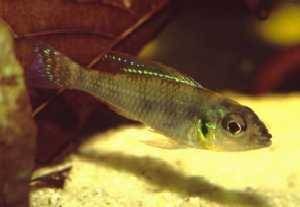
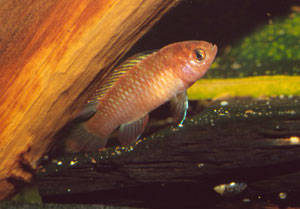
    August 2004: Now available: Lamprologus callipterus ALBINO. After several years, one of our breeder was successful in breeding this species. We have this fish for the first time in stock. You will find here more details soon.(Photo F. Schäfer, Text K. Diehl)

  • Chaetobranchopsis orbicularis

    6. July 2007

    Chaetobranchopsis orbicularis is a plankton eater, which can reach a total length of up to 20cm. This may be one of the reasons, why it is not getting imported too often, as such nutrition specialists are mostly only interesting for specialists and enthusiasts. Yet the care of this species from Brasil is not neccessarily difficult, […]

  • Geophagus sp. „Tananaco“

    Geophagus sp. „Tananaco“

    6. July 2007

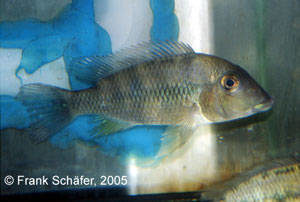
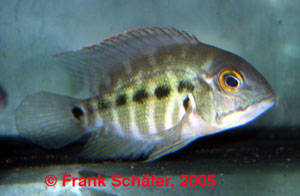
    This very beautiful representative of the surinamensis complex comes from Venezuela. These are very large animals of approximately 25 cm TL. The requirements of keeping, this species is not much different then the other members of its family. A sandy substrate, lots of shady hiding places like bogwood and round eroded stones, are basic requirements, […]

  • Awaous cf. lateristriga

    6. July 2007

    From the coastal ranges of the western Africa between Senegal and Angola originates the freshwater goby Awaous lateristriga. The animal introduced here reminds strongly of this species, whether it is identical to it could yet not be determined. With an overall length of approx. 30 cm Awaous lateristriga belongs to the larger gobys. In their […]

  • Diskus Royal Blue/Rio Moju

    6. July 2007

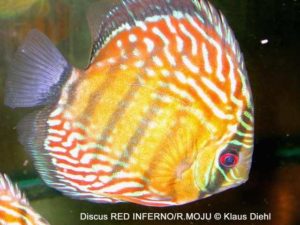
    If an increase of beauty and charisma of the at 01.02.06 introduced Diskus variant Red Inferno/Rio Moju is still possible, then by the Royal Blues originating from the same river. When first seeing these fishes I remembered the headline of an old “aquarien magazin” article. In January 1972 Eduard Schmidt Focke a famous german discus […]

  • Betta falx

    6. July 2007

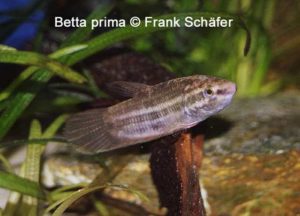
    Betta falx, belonging to the Betta picta form circle, was scientifically described 1998 by Tan and Kottelat. Their origin is the central part of Sumatra, where it occurs in dense overgrown, nearly standing waters. The water conditions at the habitat (pH 5.7, GH 0 – 1, KH 0 – 1) do not have to be […]

  • Sphaerichthys vaillanti

    6. July 2007

    Sphaerichthys vaillanti is probably the rarest and most desired species of the Chocolate Gouramies. Their origin is Kalimantan the indonesian part of Borneo. Since they are black water inhabitants, the water equivalents should be adapted in the aquarium to it. This species does best in peat filtered water. Water must be changed often, and a […]

  • Cichla temensis

    6. July 2007

    Cichla temensis does not represent a fish for everyone. We could import them from Venezuela, where they are estimated fishes for consumption and sold under the name Tucunare. In its natural environment they can reach an overall length of 1 m with a weight of approximately 10 kg. They grow to be the largest of […]

  • Retroculus lapidifer

    Retroculus lapidifer

    6. July 2007

    To take sensibly care of Retroculus lapidifer, which comes from Rio Tocantins/Rio Araguaia catchment area, you should own quariums with a base of 150 x 60cm minimum, as this species can grow very big (25-30cm). But despite its size you should not socialize it with aggressive cichlids, because it has only a certain self-assertion among […]

  • Diskus Semi royal, Rio Moju

    6. July 2007

    Like the introduced before Discus from the same area (Rio Moju) the “Semi Royal” variant shows a strong red coloration at the seam of their body and their fins. With them the wave pattern is nearly continuous distributed over the entire body. (Photo F. Schäfer, Text K. Diehl)

  • Pelvicachromis taeniatus „Lokundje“

    6. July 2007

    From Pelvicachromis taeniatus are numerous variants and local forms existing in the western parts of Africa. One of the most beautiful variants is surely Pelvicachromis taeniatus „Lokundje “(a river in the south of Cameroon). At the moment we can offer very beautiful breds from the same breeder as the already introduced Apistogramma agassizi „Fire Red […]

  • Apistogramma sp. Tefé 1 – Gold

    Apistogramma sp. Tefé 1 – Gold

    6. July 2007

    The first golden animals were found among a bred shoal of young, approx. 14 days old Apistogramma sp. Tefé 1. From them a breeding phylum for further generations of Golden Apistogramma developed. Their growth is plainly slower than the growth of the normal Apistogramma sp. Tefé 1 and their breeding is generally more difficult. Their […]

  • Geophagus altifrons

    Geophagus altifrons

    6. July 2007

    You can surely excellently argue about taste, but the various populations of Geophagus altifrons could justly conquer a solid place among Cichlid lovers. And one of the most beautiful variants might be Geophagus altifrons “Tapajos”. Additionally, G. altifrons is an easy-to-keep cichlid. It requires aquariums with at least 500 ltr. capacity due to its size […]

  • Diskus „Nhamunda rosé”

    Diskus „Nhamunda rosé”

    6. July 2007

    Nhamunda Rosé is the trade name of a strain of the brown discus Symphysodon aequifasciatus axelrodi originated in the Rio Nhamunda (northern influent of Amazon, west the city Alenquer). Now again some Nhamunda Rosé are available. Characteristic for this variety is the partially laminar high red part of the brown primary colour. Thus they are […]