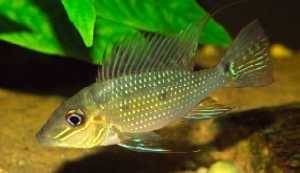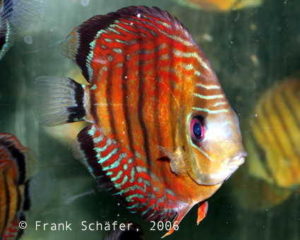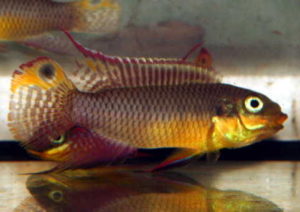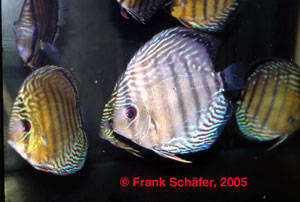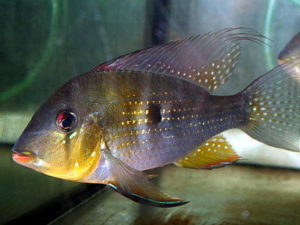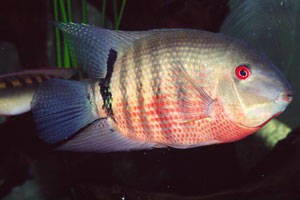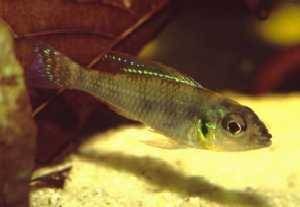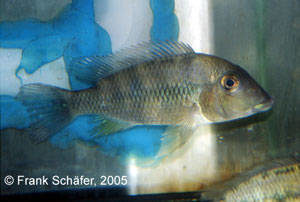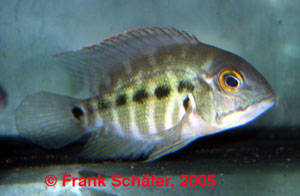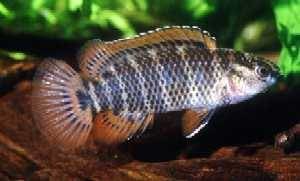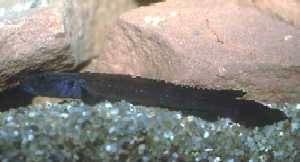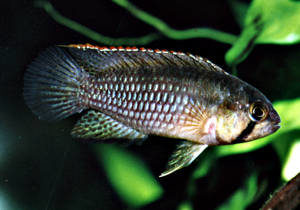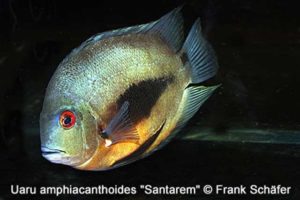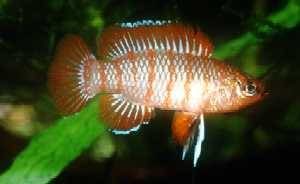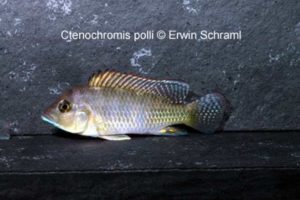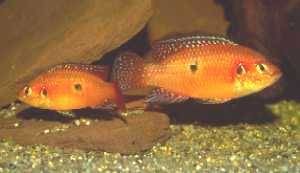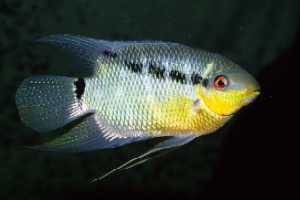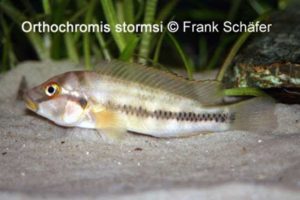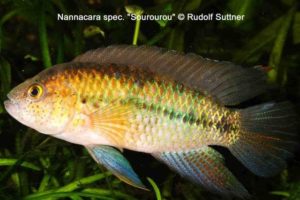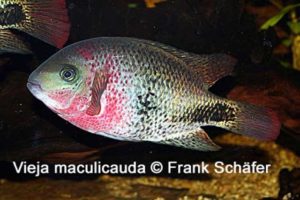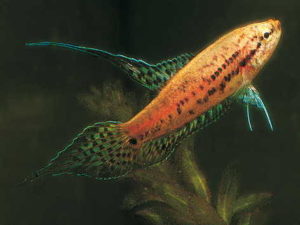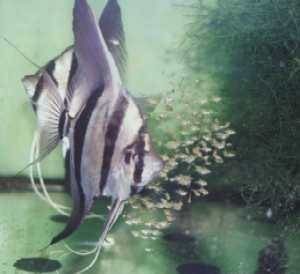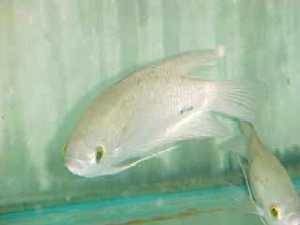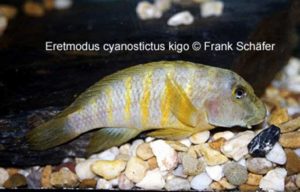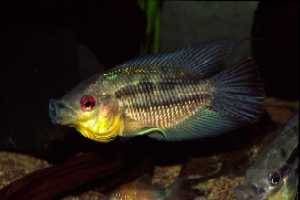

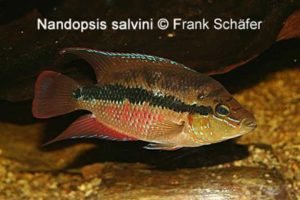
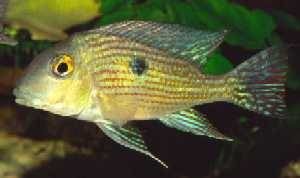
This very beautiful representative of the surinamensis complex comes from Venezuela. These are very large animals of approximately 25 cm TL. The requirements of keeping, this species is not much different then the other members of its family. A sandy substrate, lots of shady hiding places like bogwood and round eroded stones, are basic requirements, […]
25. Perchlike fishes (933)
-
-
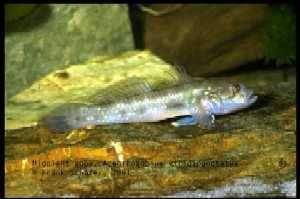
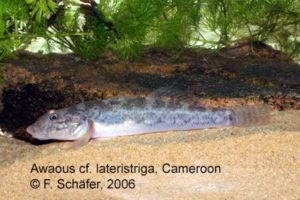
Awaous cf. lateristriga
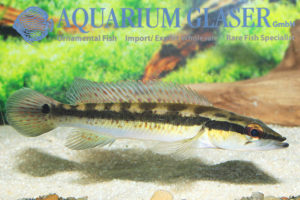
From the coastal ranges of the western Africa between Senegal and Angola originates the freshwater goby Awaous lateristriga. The animal introduced here reminds strongly of this species, whether it is identical to it could yet not be determined. With an overall length of approx. 30 cm Awaous lateristriga belongs to the larger gobys. In their […]
-
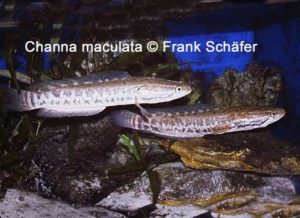
Channa stewartii
This often under the name Channa cf. barca traded Snakehead originates from the Indian province Assam. C stewartii can reach a length of 30 cm and as predators they should kept together only with fishes whose length exhibits at least 2/3 of their body length. Beside living and dead fish they accept food as insects, […]
-
Diskus Royal Blue/Rio Moju
If an increase of beauty and charisma of the at 01.02.06 introduced Diskus variant Red Inferno/Rio Moju is still possible, then by the Royal Blues originating from the same river. When first seeing these fishes I remembered the headline of an old “aquarien magazin” article. In January 1972 Eduard Schmidt Focke a famous german discus […]
-
Lamprologus callipterus ALBINO
August 2004: Now available: Lamprologus callipterus ALBINO. After several years, one of our breeder was successful in breeding this species. We have this fish for the first time in stock. You will find here more details soon.(Photo F. Schäfer, Text K. Diehl)
-
Cichla temensis
Cichla temensis does not represent a fish for everyone. We could import them from Venezuela, where they are estimated fishes for consumption and sold under the name Tucunare. In its natural environment they can reach an overall length of 1 m with a weight of approximately 10 kg. They grow to be the largest of […]
-
Retroculus lapidifer
To take sensibly care of Retroculus lapidifer, which comes from Rio Tocantins/Rio Araguaia catchment area, you should own quariums with a base of 150 x 60cm minimum, as this species can grow very big (25-30cm). But despite its size you should not socialize it with aggressive cichlids, because it has only a certain self-assertion among […]
-
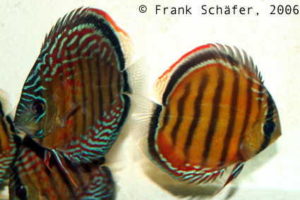
Diskus Semi royal, Rio Moju
Like the introduced before Discus from the same area (Rio Moju) the “Semi Royal” variant shows a strong red coloration at the seam of their body and their fins. With them the wave pattern is nearly continuous distributed over the entire body. (Photo F. Schäfer, Text K. Diehl)
-
Sphaerichthys osphromenoides
Sphaerichthys osphromenoides is the most famous representative of the in southeast Asia indigenous chocolate gouramis. Like other chocolate gouramis Sphaerichthys osphromenoides is a delicate and at least while settling down a sensitive fish. It’s natural biotope are shore areas of small, still and slow-moving black water on the Malayan peninsula. As a typical black water […]
-
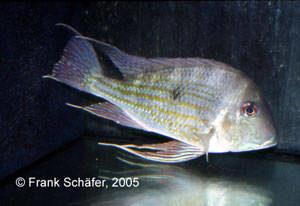
Geophagus altifrons
You can surely excellently argue about taste, but the various populations of Geophagus altifrons could justly conquer a solid place among Cichlid lovers. And one of the most beautiful variants might be Geophagus altifrons “Tapajos”. Additionally, G. altifrons is an easy-to-keep cichlid. It requires aquariums with at least 500 ltr. capacity due to its size […]
-
Diskus „Nhamunda rosé”
Nhamunda Rosé is the trade name of a strain of the brown discus Symphysodon aequifasciatus axelrodi originated in the Rio Nhamunda (northern influent of Amazon, west the city Alenquer). Now again some Nhamunda Rosé are available. Characteristic for this variety is the partially laminar high red part of the brown primary colour. Thus they are […]
-
Micropterus salmoides
Something special for your pond. The Largemouth Bass originates from the eastern part of the United States where they occur from the Canadian border down to Mexico. In the meantime they were spread in numerous countries as game fish and can therefore be found also in Europe. They prefer quiet, well warmed waters without a […]
-
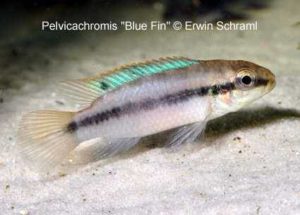
Pelvicachromis taeniatus „Lokundje“
From Pelvicachromis taeniatus are numerous variants and local forms existing in the western parts of Africa. One of the most beautiful variants is surely Pelvicachromis taeniatus „Lokundje “(a river in the south of Cameroon). At the moment we can offer very beautiful breds from the same breeder as the already introduced Apistogramma agassizi „Fire Red […]
-
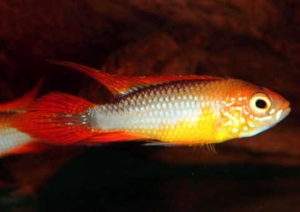
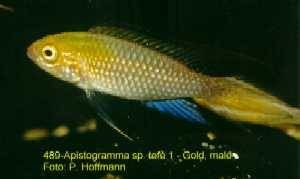
Apistogramma sp. Tefé 1 – Gold
The first golden animals were found among a bred shoal of young, approx. 14 days old Apistogramma sp. Tefé 1. From them a breeding phylum for further generations of Golden Apistogramma developed. Their growth is plainly slower than the growth of the normal Apistogramma sp. Tefé 1 and their breeding is generally more difficult. Their […]
-
Satanopera acuticeps
Normally the durable care of Satanopera acuticeps is only possible in soft and sour pH-value. But as it was finally successful to breed this eartheater inside the aquarium, it could be that the bred ones are easier to keep and even easier to breed. So far the breeding was possible furthermore only in soft (< […]
-
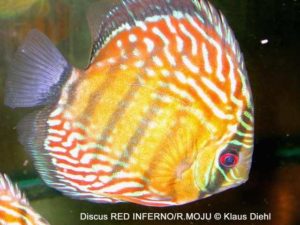
Diskus „Red Inferno/Rio Moju“
In the following pictures you see some impressions from our discus installation. Seldom could we offer a so large selection on magnificently coloured, perfectly acclimatized Discus. The animals originating from different areas are even in our facility hardly to exceed in colour splendour. Since all of them attained full growth, breeders can fast extend their […]
-
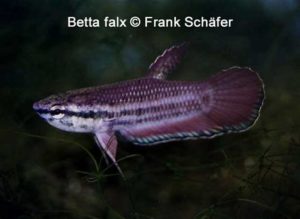
Betta falx
Betta falx, belonging to the Betta picta form circle, was scientifically described 1998 by Tan and Kottelat. Their origin is the central part of Sumatra, where it occurs in dense overgrown, nearly standing waters. The water conditions at the habitat (pH 5.7, GH 0 – 1, KH 0 – 1) do not have to be […]
-
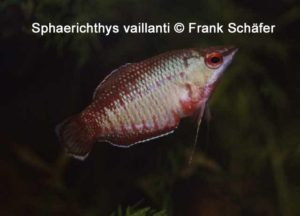
Sphaerichthys vaillanti
Sphaerichthys vaillanti is probably the rarest and most desired species of the Chocolate Gouramies. Their origin is Kalimantan the indonesian part of Borneo. Since they are black water inhabitants, the water equivalents should be adapted in the aquarium to it. This species does best in peat filtered water. Water must be changed often, and a […]
-
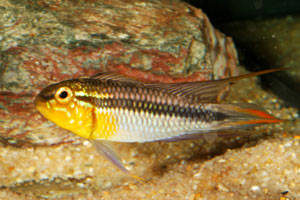
Apistogramma agassizii ,,Abacaxis“
The fish in this picture shows the beautiful A. agassizii colour morph from the Rio Abacaxis, which lies in the middle part of the Amazon River in Brasil. Recently a number of new varieties are introduced to the hobby, originating from breeding as well as import of local colour morphs. We can only hope that […]
-
Diskus „Wild Lago Inanum“
This very beautiful discus fish is traded as well under the name „Semi Royal Blue“. Wild caught discus fish are just beautiful! It is remarkable that still new wild type varieties are found and imported. Wild caught discus fish will not be feeling themselves well if not kept under optimal conditions. This malcontent will be […]
-
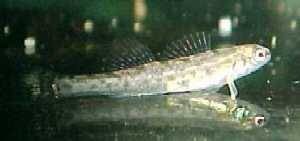
Etheostoma fusiforme
October 2003: This week we received a limited number of Etheosoma fusiforme. These goby-like perches are also called Darters and originates from North America. Darter males inspire during the courtship with beautiful colors. During the summer months this species can be held also in the domestic garden pond. (Photo F. Schäfer, Text K. Diehl)
-
Pseudocrenilabrus philander
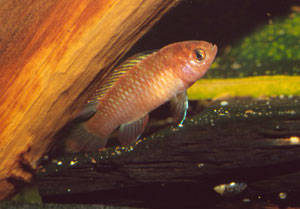
May 2007: From the Congo we received Pseudocrenilabrus philander. The fish originate from the upper parts of the Congo river (Lualaba). Their area of circulation covers nearly the entire southern Africa, where they are to be found in practically all types of waters. As mouthbreeders in the female gender their courtship and broodcare run after […]
-
Acarichthys heckelii
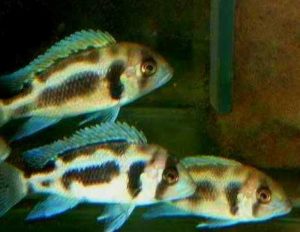
January 2007: At present we can offer particularly beautiful Acarichthys heckelii from the region around Santarem. These fish are characterised by an intensive yellow colouring of the body. It forms a beautiful contrast to the red eyes and their magnificent fin rays. Acarichthys heckelii has a large area of origin along the Amazon and the […]
-
Heros severus
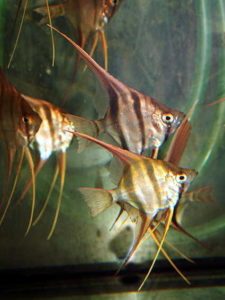
Despite the fact that Heros severus is the type species of the Heros genus, this species is the most uncharacteristic representative of this group. This is mainly caused by its reproducing behaviour, which is mouthbreeding and untypical for Heros, because they are all substrate breeding. Also the coloration is different from the other members of […]
-
Micropercops swinhonis
One of the most beautiful new fish species of 2003 is this goby, which is rather widely spread in China, Korea and Japan. Already in 1873 Günther described it under the name Eleotris swinhonis of Shanghai, China, but it made its way to our tanks only now. It can reach a maximum size of approx. […]
-
Nanochromis sp. „Lezas“
With Nanochromis sp. “Lezas” we can offer a further highlight of German bred fishes. As at the before introduced species this dwarf cichlid is hardly to be exceeded in colour and quality. Particularly noticeable is the strong red colouring of the dorsal – and the upper parts of the caudal fin. In dark, peat-coloured water […]
-
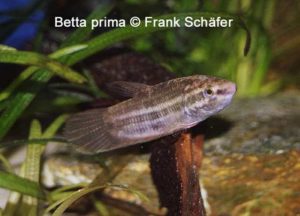
Betta prima
Betta prima originates from South East Thailand and Cambodia and is a member of the Betta pugnax group. They are found foraging along the dense vegetation of brooks, swamps and calm rivers. B. prima is a small species, they can reach the size of about 6 cm. They like well planted, and since they are […]
-
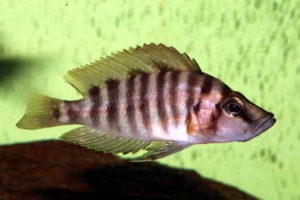
Altolamprologus compressiceps
From the shores of lake Tanganjika orgins (Alto)lamprologus compressiceps. There the about 13 cm long getting fishhunter inhabits the detrital zone, which it roams on search for food. When a prey is seen it approaches in slow motion, near the booty it speeds up and catches the victim. Because of its strong lateral flattening it […]
-
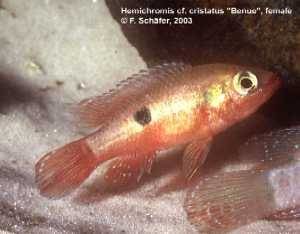
Hemichromis cf. cristatus „Benue“
This beautiful cichlid comes from the Benue-river. At least the females grow up to 5cm, the males reach their maximum size with 7cm. Among themselves they are peaceful and they also can be kept with other fish. But there is a slightly rough behaviour, which is typical for all red cichlids. But much less than […]
-
Biotoecus sp. „Tapajos – New“
For quite a while Aquarium Glaser imports this dwarfcichlid regularly from Rio Tapajos in Brasil. This Cichlids, which only get approx. 4-5cm can be kept in pairs in smaller aquariums from 50 ltr and up already. If the aquarium is bigger, a larger group can be brought in, but in doing so a slightly surplus […]
-
Geophagus crassilabris
Very large animals, up to 20 cm, came to us from Colombia. These beautiful fish came as well from the Rio Chacu. These eartheaters live in nature in a habitat of moderately flowing streams and rivers. Remarkably for this group of eartheaters is the way they breed their eggs, not as normally in the throat […]
-
Hoplarchus psittacus
This, by specialised hobbyists of large South American cichlid, well known species is only very rarely offered to the public. Our animals were imported from Columbia. The best way to take good care of these beautiful cichlids, which can grow up to 40 cm, is to keep them in large fish tanks with plenty of […]
-
Tahuantinsuyoa macantzatza
The unpronounceable from the Incas empire. So an article about Tahuantinsuyoa macantzatza the Inca Stone Fish could be titled. After fearing over years that they had become extinct, we succeeded to import a larger number of them at the beginning of 2003. For the first time we can offer now both: very beautiful wild caught […]
- « Previous Page
- 1
- …
- 8
- 9
- 10