The Rio Orinoco is with more than 2.000 km length one of the biggest rivers of South America. About 3/4 of it´s length it runs through Venezuela, the remaining 1/4 belong to the territory of Colombia. The Brazo Casiquiare connects during high water levels the Orinoco-sytem with the Amazon-sytem via the Rio Negro.
The import season for loricariid catfishes from the Rio Orinoco influence has started now. So we already can offer a good number of different species of that group.
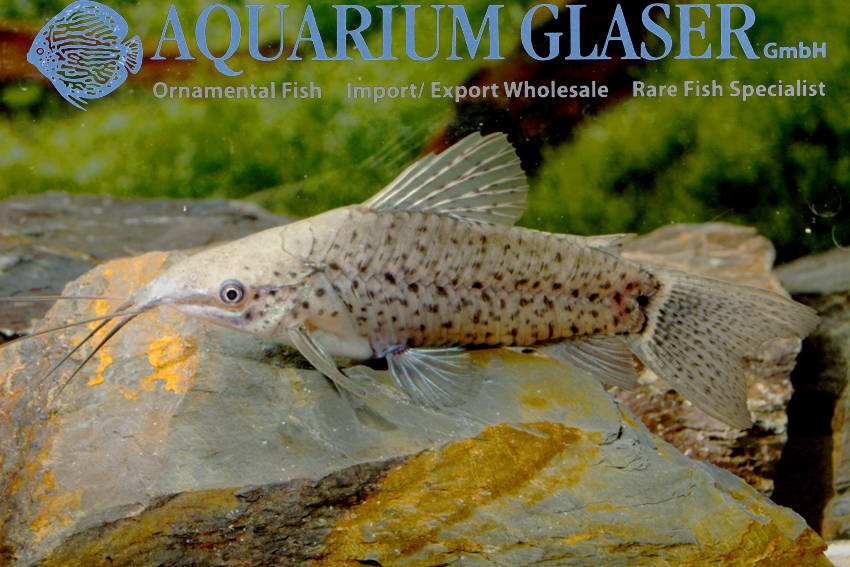
The genus Hypancistrus is formed by relatively small (around 10 cm) mainly carnivorous species. Among the recent imports are Hypancistrus contradens (L201, formerly thought to be a variety of H. inspector) with variing pattern. Some have big spots, others very small ones. Then we have Hypancistrus furunculus L199, a zebra cat with also very individual coloration. This is also true for Hypancistrus debilittera L129, which has a very attractive white wavy pattern on black ground.

Meat eaters are also Leporacanthicus species. Probably the most wanted species is L. triactis (L91). It can reach around 20 cm maximum length.
Very much sought for is also L200. Actually, there are two mimetic species that hide behind that L-number, which are often confused, although they might belong to even different genera. The real L200 is a still undescribed species. It can be easily recognized by the big gap between the end of the dorsal fin and the beginning of the adipose fin. The second species – called L200 Highfin or L200a in the trade – has been formally deescribed already as Baryancistrus demantoides. In this species dorsal and adipose fin are connected. The depth of the dorsal fin is variable and of no use for differentiation of the species. Both L200 are omnivorous with a large compound of vegetarian food.

One should not forget the robust and pretty Peckoltia species. The usually grow up to 8 – 15 cm and so they fit in almost any tank of common size. Now imported are L243 with a very attractive coloration. Peckoltia species feed on aufwuchs like the well-known Ancistrus species do. Like these they need soft wood as a necessary food compoundment.
The „flyer cats” of the genus Pseudolithoxus are funny looking, extremely flat fellows. Especially P. dumus (L244) and P. tigris (L257) are very much sought for. Both won´t grow bigger than 15 cm and can be kept like the former species.
Finally the genus Guyanancistrus should be mentioned which is represented in the actual imports by L106. Depending on the sources it grows to 8-15 cm in length. It is a very attractive species that feeds on aufwuchs.

Of course this short review of the plecos from the Orinoco is far from being complete. One should always keep in mind that fishes from that region like relatively high water temperatures, eg 26-28°C.
Text and Photos: Frank Schäfer












 After the spectacular importation of the new gourami from Manipur (http://www.aquarium-glaser.de/en/colisa-cf-fasciata-_en_1115.html) now we were able to import a beautiful new Panchax from this state in northern India. Currently only one species is accepted formally within this species-group, eg Aplocheilus panchax. This species is distributed from China over great parts of India, Burma, and Indochina (Thailand, Vietnam, Cambodia, Laos), as well as over Indonesia. Of course fish from different origin look very different and so it is more than likely that there do exist a lot of species and not only one. The new Panchax from Manipur also represents such a different form. It is distinguished from typical A. panchax by many red spots on the body, bright orange fins, and a dark band that is shown when the fish feel disturbed.




 The northern states of India are hardly researched in respect of the fishes. From the state of Manipur we currently received exceptionally colorful gouramis of the genus Colisa, which represent a species new to science. They are without doubt close relatives of the species Colisa fasciata, C. bejeus, and C. labiosa, but differ from all of them by the enlarged soft-rayed parts of the dorsal and the anal fin. Especially in males these fins are almost as big as in paradise fish (Macropodus).








 Erromyzon sinensis
 Sinogastromyzon wui
 Crossostoma lacustre
 Homaloptera tweedei
 Gastromyzon punctulatus (G. ctenocephalus?)
 Gastromyzon punctulatus (G. ctenocephalus?)




 There are two species of Black winged dwarf hatchets recognized. These charming little creatures hardly reach 3 cm in length. From Peru we get occasionally Carnegiella schereri with a spotted belly as a so-called by-catch of C. strigata, whereas Carnegiella marthae from Brazil has a lined belly and is now and then available assorted (214003).