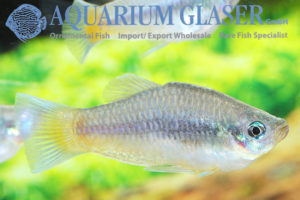
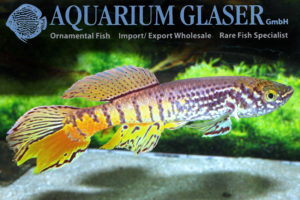
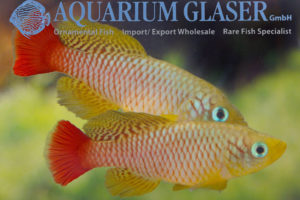
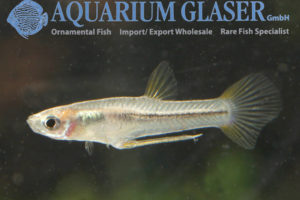
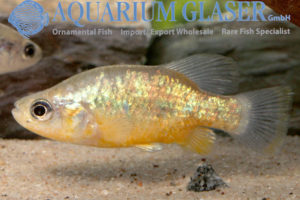
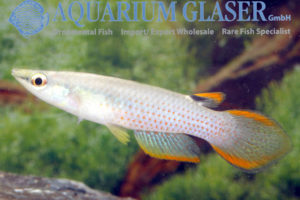
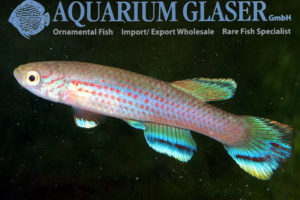
After the spectacular importation of the new gourami from Manipur (http://www.aquarium-glaser.de/en/colisa-cf-fasciata-_en_1115.html) now we were able to import a beautiful new Panchax from this state in northern India. Currently only one species is accepted formally within this species-group, eg Aplocheilus panchax. This species is distributed from China over great parts of India, Burma, and Indochina (Thailand, […]
18. Toothcarps: Killis and Livebearers (317)
-
-
Pseudepiplatys annulatus
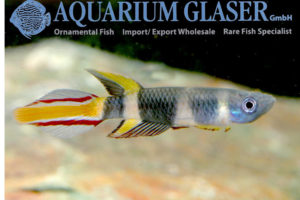
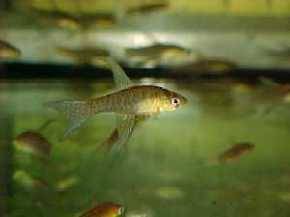
Currently we can offer wonderful bred Pseudepiplatys annulatus. This tiny species originates from West Africa, the fish we have in stock were bred in Southeast Asia. Maximum length of the male is around 3 cm, females stay even smaller. The species is completely peaceful against all other fish and an ideal choice for so called […]
-
Giradinus falcatus
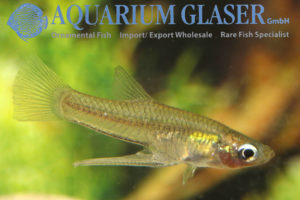
Aquarists usually think of the African killifishes of the genus Aplocheilichthys when they hear the term „lampeye fish“. However, there are also lampeyes among the livebearers! One of them is Giradinus falcatus. The shining eyes of the fish have the same sense as in their African cousins: they are used to keep the school together. […]
-
Ilyodon whitei
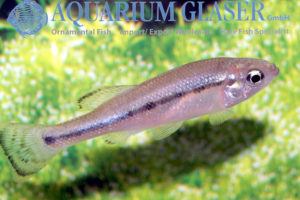
The genus Ilyodon currently comprises 4 or 5 species (the status of I. lennoni is under discussion). Like all livebearing members of the family Goodeidae (splitfins) they are restricted to the highlands of Mexico. Ilyodon whitei lives in the upper tributaries of the Rio Balsas on the Pacific slope of Mexico. The peaceful and elegant […]
-
Xiphophorus hellerii Platin Orange
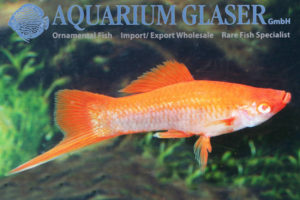
Xiphophorus hellerii Platin Orange: The latest sport in swordtails is this gorgeous variety. In swordtails exists an interesting gentic phenomenon. The gene for „albino“can be combined with body colours, if the body colours derive from a cross with platyfish. A real albino swordtail has red eyes and a whitish body. In the Platin Orange swordtail […]
-
Aphyosemion celiae celiae
Killifishes of the genus Aphyosemion are among the most colorful fishes of the World. They become only a few centimetres long (in the case of Aphyosemion celiae: about 5 cm). Many killifishes are thought to be short living, delicate fish, aggressive towards other fish and difficult to maintain. A. celiae belongs to the species that […]
-
New Guppies available!
From now in limited numbers available: beautiful strains of Guppies! Please note that you will get for all the strains the correct females.
-
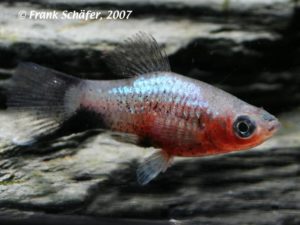
Platy BLEEDING HEART BLUE COMET
(19.Dec.2007) Also this new bred variety arrived here last week. Currently we only have a few pieces in stock, which are males only. The coloration “bleeding heart” – the deep red basic colour, which is only restricted to the below body half – can only appear at males for genetic reasons. The females cannot be […]
-
Micropoecilia picta RED
(15.Jan.2008) FINALLY in good quantities available: MICROPOECILIA PICTA RED. From now we will have this beautiful fish on a regular base in stock. We get it from our breeder by pair. A much better availability is now guaranteed. (Photo & Text R. Neunkirchen)
-
Aplocheilichthys katangae
From the Katanga province of the Congo we recieved Aplocheilichtys katangae. These non seasonal killies have a large distribution area in the central southern Africa. There they inhabit shallow, overgrown brooks and ponds. Their maximum size is approximately 6 cm. They feed on small water insects and crustaceans in tanks they can be fed with […]
-
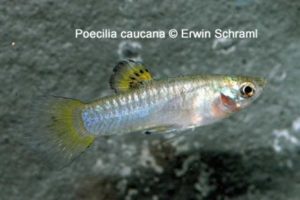
Poecilia caucana
With an overall length of 3 – 5 cm the Cauca Molly (Poecilia caucana), originating from Colombia and Venezuela, belongs to the smaller living-bearers. Remarkably is the yellow – orange coloured dorsal fin and a violet metallically shining longitudinal line. The water equivalents (pH values of 8,2- 8.6, LF 360 and 420 Mikrosiemens/cm), based on […]
-
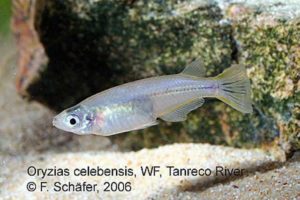
Oryzias celebensis
Oryzias celebensis the Celebes rice fish originates, as the species name indicates, from Indonesia where it inhabits the island Celebes. It lives in standing to slowly flowing waters which are heavily planted. As an approximately 5 cm large becoming schooling fish it needs a free swimming area and retreat possibilities, since rice fish occasionally tend […]
-
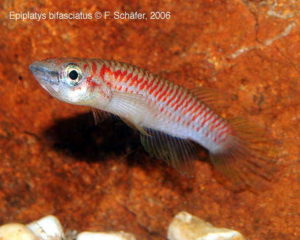
Epiplatys bifasciatus
September 2000: At the moment, we can offer the Epiplatys bifasciatus. These approximately 5-6 cm long growing killifishes come from Guinea in West-Africa. There, they live in small savanna-brooks and swamps. No big aquariums are required for keeping of this fish, they should notbe socialized with active species since they can then become quite shy. […]
-
Terranatos dolichopterus
May 2002: New arrival: german bred Terranatos dolichopterus, sailfin-killi (Aqualog “New World Killis, page 190 log-no: S27715). This fish comes from Venezuela, grows up to 5cm and should be kept in groups. The bottom of the tank should be peat, because they “dive” into the bottom when they spawn. (Photo F. Schäfer, Text K. Diehl)
-
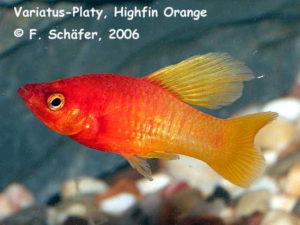
Platy variatus „Highfin Orange“
This Highfin Platy certainly belongs to the most beautiful new breds of the last time. The flowing transition from scarlet to yellow and its enlarged backfin makes it’s attraction. Since it doesn’t differ from other Platys in it’s keeping demands, it will certainly become a gain in der Aquaristik.
Beautiful new varieties of liverbearers arrived

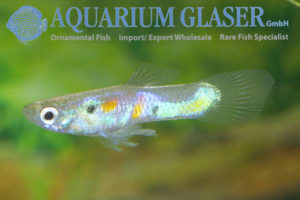
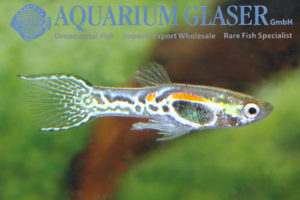
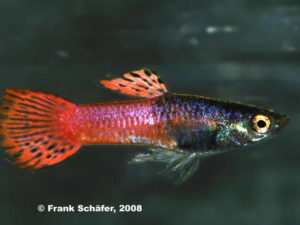
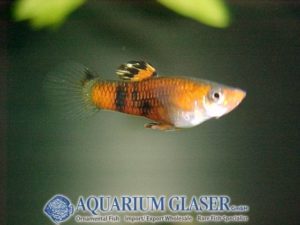
This week we received from specialised breeders in Asia five new, breathtaking varieties of livebearers. One circumstance makes this a little sensation: four of the new varieties belong to the species Micropoecilia parae, which is regarded as almost impossible to keep and breed over generations in aquaria.

Three colour varieties of M. parae display two horizontal stripes over the body. Between these stripes is another, brillantly colored stripe in red, yellow or blue. We offer these varieties assorted. This form has been described scientifically in 1909 as Acanthophacelus melanzonus. Thus the breeder has added the term „melanzonus“ to these three sports. Scientifically speaking A. melanzonus is regarded currently as a synonym of M. parae.

The fourth variety of M. parae has vertical stripes on the flanks, which are red and black. The females of all varieties mentioned exactly look the same.

Last but not least we received a new selection of wild-type guppys which is named „Three Spots“ by the breeder. This ancient guppy type is also a real eyeburner and an ideal fish for any community tank with small and peaceful tankmates.

Micropoecilia and guppy are not closely related and can never be crossed.
Text & photos: Frank Schäfer
Lexicon: Micropoecilia: means „small Poecilia“. Poecilia is another genus of livebearers. parae: means „coming from Para“. Para is a Brazilian state. Melanzonus: means „with black zones“ according to the two horizontal black stripes. Acanthophacelus: means „cluster of needles“; in respect of the microstructure of the male´s sexual organ, the gonopodium. Synonym: Synonyms are different words with identical meanings. If a species is named scientifically twice or more often, the eldest available name is the vaild one. The other name(s) are considered to be synonym(s) without validity.
Austrofundulus guajira german bred
First time in stock in limited quantities: german bred Austrofundulus guajira. A real giant of the killi family: they grow up to 8-9cm. This is really one of the biggest killis of the new world!