
Fish Archive (3130)

  • Ancistrus spec. L 111

    6. July 2007

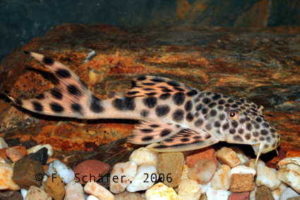
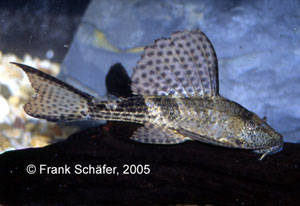
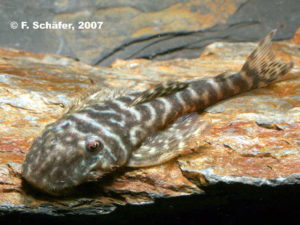
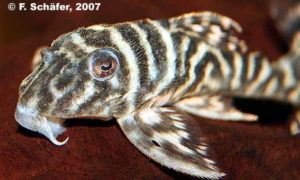
    This ancistrus, which supposedly originates from Colombia, exhibits similarities to L 89, but like L 156 has round spots arranged in a honeycomb pattern. Unlike these other two L-numbers, L 111 has a uniformly marked iris ring and light/dark grey striped pectoral fin spines. This catfish is said to grow to about 10 cm, and […]
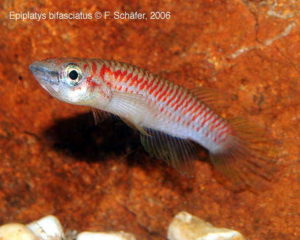
  • Labeo longipinnis

    6. July 2007

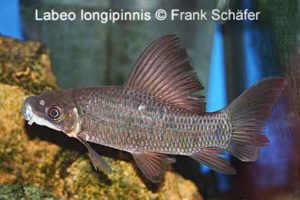
    december 2005: For the first time in Europe we can present Labeo longipinnis from the Congo River to you. This about 30 cm long growing Labeo is not noticeable by a particularly spectacular design or colour. Due to its lively manner, beautiful form and fins it can become nevertheless a genuine “eye-catcher” in the community […]
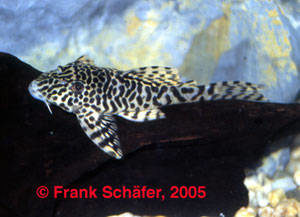
  • Potamorrhaphis guianensis

    Potamorrhaphis guianensis

    6. July 2007

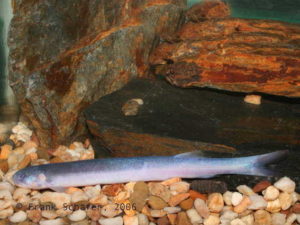
    These fish belonging to needlefish (Belonidae) reach the aquariums of interested hobbyists only very seldom. These robbers, called halfbeak, come from almost all over Amazonia. You can find them also in the Orinoco catchment area as well as in the Guyana countries. These specialized surface fish are only suitable for the the hobbyists with restrictions […]
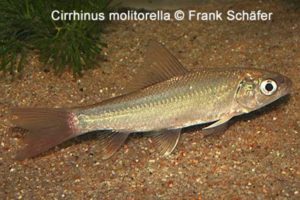
  • Dario hysginon

    Dario hysginon

    6. July 2007

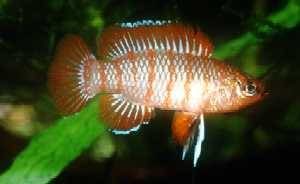
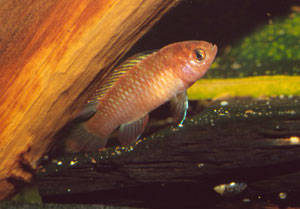
    Compared with Dario dario this species is hardly known by the general aquarists, although the males who obtain and guard their territory are looking very beautiful. Although they do not display the coloration like D. dario, they definitely show the same intense red colour. Unfortenately D. hysginon only shows his full colour when he is […]
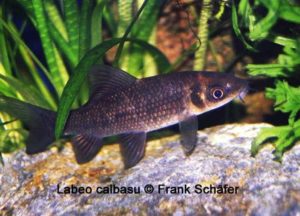
  • Lamprologus callipterus ALBINO

    Lamprologus callipterus ALBINO

    6. July 2007

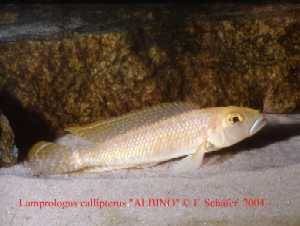
    August 2004: Now available: Lamprologus callipterus ALBINO. After several years, one of our breeder was successful in breeding this species. We have this fish for the first time in stock. You will find here more details soon.(Photo F. Schäfer, Text K. Diehl)

  • Pseudocrenilabrus philander

    6. July 2007

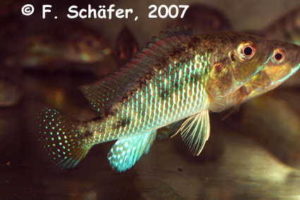
    May 2007: From the Congo we received Pseudocrenilabrus philander. The fish originate from the upper parts of the Congo river (Lualaba). Their area of circulation covers nearly the entire southern Africa, where they are to be found in practically all types of waters. As mouthbreeders in the female gender their courtship and broodcare run after […]

  • Pterophyllum altum

    6. July 2007

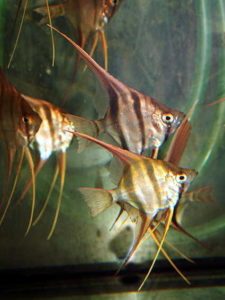
    The new season began, Pterophyllum altum (Orinoco) is available again. Deep Angels can reach 20cm length and up to 35cm in height. This has to be considered with the tank purchase, it should have a height of at least 70cm. A decoration with large bogwood, provides structure and retreat possibilities for them. Since they are […]

  • Aegla platensis

    6. July 2007

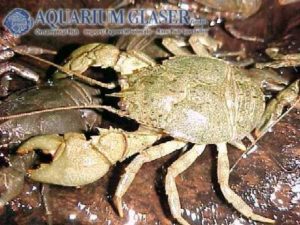
    There are more than 60 species, all of them exclusively inhabitants of freshwater, in the genus Aegla, which belongs to the family Aeglidae. All Aegla species are inhabitants of southern South America. To date they have hardly ever been seen in the aquarium hobby. The specimens recently imported by Aquarium Glaser demonstrate, however, that Aegla […]

  • Coenobita brevimanus

    6. July 2007

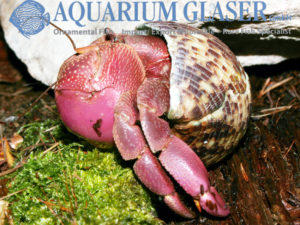
    The hermit crab C. brevimanus origins from coasts of the Indopacific, where it is found from the east coast of Africa to Tahiti. Coenobita brevimanus is the most terrestrial of all land hermit crabs. For the maintenance one needs a terrarium with only shallow water, because they do not like to get wet. Since they […]

  • Macrobrachium idae

    6. July 2007

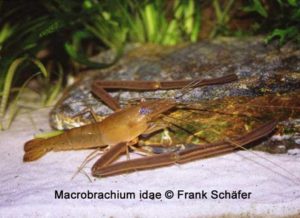
    January 2006: The long arm shrimp Macrobrachium idae reached us from Sri Lanka. Remarkable are their extreme long, name-giving “arms”, which can give the full grown animals an enormous broad reach. With that they are able to track small fish successfully, which naturally limits their use in the community tank. Together with larger fish species […]

  • Corydoras baianinha

    Corydoras baianinha

    6. July 2007

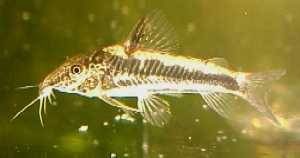
    March 2003: Some weeks ago we received a few pieces of Corydoras baianinha. This extreme rare Corydoras only occurs in a little number of small streams in the south of Brasil. The population of Cordoras baianinha is very much in danger, because its living space was already largely distroyed by environmental pollution and forest clearing! […]

  • Corydoras weitzmani

    Corydoras weitzmani

    6. July 2007

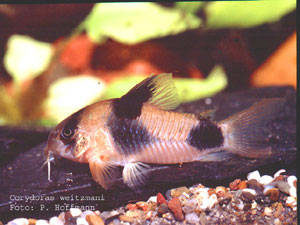
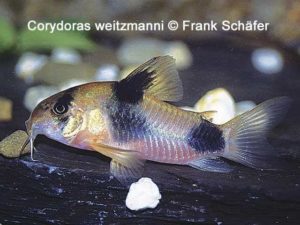
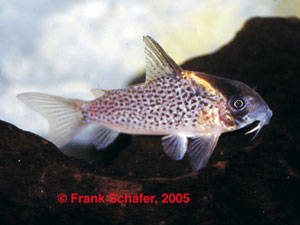
    This is one of the most spectacular representative of the Corydoras genus recently imported. For us this is the ultimate Corydoras. Its closest relative is probably Corydoras panda. The body pattern is similar to the recently described Corydoras tukano. This species was caught by the authors in September 2004 in the riverine system of the […]

  • Characidium spec. V

    6. July 2007

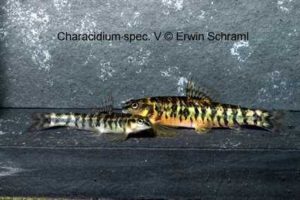
    This prettily drawn representative of the genus Characidium reached us over Rio de Janeiro, its actual occurrence area is unknown. A classification of the more than 50 Characidium species is difficult, for orientation we here adopt the numbering of the Aqualog photo collection. As natural biotope small clear watercourses are to be assumed. The water […]

  • Hyphessobrycon cf. loweae

    Hyphessobrycon cf. loweae

    6. July 2007

    It was illustrated on the homepage of Canadian fish exporter “Below Water” and designated as “Kitty” Tetra (“a new Hemigrammus-species, caught in Mato Grosso in November 2000). It is presented as Hyphessobrycon loweae in the February/March-issue of “Aquaristik Fachmagazin & Aquarium heute”. According to Dr. Géry there are “good correspondences” with Hyphessobrycon loweae (Costa & […]

  • Biotoecus sp. „Tapajos – New“

    Biotoecus sp. „Tapajos – New“

    6. July 2007

    For quite a while Aquarium Glaser imports this dwarfcichlid regularly from Rio Tapajos in Brasil. This Cichlids, which only get approx. 4-5cm can be kept in pairs in smaller aquariums from 50 ltr and up already. If the aquarium is bigger, a larger group can be brought in, but in doing so a slightly surplus […]

  • Ancistrus spec. L 352

    Ancistrus spec. L 352

    6. July 2007

    Our photo shows a pair of Ancistrus spec. L 352, one with 6 – 7 cm very small remaining loricariid from the Rio Iriri. In the view from above the different body forms can easily be be recognized. This and the characteristic beard of the males makes a differentiating of the sexes quite easy. As […]

  • Hypancistrus spec. L 236

    Hypancistrus spec. L 236

    6. July 2007

    „Simply the Best “: Some days ago we could import some of this beauties. With a size of approx. 10cm the white of the here illustrated male shows a fantastic intensity. It seems that one of imported fishes is a not less beautiful female, and so we hope to be able to offer some days […]

  • Scobiancistrus aureatus L 14

    6. July 2007

    December 2006: Last week received we a really impressive, male Scobiancistrus aureatus. With a length of about 30 cm it might be attained full growth. The strong spines on the gill cover (Interopercularodontodes), as well as on their pectoral fins are remarkable. As most L-catfishes from the Rio Xingu they like warmer waters, for their […]

  • Barbus barbus

    6. July 2007

    This endemic species can be found through Europe, from France to the Memel River, in England in the Thames and a few other rivers and in the Danube and its tributaries. During the breeding season the male fish have a cloudy secrete on the head with white nodules. The females are considerable bigger and rounder […]

  • Macrognathus aral

    Macrognathus aral

    6. July 2007

    This spiny eel originates from South East Asia, i.e. Pakistan, India, Sri Lanka, Bangladesh, Nepal up to Myanmar in their most southern distribution area. This fish is dawn and night active and will eat small fish. Therefore it should only be kept with larger tank fellows. In their natural habitat this species can reach a […]

  • Pseudophallus mindii

    6. July 2007

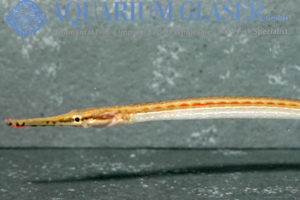
    Pseudophallus mindii is a short snouted pipefish, which reached us as a by-catch in two exemplars. Their distribution contains central and tropical South America, where it is found predominantly in freshwater habitats. Adults were caught from estuaries and mangrove areas too, while planktonic juveniles have been collected well offshore at sea. As other pipefishes and […]

  • Geophagus sp. „Pindare“

    Geophagus sp. „Pindare“

    6. July 2007

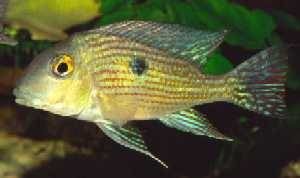
    Among the “Eartheaters”, species Geophagus, G. sp. “Pindare” is one of the most recommendable ones. Growing up to approx. 15cm only, it stays rather small and also shows a beautiful marking with red and blue lines on its flanks. The care of this species is really quite simple, because it does not care about the […]

  • Pterophyllum altum deutsche Nachzucht

    Pterophyllum altum german bred

    6. July 2007

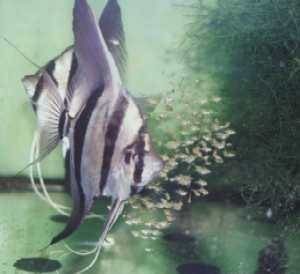
    November 2003: Lately we received German bred Pterophllyum altum. It is worth mentioning that this was a natural brood, eg both parent took care for eggs and the young. Even spawning of the Altum Angel is a remarkeble event. This species tends to get panic attacks when the fish is fully grown. Thus they tend […]

  • Barbus congicus

    6. July 2007

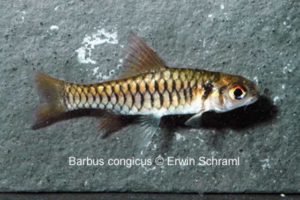
    The Congo Barb is a rarely traded ornamental fish. As you can see by their name Barbus congicus originates from the Congo river in Central Africa. With a length of 7 – 8 cm it belongs to the medium sized barbs and should, according to its vivaciousness, not be maintained in to small aquariums. With […]

  • Oreichthys crenuchoides (=spec. Hifin)

    6. July 2007

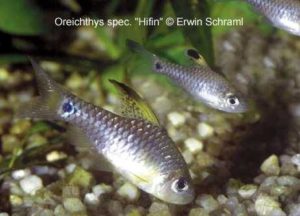
    This barb out of the relationship of Oreichthys cosuatis measures about 5 cm. They originate from northern India. This species is characterised by a pronounced sexual-dimorphism, the males are more larger than females, only them show the magnificent, flag-like increased dorsal fin. The fish tank should be decorated with dense patches of plants on the […]

  • Corydoras weitzmani

    6. July 2007

    February 2006: We are pleased to be able to offer you the first offspring of a legend. Now offspring of the recently again discovered and in the last year for the first time to Germany imported Corydoras weitzmani are available. Fortunately this beautiful small, at Corydoras panda reminding species, could quite fast be spawned by […]

  • Hoplias macrophthalmus

    6. July 2007

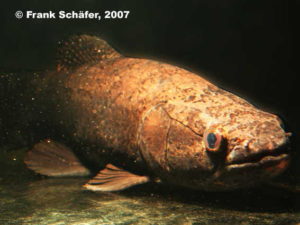
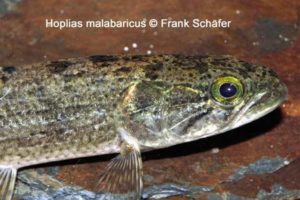
    With Hoplias macrophthalmus we could import from Colombia one of the biggest predatory fishes of the Amazon river system. Contrary to the regular imported Hoplias malabaricus these arrive only extreme rarely in the trade. As an adult with a weight of over 40 kg and a length of more than 120cm they belong to the […]

  • Crossoloricaria cf cephalaspis

    Crossoloricaria cf cephalaspis

    6. July 2007

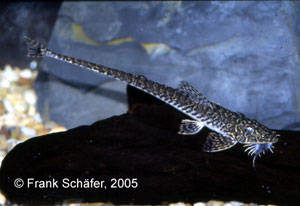
    The 5 species of the genus Crossoloricaria are all looking very similar to the flounder Loricariid genus Pseudohemiodon. These fish have as well a flattened body form, small eyes lying distally on the triangularly formed head. The difference between these two genii is the missing of the ventral bony plates of Crossoloricaria. Only at the […]

  • Loricaria simillima

    6. July 2007

    Loricaria simillima has a very wide distribution in South America. It is found in the Orinoco-, Amazon- and La Plata basins. A result of this large area many different color forms are known, which differ clearly regarding coloration and pattern. The species occurs in different water types. Black water forms are more demanding in maintenance […]

  • Pareiodon cf. microps

    6. July 2007

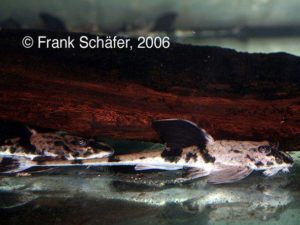
    This pencil catfish, a relative of parasitic the urethra of humans entering catfishes, is very rarely traded. The affiliation to the genus Pareiodon is rather clear, the species classification however is yet not clarifyed. As predators they should not be socialized with to small fishes. Due to their rarity no reports about their maintenance in […]