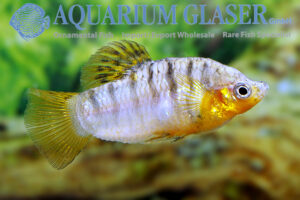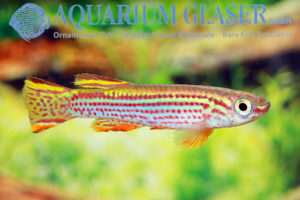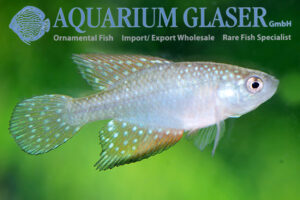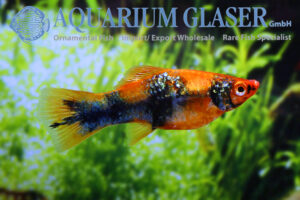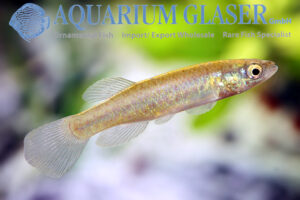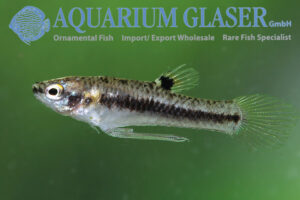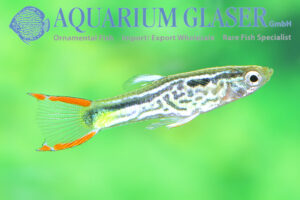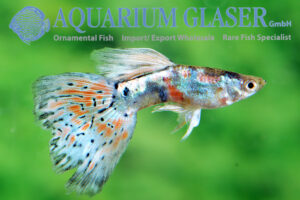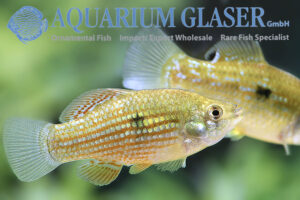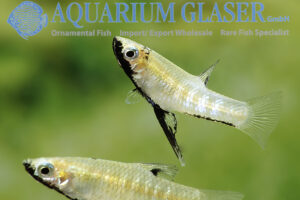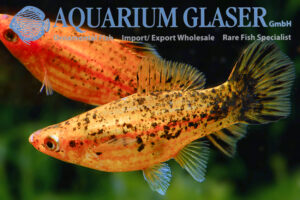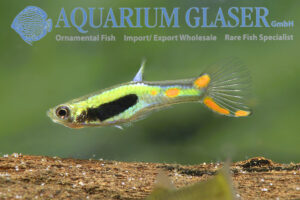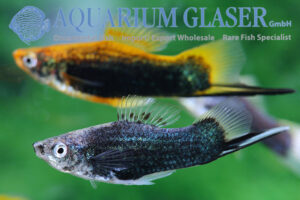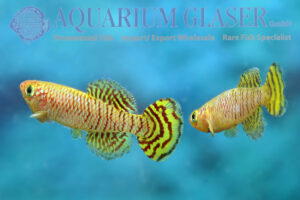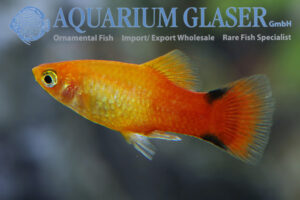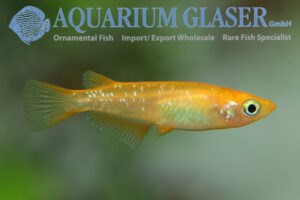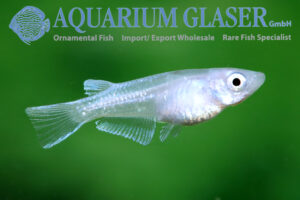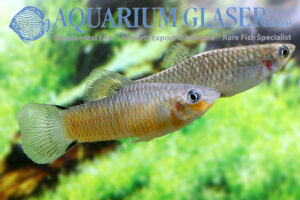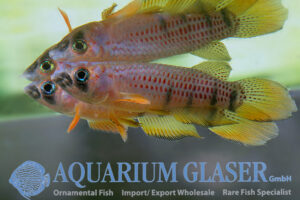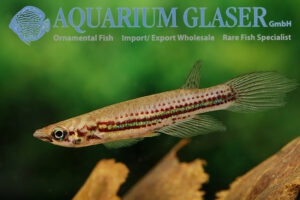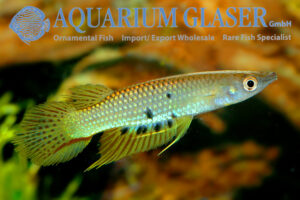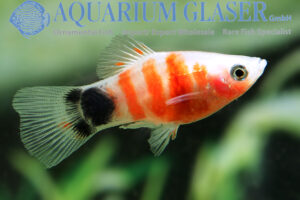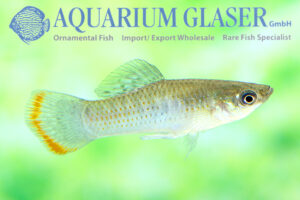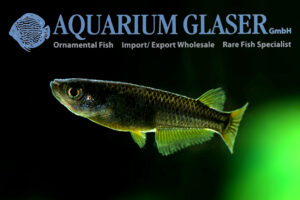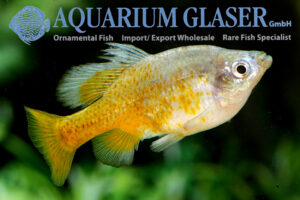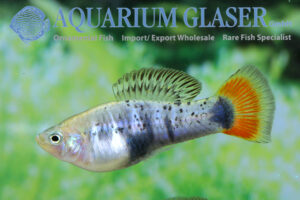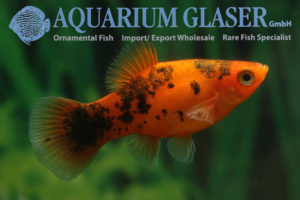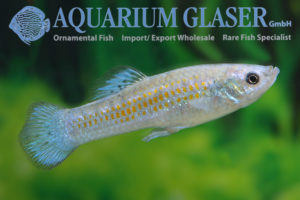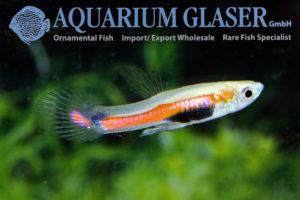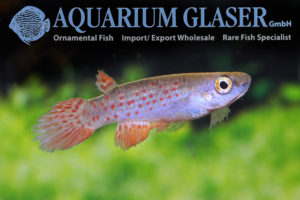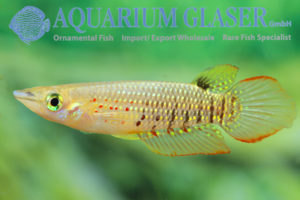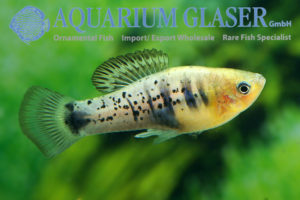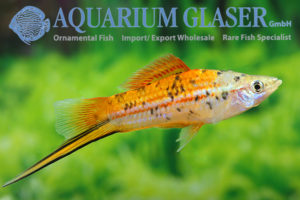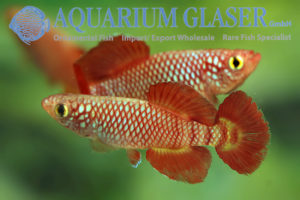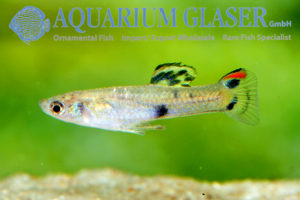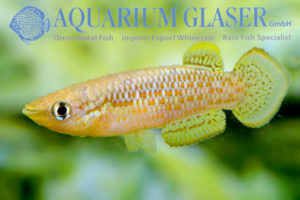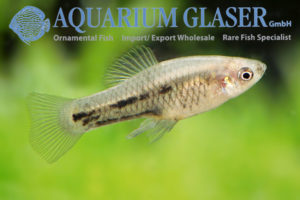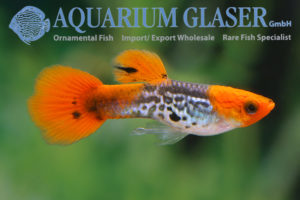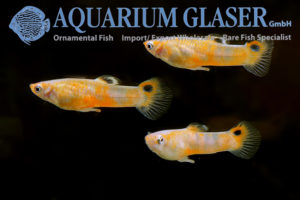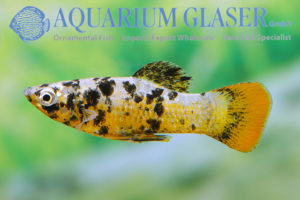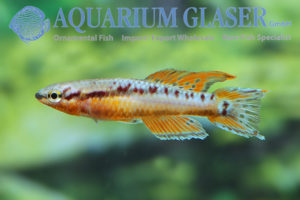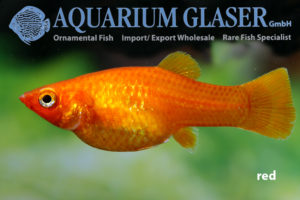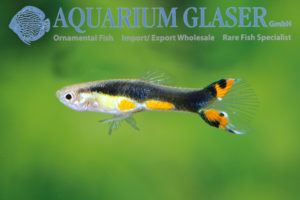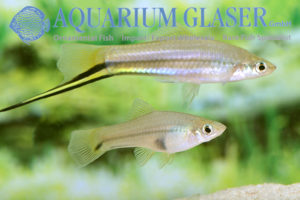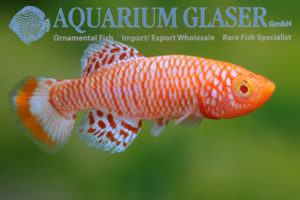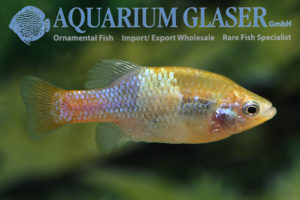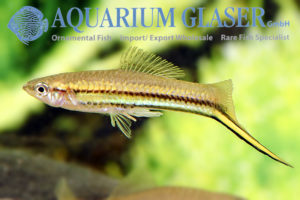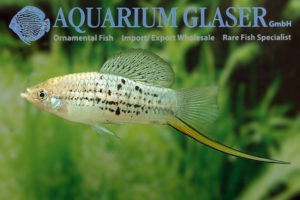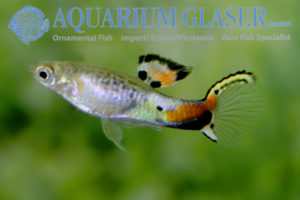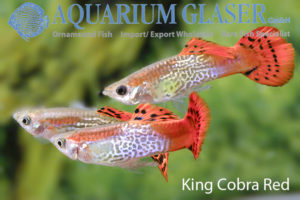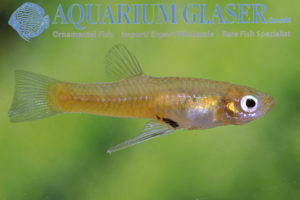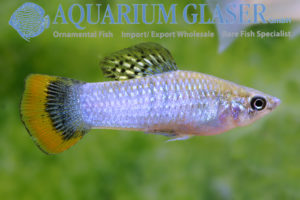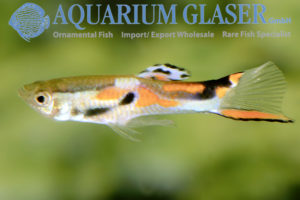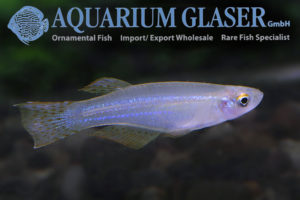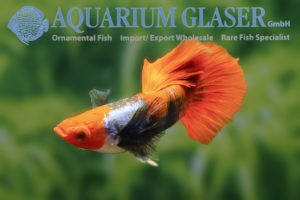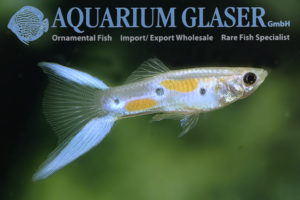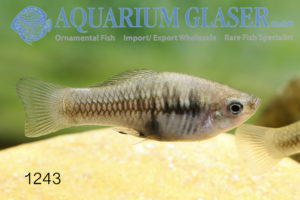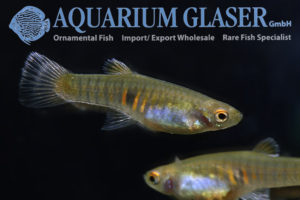

The global loss of biodiversity, i.e., species diversity, is terrible. People who are particularly interested in nature, and this includes aquarists in particular, feel the extinction of species almost as physical pain. Small fish species are among the few organisms that are very well suited for conservation breeding over a very long period of time […]
18. Toothcarps: Killis and Livebearers (308)
-
-
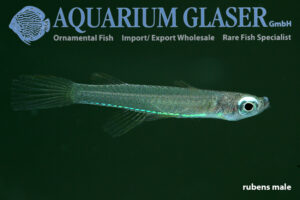
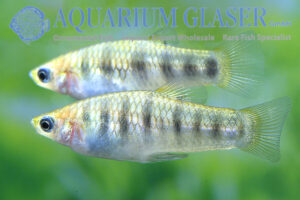
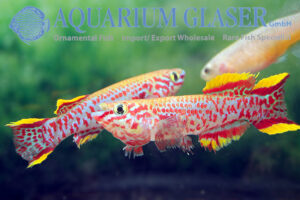
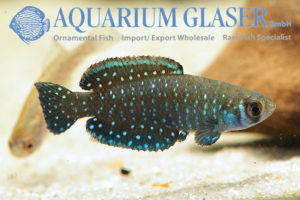
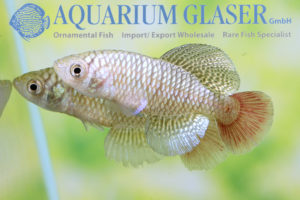
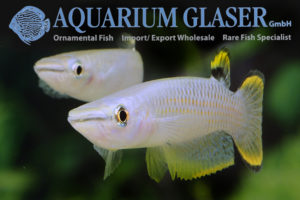
Fluviphylax rubens
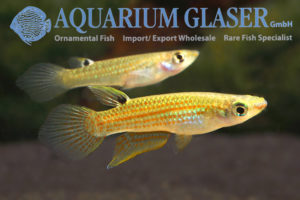
The miniature lampeyes of the genus Fluviphylax are the smallest relatives of killifish. When fully grown, their body length is less than 2 cm standard length (i.e., without the tail fin), usually around 1.5 cm. Until recently, these dwarfs were only known from Brazil, from where we were occasionally able to import them, but that […]
-
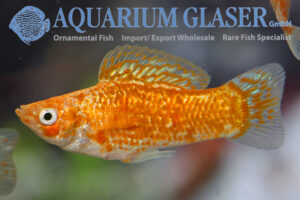
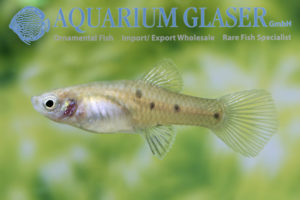
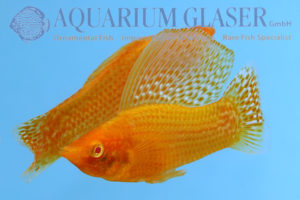
Silver Molly Orange Spots
Whenever one of our suppliers offers a “new variety,” we order a box to see what it is. However, we know from experience that the term “new variety” is often used very flexibly. The spectrum ranges from “old news, but new to our list” to “wow, we’ve never seen anything like this before.” This time […]
-
Heterandria formosa
In old aquarium books, you can still read that the males of the Least Killifish (Heterandria formosa) could claim the title of “smallest fish in the world.” They grow to a maximum length of only about 2 cm, which is significantly smaller than the females, which grow to a length of up to 3.5 cm. […]
-
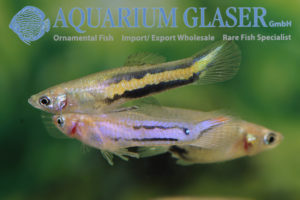
Poecilia wingei Endler Guppy Campoma No 46
It is not without reason that guppys are among the most popular ornamental fish in the world, ranking high in the top ten. The play of colors is almost endless. This applies to the “classic” guppy Poecilia reticulata as well as its slightly smaller cousin P. wingei, the Endler guppy, and the countless hybrids that […]
-
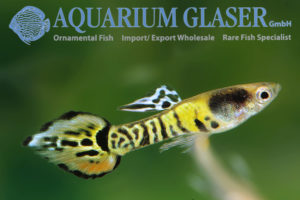
Poecilia reticulata Guppy Tricolor Cobra
The meaning and nonsense of commercial names for guppys is a matter of debate. But there is no doubt that the so-called Guppy Tricolor Cobra is a truly colorful guppy. To some, the term “colorful guppy” may seem like a pleonasm, like “white gray horse” or “cold ice.” Of course, guppys are almost always very […]
-
Jordanella floridae
This killifish from North America is one of the evergreens in the aquarium hobby and has delighted many generations of aquarists. Unfortunately it has become quiet around this attractive animal in the last years. But now beautiful American Flag fish are available again from Southeast Asian breeders. Jordanella floridae grows 4-6 cm long and is […]
-
Girardinus metallicus “Black Belly”
The Metallic Topminnow, Girardinus metallicus, like all Girardinus species (currently 7 species are recognized), originates from Cuba. It is the only species that has been able to establish itself in the hobby. Black-bellied males do not occur in nature, at least nobody has ever found any there; in the hobby, on the other hand, one […]
-
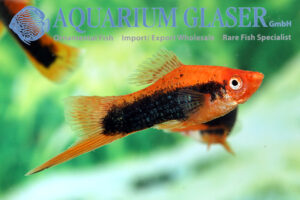
Xiphophorus hellerii “Berlin”
The famous Berlin cross of the swordtail is the result of a gene transfer by hybridisation. Sounds complicated? The Berlin Swordtail is a breed originally produced by crossbreeding species, which was later adapted to the appearance of swordtails by displacement breeding. In red and yellow Platy (Xiphophorus maculatus) strains, black-spotted animals occasionally appear as a […]
-
Guppy Endler Lime Green
We always have a good selection of different Endler types in stock, including both natural and cultivated forms. Especially with the Endler-Guppy the boundaries blur very quickly, because certain colour characteristics can be stabilised by selection. The “Lime Green” is a selection of the “Green” (see https://www.aquariumglaser.de/en/18-toothcarps-killis-and-livebearers/new_endler_sports_en/), but still very variable. For our customers: the […]
-
Xiphophorus hellerii black
The black breeding form of the swordtail Xiphophorus hellerii is also known as the Hamburg breeding form because the aquaristic tradition that is often cited states that it was first bred in Hamburg in 1912 by a breeder named W. Hoffmann. However, it is also undisputed that other black strains were created somewhat later independently […]
-
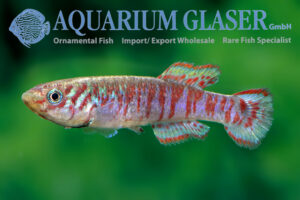
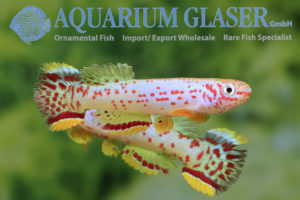
Nothobranchius ruudwildekampi
The genus Nothobranchius is a prime example of how aquarium keeping and science complement each other wonderfully. These killifish are typical seasonal fish; the genus is restricted to East Africa and offshore islands. In the wild, Nothobranchius only live for a few weeks. They produce eggs, which survive the drying out of the rainwater pools […]
-
Limia islai
Lago Miragoane in Haiti is one of the largest natural freshwater lakes in the Caribbean, with a length of 12 km and an area of about 25 km2. In terms of its fish fauna, it is aquaristically exciting. Similar to the cichlids in the great African lakes, the livebearing toothcarps of the genus Limia have […]
-
Xiphophorus hellerii, cave swordtail
Central America is famous for its numerous karst caves. A particularly interesting fauna has often developed in them. Perhaps the best-known cave fish in Mexico is the blind cave tetra (Astyanax jordani or Anoptichthys jordani, see https://www.aquariumglaser.de/en/fisharchive/blind-cave-tetras/). As with many cavefish, its eyes are severely atrophied. However, there are four underground lakes in the home […]
-
Lamprichthys tanganicanus
With a maximum length of 14 cm, the Tanganyika lampeye fish is the largest lampeye fish at all. It is found exclusively (= endemic) in Lake Tanganyika, where it lives in huge schools along rocky coasts. It is a breathtaking sight when such a shoal, comprising several thousand individuals, comes swimming around a cape like […]
-
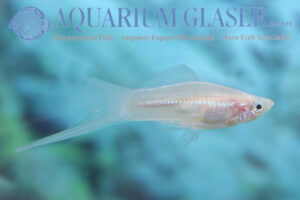
Platy Wagtail Pointed Tail
The “pointed tail” mutation, in which the middle caudal fin rays are elongated, appeared relatively late: the first specimens appeared on the market in the 1980s. It originated in the Southeast Asian large-scale breederies. The characteristic, which first appeared in the Platy (Xiphophorus maculatus), can also be transferred to other Xiphos, but the pointed tail […]
-
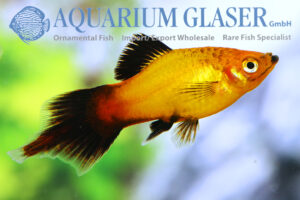
Xiphophorus maculatus Platy Sunset Comet
The breeding forms of Xiphophorus species – almost exclusively the species X. hellerii, X. variatus and X. maculatus are involved – are a never-ending story. What is confusing are the very inconsistent names. In X. maculatus it has actually proved useful to include the caudal root and caudal fin pattern in the name, if it […]
-
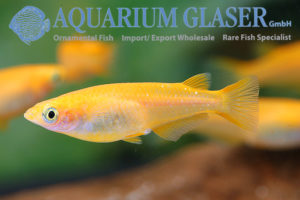
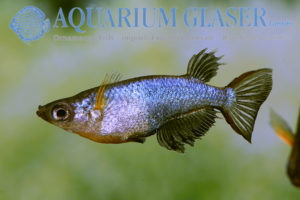
Oryzias latipes “Sparkled Orange”
The popularity of the numerous varieties of medaka (Oryzias latipes) continues unabated. Currently, so-called “sparkled” morphs are increasingly being offered. These are animals with scattered striking silver-white shiny scales. Depending on the basic coloration, “Sparkled” is then offered as orange, grey or blue. Oryzias latipes “Sparkled Orange” is basically the good old gold medaka with […]
-
Oryzias latipes “Sparkled Blue”
The popularity of the numerous varieties of medaka (Oryzias latipes) continues unabated. Currently, so-called “sparkled” morphs are increasingly being offered. These are animals with scattered striking silver-white shiny scales. Depending on the basic coloration, “sparkled” is then offered as orange, grey or even blue. „Blue” is special in that the fish do not have a […]
-
Poecilia vivipara
Only very rarely do we get this pretty livebearer. The species was scientifically described as early as 1801, is the first ever known livebearing toothcarp, is genus type for Poecilia and is said to have a huge distribution area in South America, from Venezuela in the north to the Rio de la Plata in the […]
-
Epiplatys chaperi „Angona“
The panchaxes of the genus Epiplatys are species-rich in tropical Africa. In the most recent scientific overview by Huber (2024), 54 species are recognized. Only two of these species are regularly found in the trade, namely E. annulatus (clown killifish) and E. monroviae (red chinned panchax, this species was previously regarded as a subspecies of […]
-
Epiplatys chevalieri
A killifish jewel reached us from the central Congo: Epiplatys chevalieri. Although this species was introduced into the aquarium hobby as early as 1950 and was even given a popular name (German: Zierhechtling, which means ornamental panchax) at the time, which is by no means common for killifish, it has not become established on a […]
-
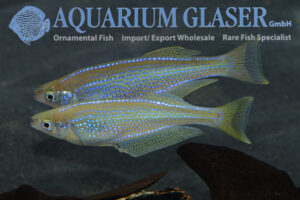
Aplocheilus dayi
The striped panchax (Aplocheilus lineatus, see https://www.aquariumglaser.de/en/18-toothcarps-killis-and-livebearers/aplocheilus-lineatus-wild-2/) from southern India is one of the most popular aquarium fish thanks to its splendid colors, easy care and breedability. It has only one disadvantage: at around 10 cm in length, it does grow quite large. A close relative of the striped panchax from Sri Lanka – the […]
-
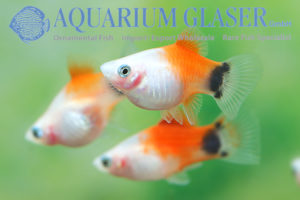
Platy Bleeding Heart Mickey Mouse
Bleeding Hearts are a breeding form of the platy (Xiphophorus maculatus), which was developed in the 1940s by the famous geneticist Myron Gordon. This breeding form is a cross between a wild platy form, namely the “Ruby-throat”, which occurs in the Rio Jamapa (Gordon collected his original strain near Veracruz) and in the Rio Papaloapan […]
-
Fundulopanchax gardneri nigerianus
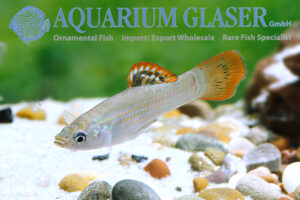
Fundulopanchax gardneri nigerianus is one of the very few species of killifish that are regularly found in the trade. It is highly likely that many of the fish bred today still originate from the old strain from Akure in Nigeria, which was introduced to Denmark in 1957. In 1963 Clausen described Aphyosemion nigerianum scientifically on […]
-
Xiphophorus hellerii Tuxedo Red
When it comes to breeding forms, it’s easy to get into philosophy. This is because breeding forms of ornamental fish are an expression of cultural creativity. They serve only one purpose, namely to please. Accordingly, they reflect the zeitgeist at the time of their creation. Experience with garden plants, which have been cultivated and cared […]
-
Oryzias pectoralis Vietnam
The wild forms of the currently very popular medaka (Oryzias) also appear in the trade from time to time in the wake of imports of the cultivated forms of these animals, whereas they were previously very specialized fish. The genus Oryzias – in addition to the popular Japanese name “medaka”, they are also known as […]
-
Fundulopanchax walkeri (formerly: Aphyosemion w.)
The 6-7 cm long killifish Fundulopanchax walkeri was once very popular and widespread among enthusiasts of this group of fish, although it was not introduced to aquariums until 1952. This beautiful fish originates from Ghana, where it lives in the jungle. Geographically, the occurrence of F. walkeri is remarkable, as it is the only species […]
-
Poecilia salvatoris
The Liberty Molly is an old acquaintance in the aquarium, but until recently it was considered to be a mere variant and synonym of the common Central American shortfin molly (Poecilia sphenops). Only in recent years have efforts been made to shed light on the darkness that makes the systematic classification of these fish so […]
-
Poecilia butleri
The species of the Poecilia sphenops complex – P. butleri, P. mexicana and P. sphenops – are among the most common, most widespread and most diverse livebearing toothcarps in Central America. The diversity of forms both geographically and within each population is enormous. There are almost always large and colorful so-called alpha males and (from […]
-
Platy Blue Butterfly Moon
The first glance into an aquarium with this breeding form of Xiphophorus maculatus may only reveal beautiful blue platies with a large tail root spot (“Moon” or “Mickey Mouse”). But a second look shows that there is more to these fish, especially the males! They are multi-colored. Dominant, optimally colored males of this breeding form […]
-
Poecilia “Chocolate”
Perhaps the most unusual of all Molly breeding forms is Chocolate. This is because it is a dark-colored albino! At first, this sounds like an absolute contradiction in terms, like a “round corner” or the “black mold”. But it’s still true. In the chocolate molly, the red eyes of the albino meet a chocolate-colored body. […]
-
Guppy Multicolor
Who can keep track of the many, many breeding forms of livebearing toothcarps? Aquarists interested in guppy genetics know that there are thousands of possible color and fin combinations in these animals. Many of these (by no means all) can be bred in pure lines, given the appropriate ambition and perseverance. Can you blame the […]
-
Aplocheilus armatus
New times bring new methods, new methods bring new findings. Who knows, perhaps Jack the Ripper would have been caught if the criminal techniques of fingerprint and DNA analysis had been available in 1888 when he committed his murders. Even before Jack the Ripper’s time, the many, many local forms of the common panchax (Aplocheilus […]
-
Dalmatian, Marble and Calico mollies
At least three species of mollies are the source species of the numerous breeding forms of these fish that exist today: Poecilia sphenops, P. latipinna and P. velifera. P. mexicana may also have been involved, but this is unclear as this species was long regarded as a synonym of P. sphenops. The scientific differentiation of […]
-
Oryzias latipes “Medaka Black”
The small rice fish Oryzias latipes was domesticated by humans at an early stage and was one of the very first exotic fish species to arrive in Germany before the turn of the 19th and 20th centuries. It became the pet of geneticists, so to speak – especially in Japan – who conducted and still […]
-
Skiffia francesae
Every year in autumn we receive the “harvest” of the season from our goodeid breeders. Because of the extraordinarily long and mild summer, this year it was the end of October. As is well known, it does these fish extremely good in permanent breeding if they are temporarily maintained and bred under outdoor conditions. However, […]
-
Xiphophorus variatus Rio Coacuilco (2)
About half a year ago we introduced this new variety of the wild form of the variable platyfish (https://www.aquariumglaser.de/en/18-toothcarps-killis-and-livebearers/xiphophorus-variatus-rio-coacuilco-2/). Now we have received the next generation of offspring from our breeder. This time we were lucky and an alpha male already formed with us. The alpha male is the dominant male within the social structure […]
-
Fundulopanchax amieti
Once again we have received Amiet´s Lyretail. Fundulopanchax (formerly: Aphyosemion) amieti is a magnificent, easy to care for and peaceful killifish. Our animals are German offspring. Originally the species comes from tropical Africa, the southwest of Cameroon (Sanaga system). Killifishes are generally considered to be fish for specialists, which live only a short time and […]
-
Limia vittata
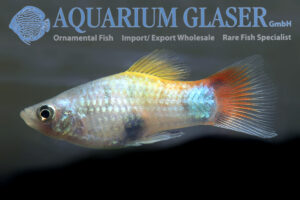
We receive a very charming lifebearer from a breeder from Thailand: Limia vittata. This species, which originally comes from Cuba, has been known aquaristically for a long time: the first import date is 1913. In the hobby, however, the animals are only sporadically available. That is hardly to be understood, because each animal has an […]
-
Poecilia reticulata Guppy Moskow Blue, Green, Black
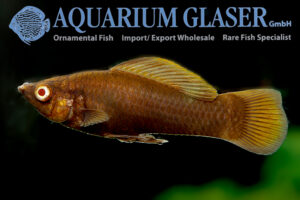
Where do the many Guppys that populate the aquariums of the world actually come from? The answer: they come from breeding farms, where these animals are professionally propagated, just like plants in a nursery. The largest breeding centers are located in tropical Asia (Sri Lanka, Singapore/Malaysia, Indonesia, Thailand, Vietnam) and Israel. Breeding is carried out […]
-
Xiphophorus variatus Highfin Orange
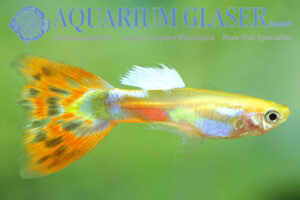
Compared to the breeding varieties of Xiphophorus maculatus, the “common” Platy, there are only comparatively few breeding forms of the Parrot Platy. This is surprising, because this species is very variable by nature, hence the species name “variatus = the variable”. But perhaps this also makes it more complicated to fix color characteristics in a […]
-
Platy red Berlin or Salt & Pepper or Calico
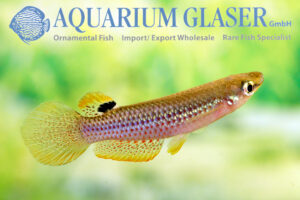
There is truly Babylonian confusion of language among the breeding forms of livebearers. This is unpleasant for everyone involved, but a solution to the problem is not in sight. Bulky descriptions do not look good on the offer lists, not every customer is a specialist and knows the breeder codes, and besides, nobody can tell […]
-
Poecilia chica
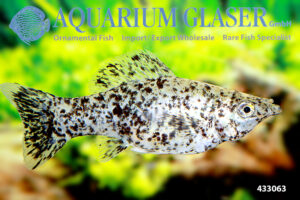
Although this small molly had been known since 1939, and studied in aquariums since 1957, its official scientific naming did not occur until 1975. It is the smallest member of the True Mollies (Mollienesia), which are currently a subgenus to Poecilia, but may regain full generic status in the future. In the wild, the dwarf […]
-
Wild Guppy “Rio Morichal”
The wild guppy from the Rio Morichal in Venezuela is also known as “orange line” among the specialists for wild forms of livebearers. These fish are a very tiny and slender variety of wild guppy, but not an artificial sport. In contrast to other wild populations of the guppy this one is known to be […]
-
Anablepsoides collieri (formerly: Rivulus ornatus)
This tiny fish from Peru is one of the smallest killifishes. The photographed, sexually mature animals are only about 2 cm long including the caudal fin! As maximum length 3.5 cm are given in the literature. Around this small fish jewel there were some ambiguities concerning the scientific naming. At first it was called Rivulus […]
-
Austrolebias nigripinnis
The Blackfin pearlfish (Austrolebias nigripinnis, formerly Cynolebias n.) is a true classic among killifish. Since its first importation in 1908, this small natural wonder has delighted fish lovers. It is only a maximum of 4.5 cm long (females remain smaller) a typical seasonal fish, which lives in nature only a few weeks. It uses this […]
-
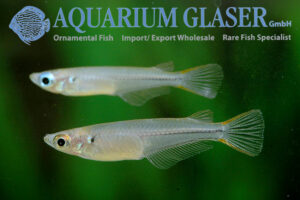
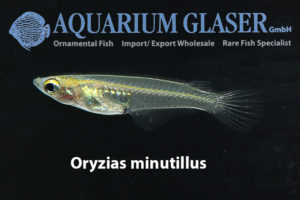
Oryzias minutillus
There are three tiny Oryzias species in the Mekong River basin of Thailand, Laos and Cambodia, which only grow to about 16 mm in length when fully grown in the wild; animals kept in aquariums can grow somewhat larger because they live much longer here (2-5x as long, i.e. 2-3 years). These are Oryzias minutillus, […]
-
Xiphophorus maculatus Platy Mickey Mouse White Red Tail
A long name for a small fish, but this extremely pretty platy is surely worth to break your tongue for. The base coloration is snow white, the fins are transparent, the eye (the iris) sky blue. The famous “Mickey Mouse” pattern is emblazoned on the caudal peduncle, which is called “moon complete” in the breeder’s […]
-
Oryzias latipes “PINK”
The rice fish of Japan are also called medaka and enjoy a great popularity. They belong to the first foreign ornamental fish ever, which came to Europe. Already in 1887 the first “golden panchax” were imported to Germany. But one cared for the fish at first wrongly. One wanted to do the exotics something good […]
-
Aplocheilus lineatus Wild
The striped panchax (Aplocheilus lineatus) is the largest of the Aplocheilus species. It reaches a length of up to 10 cm in the aquarium. In nature, such capital specimens are hardly ever found, because wild fish do not grow old enough for this. Accordingly, sexual maturity begins at about 5 cm in length. Since 1909 […]
-
Xiphophorus variatus Rio Coacuilco
Again we can offer the friends of livebearers a special treat: Xiphophorus variatus Rio Coacuilco is a wild form of the variable platyfish that has only recently become available in the hobby. The Rio Coacuilco (unfortunately we originally made a typo when adding the species to our stock list, the spelling of the river used […]
-
Xiphophorus hellerii “Rio Atoyac”
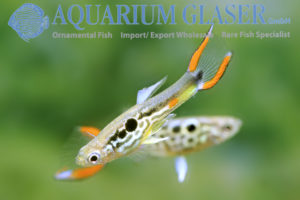
In 1896 Jordan and Evermann described a spotted swordtail form from the Rio Chisoy in honour of Günther from the British Museum as a separate species, Xiphophorus guntheri (sic!); they knew that there occur also unspotted green swordtails of the species X. hellerii. Over 60 years later, in his revision of the genus Xiphophorus, Rosen […]
-
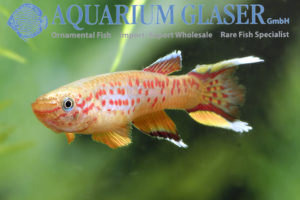
Nothobranchius korthausae
The small island of Mafia is located off the coast of Tanzania. It is the southernmost island of the so-called Zanzibar archipelago and has an area of about 435 km2. In 1972 Edith Korthaus, editor of the magazine “Das Aquarium”, visited the island. She found there a yellow Nothobranchius, which one year later – in […]
-
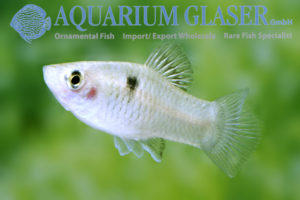
Micropoecilia picta “Trinidad“
From the only very rarely offered species Micropoecilia picta we can offer besides the attractive orange-red variant from Surinam (https://www.aquariumglaser.de/en/fish-archives/micropoecilia-picta-red-surinam-2/) also a second locality variant, namely from the island Trinidad. Perhaps this form may seem less attractive than the red cousins at first sight. But these little jack-of-all-trades more than make up for it with […]
-
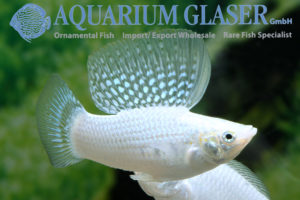
Pachypanchax playfairii
The Seychelles archipelago off East Africa in the Indian Ocean is known mainly for the giant tortoises that live there. There are hardly any freshwater fish in the Seychelles, most of the freshwater species were brought there by man as food fish. The vast majority of the rest – apart from a few gobies – […]
-
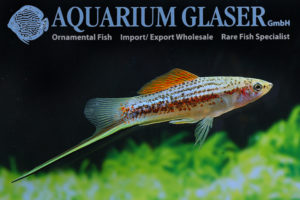
Xiphophorus meyeri (update)
The Marble Platy (Xiphophorus meyeri) is one of the rarest species on earth. It was known only from a small area in Mexico, where it was found only in very few places. The species is already considered extinct in the wild. As with its close relative, the Monterrey Platy (X. couchianus), it was the increasing […]
-
Poecilia reticulata Guppy Galaxy Koi
A splendid new breed from Sri Lanka are the Guppy Galaxy Koi, in whose males the hereditary red head and tail markings have been combined with the body color of a Snakeskin. They are beautiful, very vital animals! For our customers: the animals have code 418563 on our stocklist. Please note that we only supply […]
-
Micropoecilia picta Red Surinam
At first sight the Micropoecilia species resemble the Guppy; however, they are not closely related. Nevertheless Micropoecila picta is often called “swamp guppy” in Surinam, because the species is not only very common in general, but also very common in swampy habitats. Now one could think, the care of such fish of slightly disreputable origin […]
-
Poecilia (Mollienesia) sphenops Marble Ancient
The livebearers are the backbone of aquaristics. The hobby would be unimaginable without Guppy, Platy, Molly and Co. We notice two trends in the breeding of these fish: one deals with the wild forms, which were very rare or not available at all in the trade; and the other develops new, colorful breeding forms, but […]
-
Aphyosemion (Chromaphyosemion) bivittatum “Funge”.
The Funge is a river or, rather, estuary in southeastern Cameroon in the district of Ndian. The Funge is less than 40 km long and is part of a system of coastal marshlands whose best known outlet is the Rio del Rey. This in turn is in contact with the Cross River drainage, which forms […]
-
Poecilia (Mollienesia) sphenops RED
The breeders in Southeast Asia have realized a new color variation of the good old Black Molly, which they call “Red”. This is not a solid red fish, like for example a red swordtail, but the breeding form “Red” of the Molly has red spots in different intensity on the scales. When viewed from above, […]
-
Guppy Endler “Smoky Mary“
Breeders can’t get enough of creating new color combinations in Endler guppies. The latest thing is the “Smoky Mary”, an Endler in which the entire back appears covered in smoke, which intesivates to a deep black during courtship. Even though we don’t know the breeding way: the females of Smoky Mary are normally light colored, […]
-
Xiphophorus signum
This species of swordtail is only very rarely offered in the trade. At the first glimpse one may think that they are a variety of the common swortail X. hellerii, but the species X. signum is much more slender. The mark that is responsible for the scientific name (latin signum = sign) is always good […]
-
Nothobranchius rachovii ALBINO
Rachows Nothobranch (named in honor of Arthur Rachow, therefore in the common name with “w” at the end) belongs not only to the longest serving, but also to the timelessly most beautiful Killifishes in the aquarium. The orange color form of Beira is the most common in the trade, and has been continuously maintained in […]
-
Xenotoca doadrioi
In the past, this particularly pretty goodeid (Xenotoca doadrioi) was known as “Xentotoca eiseni San Marcos”. Unfortunately, the species, which was only “officially” described as a distinct species in 2016, is highly endangered. More than 50% of the originally known populations have already disappeared, with the rest showing a steady downward trend. The causes are […]
-
Nothobranchius patrizii
The nothobranchs (Nothobranchius) represents with N. furzeri one of the shortest-lived vertebrates of the world. Only the marine goby Eviota sigillata tops it, with it (in nature) never an animal became older than 59 days. In the case of N. furzeri, the time between hatching from the egg and death from old age is also […]
-
Oryzias woworae
The Blue Daisy (Oryzias woworae) is known by almost every aquarist child and we have this beautiful and easy to care fish regularly in our offer. Our current stock, offspring from Indonesia, consists of particularly large animals, which color themselves splendidly almost black in the courtship display. Apparently one has successfully crossed the attractive “Black” […]
-
Phallichthys quadripunctatus
Unfortunately only very rarely we can offer this cute dwarf livebearer from Costa Rica. The males grow to a length of about 1.5 cm, the females to a maximum of twice this size. The species name “quadrimaculatus” refers to the typically four spots these fish have on their flanks. However, many variations also occur in […]
-
Fundulopanchax scheeli
Within the genus Fundulopanchax, which was established already in 1924, but then was seen as a synonym to Aphyosemion for a very long time, there are very large species, like F. sjostedti, which can reach 12 cm (see https://www.aquariumglaser.de/en/fish-archives/fundulopanchax_sjostedti_usa_blue_en/), but also many small species, which do not grow longer than 6 cm. Among the latter […]
-
Aplocheilus panchax
Because of the still bad flight connections imports from India come in only sporadically. Now once again an import worked out. It contained among others the common panchax, Aplocheilus panchax. A. panchax is the most common fish in large parts of India and can be found literally everywhere, from the smallest puddle to the shores […]
-
Guppy Endler “Bengal Tiger”
The tiger breeding forms of the Endler guppy enjoy special popularity. There are multicolour, blue and also selected for yellow body color strains. The latter is called “Bengal Tiger”. The manifestation of pure yellow animals is not easy, there is a tendency to revert to a gray-blue base coloration. But these are also very pretty […]
-
Poecilia velifera Blood Red
The golden albino breeding form of the sailfin molly (Poecilia velifera) was created in the early 1980s. At that time it was celebrated as a sensation. Nowadays it is one of the most popular breeding forms of this molly. Particularly color-intensive golden sailfin mollies are called “Blood Red”. These animals are currently brought to the […]
-
Micropoecilia parae German Bred
Micropoecilia parae belongs to the very few fish species, whose breeding in the aquarium over numerous generations has not succeeded so far. Basically the reproduction of the viviparous fish is not difficult, but from generation to generation the animals become smaller and smaller, until finally no further breeding is possible, because the fish die before […]
-
Xiphophorus hellerii “Jalapa”
When you first see this slender, splendidly colored swordtail wild form, you involuntarily think: this is no X. hellerii! And yet, when X. hellerii was first described in 1848, exactly such animals became the type specimens. The traveler of the royal imperial horticultural society Karl Heller discovered and collected the animals in clear streams of […]
-
Xiphophorus nezahualcoyotl
We have just obtained very attractive offspring of the “Northern Mountain Swordtail”. The fish are young adults, i.e. the sword of the males is still relatively short. For comparison we show here also an adult pair of another strain. In former times X. nezahualcoyotl was considered as a local variant of X. montezumae. The name […]
-
Poecilia wingei Campoma No31 Snake Blue
Infinite is the variety of colors, patterns and color combinations possible in wild guppys. In natural biotopes no two males are alike. There are multiple mechanisms, genetic and biological, that ensure this. This is also true for the two wild guppy populations assigned to the species Poecilia wingei: Campoma and Cuminá. However, if individual males […]
-
Filigran Guppys – King Cobra Guppys
The Filigran Guppys belong to the most popular Guppy forms. They have a body pattern of squiggles and dots, which is also called “Snakeskin” or King Cobra. This body pattern sometimes appears in wild Guppys, but it was not until the 1950s that it received more attention and was genetically characterized by M. Dzwillo in […]
-
Girardinus uninotatus
From the currently seven accepted species of the genus Giradinus only G. metallicus and occasionally G. falcatus are offered in the trade. We have now received a small number of G. uninotatus from a breeder. They are really no color miracle, but their pretty apricot color is quite interesting. The species oirginates from Cuba. The […]
-
Poecilia mexicana “Campeche”
The wild mollies are – from a zoological-systematic point of view – certainly one of the most difficult fish groups at all. Not without reason, science has been wavering between two extreme views for over 100 years: the first states that all wild mollies belong to only one, highly variable species, which would then be […]
-
Guppy Endler
No fish species is as changeable as the Guppy. There are no two males in nature that are exactly alike in color. This is true for all four Guppy species (Poecilia reticilata, P. wingei, P. obscura and P. kempkesi), which therefore cannot really be distinguished from each other externally (genetically, however, they can). In the […]
-
Procatopus aberrans
Again we could import the lampeye fish Procatopus aberrans from NIgeria; unfortunately we do not know the location where they were collected. However, we know that our supplier occasionally receives fish from Cameroon. Anyway, the current imports are a bit more graceful in body structure and the upper half of the iris lacks the red […]
-
Guppy Japan Blue and Japan Red
There is a number of tail fin shapes of the guppy, which have been standardized by the guppy breeders. As a rule, however, these breeds are only found at private breeders. In the pet trade the triangle guppies dominate in such a way that aquarists, who do not inform themselves specifically about guppies, could get […]
-
Xiphophorus signum
This species of swordtail is only very rarely offered in the trade. At the first glimpse one may think that they are a variety of the common swortail X. hellerii, but the species X. signum is much more slender. The mark that is responsible for the scientific name (latin signum = sign) is always good […]
-
Poecilia wingei Blue Star
Poecilia wingei is widely distributed in the hobby after its best known local variant as Endler´s Guppy. It remains much smaller than the normal Guppy and is very popular with many aquarists because of its graceful body shape. Just as with the common Guppy, numerous local forms can be observed with P. wingei. The ancestor […]
-
Platy Wagtail Pointed Tail
The “pointed tail” mutation, in which the middle caudal fin rays are elongated, appeared relatively late: the first specimens appeared on the market in the 1980s. It originated in the Southeast Asian large-scale breederies. The characteristic, which first appeared in the Platy (Xiphophorus maculatus), can also be transferred to other Xiphos, but the pointed tail […]
-
Guppy Kohaku Koi Tuxedo
Guppy breeders are currently very active again and bring new, attractive strains on the market. The Guppy Kohaku Koi Tuxedo combines two special characteristics: The Kohaku factor, which causes males and females to have a red head combined with a red caudal fin and red dorsum; and the Elephant Ear factor, which causes the greatly […]
-
Guppy Neon Green Lyretail
Aquaristics is unimaginable without the multitude of colorful livebearer breeding forms. However, this also means that there is competition between the different breeding lines for the buyers’ favor. A good name clearly sells. And even if, strictly speaking, the Neon Green Lyretail is neither neon green in color nor has a lyre tail – who […]
-
Xiphophorius variatus “Hotel Taninul” and “Code 1243”
We have already introduced several wild strains of Xiphophorus variatus, which rightly bears its scientific species name (variatus = variable). Now we have again two new variants on offer, both are German bred ones, descended from wild populations. The first is a pretty speckled fish discovered and brought back on a scientific collecting trip in […]
-
Neoheterandria elegans
Finally we have the dwarfish Neoheterandria elegans in our stock again. They originate from German breeding. These are among the smallest livebearing toothcarps regularly kept in the aquarium. Males grow to about 1-2 cm long, females up to 3 cm, but usually around 2 cm. The Teddy Livebearer, as it is called to distinguish it […]
-
Poecilia wingei Endler Campona No48 black green snakeskin
If there is one fashionable fish that has defined the last decade, it is the Endler guppy, Poecilia wingei. This small guppy species has countless fans all over the world and efforts are made to preserve the “pure” strains of wild caught variants. However, in the wild these wild variants are by no means uniformly […]
-
Aphyosemion australe
The “Cape Lopez” (Aphyosemion australe) is one of the longest serving killifishes. It was discovered due to aquarium imports from Gabon (Ogooué River estuary, Port-Gentil, Cape Lopez, northwestern Gabon), from where it was first brought in 1913. In 1921 Arthur Rachow described it as a new species, then cautiously as Haplochilus calliurus var. australis. The […]
-
Xiphophorus maculatus “Tabasco”
Hearing the name Tabasco, the first thing that comes to mind for a Central European is the spicy chili sauce. However, the Platy (Xiphophorus maculatus) that bears this name is neither particularly fiery nor particularly red – it merely originates, like the chili sauce, from the Mexican state of Tabasco, where this population was first […]
-
Poecilia velifera Silver
Silver mollies are among the most popular livebearers. Most of the silver mollies in the trade are a breeding form of Poecilia latipinna. Since the species Poecilia latipinna, P. sphenops, P. mexicana and P. velifera can be crossed and color characteristics and certain fin shapes (e.g. lyratail) are transferred to the hybrid young, the desired […]
-
Xiphophorus hellerii “Yucatan 2”
From a German breeder we received this extraordinarily attractive wild form of the swordtail. Unfortunately we could not find out where exactly and by whom these animals were collected. It could only be determined that they were originally brought from Yucatan (Mexico). As a distinction to the completely different looking X. hellerii “Yucatan” (see https://www.aquariumglaser.de/en/fish-archives/xiphophorus_hellerii_yucatan_en/) […]
-
Aplocheilus blockii
The Green panchax (Aplocheilus blockii) is one of the tiniest and most beautiful species of panchax in Asia. We were able once more to import the species from Kerala (South India). Its maximum length is around 3 cm, at least as far as wild collected specimens are concerned. Aquarium specimens may become a bit larger […]
-
Poecilia velifera Green
From the sailfin molly, Poecilia velifera, which originates in the hot coastal regions of Mexico, there are mostly cultivated forms in the trade: Golden, chocolate, leopard, dalmatian, black, etc.. The “green” wild form is much rarer, although they are very colorful animals. All sailfin mollies on the market are bred ones. The huge dorsal fin […]
-
Procatopus aberrans
We obtained very nice Procatopus aberrans from Nigeria. These lampeyes are very peaceful schooling fish that live near the water surface or at least in the upper third of the water column. In contrast to most other species of lampeye that have an iridescent blue zone in the iris, in P. aberrans the iridescent zone […]
-
Poecilia velifera “Dalmatiner”
At least three species of mollies are the parent species of the numerous breeding forms that exist of these fish today: Poecilia sphenops, P. latipinna, and P. velifera. Possibly P. mexicana was also involved, but this is unclear, as this species was long considered a synonym of P. sphenops. Some color and fin characteristics could […]
-
Xiphophorus montezumae
With the swordtails (Xiphophorus), the males carry a sword-like extension at the low end of the tail fin in many species. This is a luxury structure, that serves the intraspecific communication. Sword-bearing males appear especially sexy on the females and especially intimidating on male conspecifics. The also with primates (the ape-like animals) well known game […]
- 1
- 2
- 3
- 4
- Next Page »